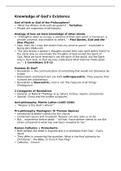
Knowledge of God’s Existence
God of faith or God of the Philosophers?
• ‘What has Athens to do with Jerusalem?’ - Tertullian
• People are suspicious of philosophy.
Analogy of how we have knowledge of other minds:
• “(Thoughts) seem to occupy a universe of their own which is moreover, a
private universe, inaccessible to others.” - Paul Davies, God and the
New Physics
• How, then, do I cross the chasm from my mind to yours? - examined in
Being John Malkovich.
• “For who knows a person’s thoughts except their own spirit within them? In
the same way no one knows the thoughts of God except the Spirit of
God. What we have received is not the spirit of the world, but the Spirit
who is from God, so that we may understand what God has freely given
us.” - 1 Corinthians 2:9-12
Humans Or God?
• Revelation = the communication of something that would not otherwise be
known
• Rationalism and Empiricism are both anthropocentric. They assume that
humans are autonomous.
• Revelation is theocentric, man is not ‘the measure of all things.’
(Protagurus)
2 Categories of Revelation:
• General: or Natural Theology (e.g. nature, history, reason, conscience)
• Special: Christ and the written scriptures.
Anti-philosophy, Martin Luther (1483-1546)
• “Reason is the devil’s whore!”
Pro-philosophy theologian: St Thomas Aquinas
• Introduced Aristotle’s ideas into the church.
• Combined reason and revelation. Reason can only take us so far.
• But… experience before death - “All that I have written seems to me like
straw compared to what has now been revealed to me.”
Roman Catholics + Protestants:
• Both believe the Bible is inspired and is a revelation from God - ‘God’s
Word’
• They differ in answering the question: What is the final authority for
Christians? - the Bible, or Church Teaching?
• Catholics - Church
, • Traditional Protestants - Bible ‘sola scriptura’
• Liberal Christians - reason.
Calvin on the Impact of the Fall:
• Agrees with Aquinas that God could be known through nature if Adam
had remained ‘upright.’
• Even now all people have a sense of God (census divinitatus) or a ‘seed’ of
God (semen religious)
• But criticises Aquinas for neglecting to show that:
• 1) this truth is suppressed by sin.
• 2) Therefore we need God’s grace to reveal Christ to us (through the
Holy Spirit) before we can know God.
• Many are predestined to not receive this grace.
Is the Bible the ‘Word of God’?
• The writers of the Bible were guided by God to give his message?
• Conservative view (e.g. Aquinas) based on claims in scripture, “All
Scripture is God-breathed and is useful for teaching, rebuking, correcting
and training in righteousness” (2 Timothy 3:16) - meaning it is absolute
verbal inspiration.
Conservative + Liberal beliefs about the bible:
• Conservatives: the Bible is the word of God. It is propositional
revelation. It is trustworthy (fundamentalists go further to say ‘without
error’) because it is inspired by God and God is trustworthy. (Francis
Schaeffer ‘He is there and He is not silent’)
• Liberals: The Bible contains the word of God, but is not the word of God.
Writers were ‘inspired’ but still made mistakes. E.g different ideas about
creation, miracles, place of women, homosexuality etc. Revelation is
mainly non-propositional.
Deductive or Inductive:
• Fundamentalists use a deductive argument: God cannot lie, The Bible is
the Word of God, thus the Bible cannot lie or have errors.
• Liberals use an Inductive argument: The date of the Bible appears to
conflict with modern science and morality, therefore the Bible cannot be
without error, thus it is not literally the ‘Word of God.’
• Barth VS Brunner:
Barmen Declaration 1934:
• Adopted by the TCC in Nazi Germany
• Rejected the German Christian movement which tried to impose Nazi
ideology in the churches and appoint Aryan-only leaders.
• Draft was written by Karl Barth.
God of faith or God of the Philosophers?
• ‘What has Athens to do with Jerusalem?’ - Tertullian
• People are suspicious of philosophy.
Analogy of how we have knowledge of other minds:
• “(Thoughts) seem to occupy a universe of their own which is moreover, a
private universe, inaccessible to others.” - Paul Davies, God and the
New Physics
• How, then, do I cross the chasm from my mind to yours? - examined in
Being John Malkovich.
• “For who knows a person’s thoughts except their own spirit within them? In
the same way no one knows the thoughts of God except the Spirit of
God. What we have received is not the spirit of the world, but the Spirit
who is from God, so that we may understand what God has freely given
us.” - 1 Corinthians 2:9-12
Humans Or God?
• Revelation = the communication of something that would not otherwise be
known
• Rationalism and Empiricism are both anthropocentric. They assume that
humans are autonomous.
• Revelation is theocentric, man is not ‘the measure of all things.’
(Protagurus)
2 Categories of Revelation:
• General: or Natural Theology (e.g. nature, history, reason, conscience)
• Special: Christ and the written scriptures.
Anti-philosophy, Martin Luther (1483-1546)
• “Reason is the devil’s whore!”
Pro-philosophy theologian: St Thomas Aquinas
• Introduced Aristotle’s ideas into the church.
• Combined reason and revelation. Reason can only take us so far.
• But… experience before death - “All that I have written seems to me like
straw compared to what has now been revealed to me.”
Roman Catholics + Protestants:
• Both believe the Bible is inspired and is a revelation from God - ‘God’s
Word’
• They differ in answering the question: What is the final authority for
Christians? - the Bible, or Church Teaching?
• Catholics - Church
, • Traditional Protestants - Bible ‘sola scriptura’
• Liberal Christians - reason.
Calvin on the Impact of the Fall:
• Agrees with Aquinas that God could be known through nature if Adam
had remained ‘upright.’
• Even now all people have a sense of God (census divinitatus) or a ‘seed’ of
God (semen religious)
• But criticises Aquinas for neglecting to show that:
• 1) this truth is suppressed by sin.
• 2) Therefore we need God’s grace to reveal Christ to us (through the
Holy Spirit) before we can know God.
• Many are predestined to not receive this grace.
Is the Bible the ‘Word of God’?
• The writers of the Bible were guided by God to give his message?
• Conservative view (e.g. Aquinas) based on claims in scripture, “All
Scripture is God-breathed and is useful for teaching, rebuking, correcting
and training in righteousness” (2 Timothy 3:16) - meaning it is absolute
verbal inspiration.
Conservative + Liberal beliefs about the bible:
• Conservatives: the Bible is the word of God. It is propositional
revelation. It is trustworthy (fundamentalists go further to say ‘without
error’) because it is inspired by God and God is trustworthy. (Francis
Schaeffer ‘He is there and He is not silent’)
• Liberals: The Bible contains the word of God, but is not the word of God.
Writers were ‘inspired’ but still made mistakes. E.g different ideas about
creation, miracles, place of women, homosexuality etc. Revelation is
mainly non-propositional.
Deductive or Inductive:
• Fundamentalists use a deductive argument: God cannot lie, The Bible is
the Word of God, thus the Bible cannot lie or have errors.
• Liberals use an Inductive argument: The date of the Bible appears to
conflict with modern science and morality, therefore the Bible cannot be
without error, thus it is not literally the ‘Word of God.’
• Barth VS Brunner:
Barmen Declaration 1934:
• Adopted by the TCC in Nazi Germany
• Rejected the German Christian movement which tried to impose Nazi
ideology in the churches and appoint Aryan-only leaders.
• Draft was written by Karl Barth.