Ontological Argument (Reason)
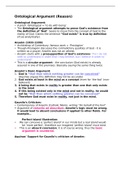
Ontological Argument:
• A priori. Ontological = ‘to do with being’
• The Ontological argument attempts to prove God’s existence from
the definition of ‘God’. Seeks to move from the concept of God to the
reality of God. Claims the sentence “God exists” is true by definition
(/true analytically).
Anselm (1033-1109):
• Archbishop of Canterbury, famous work = ‘Proslogion’
• Though Proslogion discusses the contradictory qualities of God - it is
written as a prayer, Anselm was not an atheist.
• Anselm starts with a presupposition of God’s existence: “For I do not
seek to understand in order that I may believe, but I believe in order to
understand”
• This is a circular argument - the conclusion (God exists) is already
assured in one of the premises. Basically saying the same thing twice
Anselm’s Basic Argument:
1. God is “that than which nothing greater can be conceived”
(Aquinas argues this definition may not be accurate)
2. God exists at least in the mind as a concept (even for ‘the fool’ (non-
believer))
3. A being that exists in reality is greater than one that only exists
in the mind
4. If this being existed only in the mind and not in reality, he would
not be “that than which nothing greater can be conceived”
5. Therefore God must exist in reality, not just in the mind.
Gaunilo’s Criticism:
• Contemporary of Anselm (Catholic Monk), writing “On behalf of the fool”
• Argument of reductio ad absurdum: Anselm’s logic must be wrong.
It would lead to absurd conclusions if applied to other fields. For
example…
Perfect Island Illustration:
• We can conceive a ‘perfect island’ in our minds but a real island would
be ‘more perfect’, therefore our imagined ‘perfect island’ must exist.
• This is an absurd conclusion, it is of course wrong, thus the basic
argument is countered.
Aquinas’ Support for Gaunilo’s criticism of Anselm:
, • Aquinas argues that God’s existence is obvious to God Himself, but it
is not obvious for us because we cannot grasp God’s nature with
the human mind.
To summarise Anselm’s thoughts thus far:
1. ‘God exists’ is true by definition
2. ‘God does not exist’ is a self contradictory statement.
Anselm’s reply (2nd form of argument):
1. God is that than which nothing greater can be conceived.
2. It is greater to be a necessary being than a contingent being
(contingent = could not exist, necessary = could not NOT exist)
3. If God is contingent we can imagine a greater God who IS
necessary.
4. This being would be greater than God.
5. Therefore, God is a necessary being.
René Descartes (1596-1650):
• Founder of modern philosophy, tried establishing basic certainties and
doubted everything he could.
• Conclusion: “I doubt therefore I think. I think therefore I am.”
Possible way out of scepticism:
• A perfectly good God would not trick us.
• But how do we know God exists? The sense evidence (a posteriori) is
not sufficient
• This is Descartes saying that A priori is better than A posteriori.
Meditation 5 - Ontological argument from idea of a perfect being
P1. God is a “supremely perfect being” (note the different definition to
Anselm)
P2. Whatever perfect qualities are found in things are found
supremely in God (as the cause of these things).
P3. Existence is one of these perfect qualities (a “perfection”)
C1. God, a supremely perfect being must possess existence.
C2. Therefore God must exist.
—> Shows God and Existence cannot be separated.
• He uses the illustration of a triangle. It must have 3 angles to be a triangle.
God must have existence to be a God.
• Descartes brought ideas of existence as a “perfection” to the fore.
• Criticising Ontological Arguments:
Immanuel Kant (1721-1804) was a majorly involved in criticising the
ontological argument - he even coined the term ‘ontological’.
Ontological Argument:
• A priori. Ontological = ‘to do with being’
• The Ontological argument attempts to prove God’s existence from
the definition of ‘God’. Seeks to move from the concept of God to the
reality of God. Claims the sentence “God exists” is true by definition
(/true analytically).
Anselm (1033-1109):
• Archbishop of Canterbury, famous work = ‘Proslogion’
• Though Proslogion discusses the contradictory qualities of God - it is
written as a prayer, Anselm was not an atheist.
• Anselm starts with a presupposition of God’s existence: “For I do not
seek to understand in order that I may believe, but I believe in order to
understand”
• This is a circular argument - the conclusion (God exists) is already
assured in one of the premises. Basically saying the same thing twice
Anselm’s Basic Argument:
1. God is “that than which nothing greater can be conceived”
(Aquinas argues this definition may not be accurate)
2. God exists at least in the mind as a concept (even for ‘the fool’ (non-
believer))
3. A being that exists in reality is greater than one that only exists
in the mind
4. If this being existed only in the mind and not in reality, he would
not be “that than which nothing greater can be conceived”
5. Therefore God must exist in reality, not just in the mind.
Gaunilo’s Criticism:
• Contemporary of Anselm (Catholic Monk), writing “On behalf of the fool”
• Argument of reductio ad absurdum: Anselm’s logic must be wrong.
It would lead to absurd conclusions if applied to other fields. For
example…
Perfect Island Illustration:
• We can conceive a ‘perfect island’ in our minds but a real island would
be ‘more perfect’, therefore our imagined ‘perfect island’ must exist.
• This is an absurd conclusion, it is of course wrong, thus the basic
argument is countered.
Aquinas’ Support for Gaunilo’s criticism of Anselm:
, • Aquinas argues that God’s existence is obvious to God Himself, but it
is not obvious for us because we cannot grasp God’s nature with
the human mind.
To summarise Anselm’s thoughts thus far:
1. ‘God exists’ is true by definition
2. ‘God does not exist’ is a self contradictory statement.
Anselm’s reply (2nd form of argument):
1. God is that than which nothing greater can be conceived.
2. It is greater to be a necessary being than a contingent being
(contingent = could not exist, necessary = could not NOT exist)
3. If God is contingent we can imagine a greater God who IS
necessary.
4. This being would be greater than God.
5. Therefore, God is a necessary being.
René Descartes (1596-1650):
• Founder of modern philosophy, tried establishing basic certainties and
doubted everything he could.
• Conclusion: “I doubt therefore I think. I think therefore I am.”
Possible way out of scepticism:
• A perfectly good God would not trick us.
• But how do we know God exists? The sense evidence (a posteriori) is
not sufficient
• This is Descartes saying that A priori is better than A posteriori.
Meditation 5 - Ontological argument from idea of a perfect being
P1. God is a “supremely perfect being” (note the different definition to
Anselm)
P2. Whatever perfect qualities are found in things are found
supremely in God (as the cause of these things).
P3. Existence is one of these perfect qualities (a “perfection”)
C1. God, a supremely perfect being must possess existence.
C2. Therefore God must exist.
—> Shows God and Existence cannot be separated.
• He uses the illustration of a triangle. It must have 3 angles to be a triangle.
God must have existence to be a God.
• Descartes brought ideas of existence as a “perfection” to the fore.
• Criticising Ontological Arguments:
Immanuel Kant (1721-1804) was a majorly involved in criticising the
ontological argument - he even coined the term ‘ontological’.