W4: Economic, social and cultural rights
Recall W3
- Derogation: during emergency, a state can derogate a human right- this can nly be
done for a temporary time. Eg disponment of elections
- Lopez Burgos case: a case about the extra-territorial application of human rights
treaties
Remember case names and content for exam
- Scope of a right= whether or not this right is applicable
- Criteria for limitation:
1. legitimate aim
2. necessity
3. proportionality
- Subordinate norms = prohibit discrimination in enjoyment of other human rights
- Formal equality: equals must be treated alike
- Substantive equality: we treat people who are the same, the same. But some
minorities need to be treated differently to become equal to the others
- Sectional discrimination= discrimination based on more than one ground
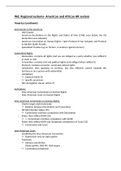
W4
Mozambique short film: right of housing, right of food, right of life
History ESC Rights
- Industrialization and cross-border trade -> led to more economically international
standards
- Cooperation health and education -> led to more international standards in health
and education
- Four freedoms: Roosevelt speech; everyone should have; freedom from welfare,
freedom of religion, freedom of speech, one more freedom (FREEDOM OF HEALTH!)
Nature ESC Rights
- Social issues
- Demands State action – positive obligations
- Rights or goals?
o Justiciability
- Art 2 ICESCR: positive obligation =s of s states (requirement: use the maximum of the
available recourses)
Subjects
- Individuals, but also collective dimension
- No reference to jurisdiction
- Extra-territorial application
ICJ Wall case: territories over which a state party has sovereignty and over which it
exercises territorial jurisdiction (when territorial jurisdiction: then you have to
respect these rights as well)
, ICJ Congo v Uganda: acts done exercising jurisdiction (the negative obligations apply
not only inside the territory but also outside)
- Respect and protect also abroad
State obligations
- General comment 3 (1990)
Progressive realization: not every country has the same sources/chances to achieve
the obligations, progression in some time is okay (no retrogression: level you achieve
is the lowest you can get, you can’t go back unless you have a good justification). But
there are also some immediate obligations (obligations which any state has to
achieve (also the ones who have less good sources/chances)
Non-retrogression: see above
Core obligations/ core content: core is important in protecting the issues
Types of state obligations
- Immediate obligations= as soon as you ratified, you immediate need to provide the
rights
- Progressive obligations= states have some time to slowly provide the obligations
- Conduct obligations= describe what you should do, but not the end result
(progressive obligations are conduct obligations)
- Result obligations= you have to achieve a certain thing, but the way you do this is not
defined (progressive rights are result)
- Positive obligations= states must do something (state provides the activity)
- Negative obligations= state must not interfere (refrain of intervening in that activity)
- Tripartite typology
Obligation to respect (negative obligation: state should respect the rights)
Obligation to protect (positive and negative: state should protect individuals against
third parties)
Obligation to fulfill (positive: state should fulfill the rights)
Limitations
One limitation clause for the whole treaty: article 4 ICESCR
Monitoring ESC Rights
- Committee on ESC Rights
State reports
General comments
- Use of ICCPR or other systems
- ESC rights in CEDAW and CRC
- Optional Protocol to the ICESCR
Who can file communication? The victim or you give someone else permission
Admissibility criteria
a. Exhaustion of local remedies
b. Ratione materiae/ ratione temporis
c. No other international procedure
Article 4
Recall W3
- Derogation: during emergency, a state can derogate a human right- this can nly be
done for a temporary time. Eg disponment of elections
- Lopez Burgos case: a case about the extra-territorial application of human rights
treaties
Remember case names and content for exam
- Scope of a right= whether or not this right is applicable
- Criteria for limitation:
1. legitimate aim
2. necessity
3. proportionality
- Subordinate norms = prohibit discrimination in enjoyment of other human rights
- Formal equality: equals must be treated alike
- Substantive equality: we treat people who are the same, the same. But some
minorities need to be treated differently to become equal to the others
- Sectional discrimination= discrimination based on more than one ground
W4
Mozambique short film: right of housing, right of food, right of life
History ESC Rights
- Industrialization and cross-border trade -> led to more economically international
standards
- Cooperation health and education -> led to more international standards in health
and education
- Four freedoms: Roosevelt speech; everyone should have; freedom from welfare,
freedom of religion, freedom of speech, one more freedom (FREEDOM OF HEALTH!)
Nature ESC Rights
- Social issues
- Demands State action – positive obligations
- Rights or goals?
o Justiciability
- Art 2 ICESCR: positive obligation =s of s states (requirement: use the maximum of the
available recourses)
Subjects
- Individuals, but also collective dimension
- No reference to jurisdiction
- Extra-territorial application
ICJ Wall case: territories over which a state party has sovereignty and over which it
exercises territorial jurisdiction (when territorial jurisdiction: then you have to
respect these rights as well)
, ICJ Congo v Uganda: acts done exercising jurisdiction (the negative obligations apply
not only inside the territory but also outside)
- Respect and protect also abroad
State obligations
- General comment 3 (1990)
Progressive realization: not every country has the same sources/chances to achieve
the obligations, progression in some time is okay (no retrogression: level you achieve
is the lowest you can get, you can’t go back unless you have a good justification). But
there are also some immediate obligations (obligations which any state has to
achieve (also the ones who have less good sources/chances)
Non-retrogression: see above
Core obligations/ core content: core is important in protecting the issues
Types of state obligations
- Immediate obligations= as soon as you ratified, you immediate need to provide the
rights
- Progressive obligations= states have some time to slowly provide the obligations
- Conduct obligations= describe what you should do, but not the end result
(progressive obligations are conduct obligations)
- Result obligations= you have to achieve a certain thing, but the way you do this is not
defined (progressive rights are result)
- Positive obligations= states must do something (state provides the activity)
- Negative obligations= state must not interfere (refrain of intervening in that activity)
- Tripartite typology
Obligation to respect (negative obligation: state should respect the rights)
Obligation to protect (positive and negative: state should protect individuals against
third parties)
Obligation to fulfill (positive: state should fulfill the rights)
Limitations
One limitation clause for the whole treaty: article 4 ICESCR
Monitoring ESC Rights
- Committee on ESC Rights
State reports
General comments
- Use of ICCPR or other systems
- ESC rights in CEDAW and CRC
- Optional Protocol to the ICESCR
Who can file communication? The victim or you give someone else permission
Admissibility criteria
a. Exhaustion of local remedies
b. Ratione materiae/ ratione temporis
c. No other international procedure
Article 4