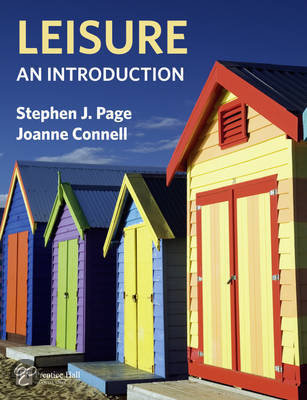
Leisure an Introduction
Stephen J.Page
Joanne Connel
Chapter 1: Introduction to leisure
What is leisure?
Leisure is usually associated with what we do in our non-work or free time
Time free from obligations
Sports, recreations activities
Tourism
Arts
Entertainment, etc.
Or a state of mind
Reasons for studying leisure?
Economic reasons:
o Where leisure has emerged as a key factor of many countries’
bourgeoning service sector economies, as consumer spending on
leisure as a form of consumption creates a key economic activity.
o Also an alternative form of employment after the relocation of
companies to low-cost-of-production countries.
Psychological reasons:
o Life-satisfaction – emphasises the positives benefits for individual
and family wellbeing.
o Life satisfaction has increased thanks to the ability to rest and relax
through leisure.
o Psychological reasons refer to the health benefits of leisure
activities.
Social reasons:
o Where sociologist point to the potential of leisure to unite societies
(e.g. through civic pride, with community events such as festivals).
o Also to divide societies
o Events as the World Championship Football can unite a nation, but
games between Feyenoord and Ajax can divide them.
Political reasons:
o Where governments have an interest in how the public sector can
assist in developing and implementing policies to manage public
leisure provision, as the state is a major provider and manager of
leisure services (e.g. outdoor resources such as parks and gardens,
leisure centres, playing fields, art centres and museums).
o Important because of its economic significance and value
o Studies on how people spend their money are important to
determine what the price of a project of a product will be in order to
earn all the money spent back.
o Encouraging national solidarity is an important underlining reason
too.
o Increased physical activity will improve the health which will
decrease treatment costs eventually.
, Hall & Paige: Even though work is distinct from leisure, the time to travel has a
degree of overlap
o You travel to work but you’re not actually working yet – they agree that a
leisure spectrum exists and travelling differentiates every activity.
Stebbins: Serious leisure: work and leisure activities overlap
Mommas: Leisure exists as one of the oldest topics of social scientific research
In studying leisure, one needs to be aware of two broad considerations prior to
examining any definitions:
Understanding enables us to appreciate how modern society is structured
and operates.
Consider how people use their time when not working (specifically).
Evaluate who does what and why in relation to their leisure time as well as
examining the activity patterns (e.g. where they spend their leisure time
and space).
Examine the constraints and attitudes of different social groups in leisure
settings.
Defining leisure:
Leisure studies is not an academic disciplines in its own right, but a subject
area that has arisen from other disciplines which have approached it from
different perspectives.
Subject areas which contribute to the study of leisure:
o Leisure studies
Economics
Sociology
Geography
Politics
History
Planning
Psychology
Elements of leisure to consider in definitions:
o Leisure:
Freedom of constraints
Time left over after work
Opportunity to choose
Opposite of work
Stockdale (1985) listed three approaches to leisure:
As a period of time: in which choice is the dominant feature – therefore
leisure may be a form of free time for an individual.
In an objectives sense: where leisure is perceived as the opposite of
work and so leisure time is construed as non-work or residual time (e.g.
that time left after all of the normal obligations have been fulfilled).
In a subjective manner: where leisure is viewed as a qualitative notion,
so that leisure activities take on a meaning in relation to the perceptions
and beliefs of individuals.
Hall & Page argue, useful definitions are as follows:
Leisure is viewed as time, activities and experience derived, characterized
by freedom.
Stephen J.Page
Joanne Connel
Chapter 1: Introduction to leisure
What is leisure?
Leisure is usually associated with what we do in our non-work or free time
Time free from obligations
Sports, recreations activities
Tourism
Arts
Entertainment, etc.
Or a state of mind
Reasons for studying leisure?
Economic reasons:
o Where leisure has emerged as a key factor of many countries’
bourgeoning service sector economies, as consumer spending on
leisure as a form of consumption creates a key economic activity.
o Also an alternative form of employment after the relocation of
companies to low-cost-of-production countries.
Psychological reasons:
o Life-satisfaction – emphasises the positives benefits for individual
and family wellbeing.
o Life satisfaction has increased thanks to the ability to rest and relax
through leisure.
o Psychological reasons refer to the health benefits of leisure
activities.
Social reasons:
o Where sociologist point to the potential of leisure to unite societies
(e.g. through civic pride, with community events such as festivals).
o Also to divide societies
o Events as the World Championship Football can unite a nation, but
games between Feyenoord and Ajax can divide them.
Political reasons:
o Where governments have an interest in how the public sector can
assist in developing and implementing policies to manage public
leisure provision, as the state is a major provider and manager of
leisure services (e.g. outdoor resources such as parks and gardens,
leisure centres, playing fields, art centres and museums).
o Important because of its economic significance and value
o Studies on how people spend their money are important to
determine what the price of a project of a product will be in order to
earn all the money spent back.
o Encouraging national solidarity is an important underlining reason
too.
o Increased physical activity will improve the health which will
decrease treatment costs eventually.
, Hall & Paige: Even though work is distinct from leisure, the time to travel has a
degree of overlap
o You travel to work but you’re not actually working yet – they agree that a
leisure spectrum exists and travelling differentiates every activity.
Stebbins: Serious leisure: work and leisure activities overlap
Mommas: Leisure exists as one of the oldest topics of social scientific research
In studying leisure, one needs to be aware of two broad considerations prior to
examining any definitions:
Understanding enables us to appreciate how modern society is structured
and operates.
Consider how people use their time when not working (specifically).
Evaluate who does what and why in relation to their leisure time as well as
examining the activity patterns (e.g. where they spend their leisure time
and space).
Examine the constraints and attitudes of different social groups in leisure
settings.
Defining leisure:
Leisure studies is not an academic disciplines in its own right, but a subject
area that has arisen from other disciplines which have approached it from
different perspectives.
Subject areas which contribute to the study of leisure:
o Leisure studies
Economics
Sociology
Geography
Politics
History
Planning
Psychology
Elements of leisure to consider in definitions:
o Leisure:
Freedom of constraints
Time left over after work
Opportunity to choose
Opposite of work
Stockdale (1985) listed three approaches to leisure:
As a period of time: in which choice is the dominant feature – therefore
leisure may be a form of free time for an individual.
In an objectives sense: where leisure is perceived as the opposite of
work and so leisure time is construed as non-work or residual time (e.g.
that time left after all of the normal obligations have been fulfilled).
In a subjective manner: where leisure is viewed as a qualitative notion,
so that leisure activities take on a meaning in relation to the perceptions
and beliefs of individuals.
Hall & Page argue, useful definitions are as follows:
Leisure is viewed as time, activities and experience derived, characterized
by freedom.