THE NERVOUS SYSTEM
Coordination and control in animals is controlled by 2 systems -the nervous systemandthe endocrine
systemwhich are both responsible for carrying out responses across the body.
the nervous system the endocrine system
○ communication viaelectricalimpulses ○ communication via hormones (chemicals)
○ short livedeffects e.g. one muscle contraction ○ long lasting effects
○ localised response ○ affect alarger areaof the body
○ faster response ○ slower response
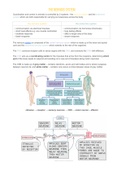
The nervous system is composed of the central nervous system which is made up of the brain andspinal
cord and theperipheral nervous system which extends to the rest of the organism.
The PNS connects receptor cells in sense organs with the CNS, and connects the CNS with effectors.
The CNS acts as a coordinating centre for the impulses that arrive from the receptors, determining which
part of the body needs to respond and sending out a new set of impulses along motor neurones
The CNS is made up of grey matter – contains dendrons, axons and cell bodies and is where synapses
between neurons lie; and white matter – containsonly axonsso links between areas of grey matter.
stimulus → receptor → sensory neurone → CNS → motor neuron – effector
, Spinal reflex arc (involves relay neurons in the spinal cord)
1. stimulus detected by receptors and generate action potential
2. impulse travels up the sensory neuron through the dorsal root ganglion into the grey matter of the
spinal cord where it synapses with a relay neuron.
3. impulse passes along the motor neuron, leaving the spinal cord through the ventral root.
4. it then travels to an effector organ, which is often a muscle
5. the motor end plate in the muscle transfers the stimulus to the muscle which then contracts.
stimulus → receptor → sensory neurone → relay neurone in spinal cord → motor neurone → effector
cranial reflex arc (involves relay neurons in the brain)
1. photoreceptors detect light and generate a potential which
travels through the optic nerve to the brain. The brighter the light,
the bigger frequency of action potentials.
2. sensory neurons send impulses to the CNS and pass on to a relay
neuron in the brain/midbrain
3. nerve impulses synapse with branches of the parasympathetic
cranial nerve (oculomotor) which transmits impulses to the
effector (muscles of the iris)
4. circular muscles contract + radial muscles relax so pupil constricts
receptor → sensory neurone → relay neurone in brain → motor neurone → effector
Coordination and control in animals is controlled by 2 systems -the nervous systemandthe endocrine
systemwhich are both responsible for carrying out responses across the body.
the nervous system the endocrine system
○ communication viaelectricalimpulses ○ communication via hormones (chemicals)
○ short livedeffects e.g. one muscle contraction ○ long lasting effects
○ localised response ○ affect alarger areaof the body
○ faster response ○ slower response
The nervous system is composed of the central nervous system which is made up of the brain andspinal
cord and theperipheral nervous system which extends to the rest of the organism.
The PNS connects receptor cells in sense organs with the CNS, and connects the CNS with effectors.
The CNS acts as a coordinating centre for the impulses that arrive from the receptors, determining which
part of the body needs to respond and sending out a new set of impulses along motor neurones
The CNS is made up of grey matter – contains dendrons, axons and cell bodies and is where synapses
between neurons lie; and white matter – containsonly axonsso links between areas of grey matter.
stimulus → receptor → sensory neurone → CNS → motor neuron – effector
, Spinal reflex arc (involves relay neurons in the spinal cord)
1. stimulus detected by receptors and generate action potential
2. impulse travels up the sensory neuron through the dorsal root ganglion into the grey matter of the
spinal cord where it synapses with a relay neuron.
3. impulse passes along the motor neuron, leaving the spinal cord through the ventral root.
4. it then travels to an effector organ, which is often a muscle
5. the motor end plate in the muscle transfers the stimulus to the muscle which then contracts.
stimulus → receptor → sensory neurone → relay neurone in spinal cord → motor neurone → effector
cranial reflex arc (involves relay neurons in the brain)
1. photoreceptors detect light and generate a potential which
travels through the optic nerve to the brain. The brighter the light,
the bigger frequency of action potentials.
2. sensory neurons send impulses to the CNS and pass on to a relay
neuron in the brain/midbrain
3. nerve impulses synapse with branches of the parasympathetic
cranial nerve (oculomotor) which transmits impulses to the
effector (muscles of the iris)
4. circular muscles contract + radial muscles relax so pupil constricts
receptor → sensory neurone → relay neurone in brain → motor neurone → effector