

Photosynthesis
Photosystems
• Photosynthetic pigments are arranged into structures called photosystems.
• Photosystems will allow the maximum absorption of light energy.
• The photosystems are held in place by protein embedded in the grana.
• Photosystem I (PSI) occur mainly on integral lamellae.
• Photosystem II (PSII) occur almost exclusively on the granal lamellae.
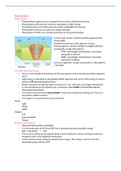
Funnel shape cluster of photosynthetic pigments that
harvest light.
Thylakoid membrane: holds pigment in place.
Primary pigment: absorb red lights of slightly different
wavelength, usually chlorophyll a
- P700= wavelength, photosystem 1 and peak
absorption is 700 nm
- P680= wavelength, photosystem 2 and peak
absorption is 680nm
Accessory pigments: usually carotenoids or chlorophyll b
– blue light
The Light Dependant Stage
• Occurs in the thylakoid membranes of the chloroplasts, where the photosynthetic pigments
occur.
• Light energy is absorbed by the photosynthetic pigments and some of this energy is used to
produce ATP (photophosphorylation).
• Water molecules are split (by light) to produce H + ions, electrons, and oxygen (photolysis).
• H+ ions and electrons are picked up by a coenzyme called NADP (nicotinamide adenine
dinucleotide phosphate).
• This is then converted into reduced NADP. (It becomes reduced by picking up H+ ions as it
has gained, OILRIG reaction)
• The oxygen is a waste product and is excreted.
Inputs
- Light
- Water
- NADP
Outputs
- ATP
- Reduced NADP
- Oxygen
Photophosphorylation
• Means phosphorylation using light.
• It is the production of ATP from ADP and a phosphate group using light energy.
ADP + phosphate ATP
• This occurs as electrons are passed along a series of electron carriers forming an electron
transport chain in the thylakoid membranes.
• As the electron moves along it gradually loses energy. This energy is used to react the
phosphate group with the ADP.
Photosystems
• Photosynthetic pigments are arranged into structures called photosystems.
• Photosystems will allow the maximum absorption of light energy.
• The photosystems are held in place by protein embedded in the grana.
• Photosystem I (PSI) occur mainly on integral lamellae.
• Photosystem II (PSII) occur almost exclusively on the granal lamellae.
Funnel shape cluster of photosynthetic pigments that
harvest light.
Thylakoid membrane: holds pigment in place.
Primary pigment: absorb red lights of slightly different
wavelength, usually chlorophyll a
- P700= wavelength, photosystem 1 and peak
absorption is 700 nm
- P680= wavelength, photosystem 2 and peak
absorption is 680nm
Accessory pigments: usually carotenoids or chlorophyll b
– blue light
The Light Dependant Stage
• Occurs in the thylakoid membranes of the chloroplasts, where the photosynthetic pigments
occur.
• Light energy is absorbed by the photosynthetic pigments and some of this energy is used to
produce ATP (photophosphorylation).
• Water molecules are split (by light) to produce H + ions, electrons, and oxygen (photolysis).
• H+ ions and electrons are picked up by a coenzyme called NADP (nicotinamide adenine
dinucleotide phosphate).
• This is then converted into reduced NADP. (It becomes reduced by picking up H+ ions as it
has gained, OILRIG reaction)
• The oxygen is a waste product and is excreted.
Inputs
- Light
- Water
- NADP
Outputs
- ATP
- Reduced NADP
- Oxygen
Photophosphorylation
• Means phosphorylation using light.
• It is the production of ATP from ADP and a phosphate group using light energy.
ADP + phosphate ATP
• This occurs as electrons are passed along a series of electron carriers forming an electron
transport chain in the thylakoid membranes.
• As the electron moves along it gradually loses energy. This energy is used to react the
phosphate group with the ADP.


