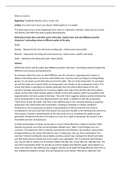
Refer to Scene 8,
beginning ‘(suddenly) Stanley, tell us a joke’ and
ending ‘You want me to clear your places? Stella begins to cry weakly’.
This interaction occurs at the beginning of the scene. It is Blanche’s birthday. Mitch has not arrived,
and Stanley and Stella have been arguing about Blanche.
Referring to these lines and other parts of the play, explore how and why Williams presents
characters’ contrasting values at different points in the play.
PLAN:
Stanley – Represents the new American working class. Values power and wealth.
Blanche – Represents the dying old south aristocracy. Values desire, wealth, and vanity.
Stella – Represents the dying old south. Values family.
Answer:
Within the extract and the wider play Williams presents characters’ contrasting values through their
different social classes and backgrounds.
An example within this scene in which Williams uses the characters’ opposing social classes to
display contrasting values can be seen when Stella says ‘Your face and your fingers are disgustingly
greasy. Go and wash up and then help me clear the table.’ The use of the imperative ‘Go and wash
up and then help me’ presents Stella as having power over Stanley as she is giving him orders. This
power that Stella is asserting over Stanley originates from her aristocratical status of her old
southern heritage and presents her as having a higher-class status than Stanley with old southern
values. On the other hand, Stanley replies to Stella’s orders with violence which is presented in the
stage directions ‘he hurls a plate to the floor.’ The verb ‘hurls’ suggests violence and force behind his
action showing that he has more physical power over Stella. In addition to this the exclamative
‘That’s how I’ll clear the table!’ and ‘Don’t ever talk that way to me!’ presents Stanley as asserting
dominance over Stella within the conversation, creating an imbalance in felicity conditions.
Furthermore, this re-possession of power is representative of the fact that the new South is
overtaking the old south and with it the power has now been handed to the Working class who drive
the economy. Stanley is representative of the new south as he is a working-class polish second
generation immigrant who due to his status as a man, has a right to overpower the women in the
household and own all possessions.
A similar presentation of values can be seen in scene 4 where Blanche is trying to convince Stella
that she can get her out of her current situation. Blanche says, ‘Well- if you’ll forgive me- he’s
common!’ The statement refers to Stanley and presents how Blanche’s old southern aristocratical
heritage influences the values she holds for men. Furthermore, the use of the exclamative ‘He’s
common!’ shows how Blanche views Stanley as being a lower class compared to herself and stella
and that Stella deserves better due to her upper-class upbringing. This is enhanced when Blanche
says ‘He acts like an animal, has an animal’s habits! Eats like one, moves like one, talks like one!’ the
use of the zoomorphic simile ‘he acts like an animal’ displays how Blanche again views Stanley as a
lower class than her and stella but also suggests that due to his polish heritage Blanche views him as
less civilised and suited to society, thus portraying him as an animal. This links to. Blanche’s old
beginning ‘(suddenly) Stanley, tell us a joke’ and
ending ‘You want me to clear your places? Stella begins to cry weakly’.
This interaction occurs at the beginning of the scene. It is Blanche’s birthday. Mitch has not arrived,
and Stanley and Stella have been arguing about Blanche.
Referring to these lines and other parts of the play, explore how and why Williams presents
characters’ contrasting values at different points in the play.
PLAN:
Stanley – Represents the new American working class. Values power and wealth.
Blanche – Represents the dying old south aristocracy. Values desire, wealth, and vanity.
Stella – Represents the dying old south. Values family.
Answer:
Within the extract and the wider play Williams presents characters’ contrasting values through their
different social classes and backgrounds.
An example within this scene in which Williams uses the characters’ opposing social classes to
display contrasting values can be seen when Stella says ‘Your face and your fingers are disgustingly
greasy. Go and wash up and then help me clear the table.’ The use of the imperative ‘Go and wash
up and then help me’ presents Stella as having power over Stanley as she is giving him orders. This
power that Stella is asserting over Stanley originates from her aristocratical status of her old
southern heritage and presents her as having a higher-class status than Stanley with old southern
values. On the other hand, Stanley replies to Stella’s orders with violence which is presented in the
stage directions ‘he hurls a plate to the floor.’ The verb ‘hurls’ suggests violence and force behind his
action showing that he has more physical power over Stella. In addition to this the exclamative
‘That’s how I’ll clear the table!’ and ‘Don’t ever talk that way to me!’ presents Stanley as asserting
dominance over Stella within the conversation, creating an imbalance in felicity conditions.
Furthermore, this re-possession of power is representative of the fact that the new South is
overtaking the old south and with it the power has now been handed to the Working class who drive
the economy. Stanley is representative of the new south as he is a working-class polish second
generation immigrant who due to his status as a man, has a right to overpower the women in the
household and own all possessions.
A similar presentation of values can be seen in scene 4 where Blanche is trying to convince Stella
that she can get her out of her current situation. Blanche says, ‘Well- if you’ll forgive me- he’s
common!’ The statement refers to Stanley and presents how Blanche’s old southern aristocratical
heritage influences the values she holds for men. Furthermore, the use of the exclamative ‘He’s
common!’ shows how Blanche views Stanley as being a lower class compared to herself and stella
and that Stella deserves better due to her upper-class upbringing. This is enhanced when Blanche
says ‘He acts like an animal, has an animal’s habits! Eats like one, moves like one, talks like one!’ the
use of the zoomorphic simile ‘he acts like an animal’ displays how Blanche again views Stanley as a
lower class than her and stella but also suggests that due to his polish heritage Blanche views him as
less civilised and suited to society, thus portraying him as an animal. This links to. Blanche’s old