

🟦
Viruses
Monday, 4th April 2022
Preface to Viruses:
Virions are viral particles and are not viruses themselves.
💡 Viruses are defined as acellular organisms whose genomes consist of
nucleic acid, and which obligately replicate inside host cells using the
host’s metabolic machinery to form a pool of genomes and structural
components to form new virions, which are particles that protect the
genome and transfer it to other cells.
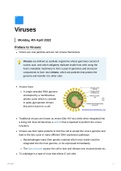
Viruses have:
A single stranded RNA genome
enveloped by a membranous
protein cover which is covered
in spike glycoprotein trimers
that aid in fusion to a cell.
Traditional viruses are known as virions (like HIV etc) while when integrated into
a living cell, that cell becomes a virocell that is hijacked to perform the virus’s
functions.
Viruses use their spike proteins to trick the cell to accept the virus’s genome and
lead to the lytic cycle in many different DNA expression pathways.
Bacteriophages inject their genetic material which once inside could be
integrated into the host genome, or be expressed immediately.
The lysin enzyme causes the cell to lyse and release new viruses/viroids etc.
T4 coliphage is a type of virus that infects E coli cells.
Viruses 1
, The virus has a tail that recognises the host cell and aids in attachment to
the cell membrane.
The tail is forced through the cell wall using enzymatic reactions and
provides a “hole” to inject DNA using molecular motors into the host.
Viral examples:
1. The human adenovirus type 36 is related to obesity and has a few circular
spikes.
2. The human herpesvirus causes a variety of diseases from certain cancers to
oral and genital herpes. It has a large genome and many spikes.
3. HIV has a rigid structure with three layers.
i. The outer membrane with spike proteins.
ii. Matrix shell which provides shape.
iii. A capsid that surrounds the helical nucleoprotein.
4. The Ebola virus causes the infamous ebola disease mainly in Central Africa,
and spreads between animals and humans.
5. Influenza is the virus that causes the common cold and has an extreme
number of variations due to its high evolutionary rate. It has a capsid with -
RNA (+RNA is in HIV). New influenza viruses are usually highly virulent and
can cause large numbers of deaths (for example, the Spanish Flu in 1918).
i. The Spanish Flu moved via ships and trains all around the world, with
South Africa being the 5th most affected country globally.
6. Human papilloma virus causes cervical cancer.
Abundance:
Fluorescent dyes that attach to nucleic acids are used to help identify viruses in
water, and show that they far outnumber prokaryotic and eukaryotic cells.
In sea water, 94% of DNA diversity is constituted from viruses that make up only
5% of the total biomass.
Viromics is the study of viral genetics, and has been used to show that there are
unfathomable numbers of viruses (specifically phages; around 10^31) in the
biosphere.
The DNA of all viruses placed end to end would stretch 106M light years.
Viruses 2
Viruses
Monday, 4th April 2022
Preface to Viruses:
Virions are viral particles and are not viruses themselves.
💡 Viruses are defined as acellular organisms whose genomes consist of
nucleic acid, and which obligately replicate inside host cells using the
host’s metabolic machinery to form a pool of genomes and structural
components to form new virions, which are particles that protect the
genome and transfer it to other cells.
Viruses have:
A single stranded RNA genome
enveloped by a membranous
protein cover which is covered
in spike glycoprotein trimers
that aid in fusion to a cell.
Traditional viruses are known as virions (like HIV etc) while when integrated into
a living cell, that cell becomes a virocell that is hijacked to perform the virus’s
functions.
Viruses use their spike proteins to trick the cell to accept the virus’s genome and
lead to the lytic cycle in many different DNA expression pathways.
Bacteriophages inject their genetic material which once inside could be
integrated into the host genome, or be expressed immediately.
The lysin enzyme causes the cell to lyse and release new viruses/viroids etc.
T4 coliphage is a type of virus that infects E coli cells.
Viruses 1
, The virus has a tail that recognises the host cell and aids in attachment to
the cell membrane.
The tail is forced through the cell wall using enzymatic reactions and
provides a “hole” to inject DNA using molecular motors into the host.
Viral examples:
1. The human adenovirus type 36 is related to obesity and has a few circular
spikes.
2. The human herpesvirus causes a variety of diseases from certain cancers to
oral and genital herpes. It has a large genome and many spikes.
3. HIV has a rigid structure with three layers.
i. The outer membrane with spike proteins.
ii. Matrix shell which provides shape.
iii. A capsid that surrounds the helical nucleoprotein.
4. The Ebola virus causes the infamous ebola disease mainly in Central Africa,
and spreads between animals and humans.
5. Influenza is the virus that causes the common cold and has an extreme
number of variations due to its high evolutionary rate. It has a capsid with -
RNA (+RNA is in HIV). New influenza viruses are usually highly virulent and
can cause large numbers of deaths (for example, the Spanish Flu in 1918).
i. The Spanish Flu moved via ships and trains all around the world, with
South Africa being the 5th most affected country globally.
6. Human papilloma virus causes cervical cancer.
Abundance:
Fluorescent dyes that attach to nucleic acids are used to help identify viruses in
water, and show that they far outnumber prokaryotic and eukaryotic cells.
In sea water, 94% of DNA diversity is constituted from viruses that make up only
5% of the total biomass.
Viromics is the study of viral genetics, and has been used to show that there are
unfathomable numbers of viruses (specifically phages; around 10^31) in the
biosphere.
The DNA of all viruses placed end to end would stretch 106M light years.
Viruses 2


