

NUCLEIC ACIDS
Who discovered DNA ? → Friedrich Miescher in 1869
Central dogma = DNA → RNA → Protein = the order
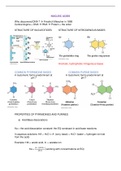
STRUCTURE OF NUCLEOTIDES STRUCTURE OF NITROGENOUS BASES
Aromatic, hydrophobic nitrogenous bases
COMMON PYDRIMIDINE BASES COMMON PURINE BASES
in tautomeric forms predominant at in tautomeric forms predominant at
pH 7 pH 7
PROPERTIES OF PYRIMIDINES AND PURINES
a) Acid/Base dissociations
Ka = the acid dissociation constant/ the EQ constsant in acid-base reactions
In aqueous solutions: HA + H2O ⥬ A- (conj. base) + H3O+ (water + hydrogen ion lost
from the acid)
Example: HA = acetic acid, A- = acetate ion
[𝐴−] [𝐻3𝑂+]
Ka = [𝐻𝐴]
(working with concentrations at EQ)
, pKa= -log10Ka
*The LARGER pKa, the SMALLER the extent of dissociation*
the lower the pKa, the lower the pH, the higher the Ka
Henderson-Hasselbalch Equation
used to calculate the pH of a solution, if Ka is given, and the concentrations of the
weak HA acid, and its conjugate base A-, are given.
[𝑨−]
pH = pKa + log10 [𝑯𝑨]
*when [A-] = [HA], then pKa = pH*
the more you increase the pH above the pKa, the more the acid dissociates into its
conjugate base.
For titration curves with multiple acids and different midpoints:
A stronger acid dissociates completely into its ions very quickly, and hence the
graphs that are closer to the bottom need less base to be added in order to
neutralize them because most of the acid has already dissociated into its conjugate
base
Who discovered DNA ? → Friedrich Miescher in 1869
Central dogma = DNA → RNA → Protein = the order
STRUCTURE OF NUCLEOTIDES STRUCTURE OF NITROGENOUS BASES
Aromatic, hydrophobic nitrogenous bases
COMMON PYDRIMIDINE BASES COMMON PURINE BASES
in tautomeric forms predominant at in tautomeric forms predominant at
pH 7 pH 7
PROPERTIES OF PYRIMIDINES AND PURINES
a) Acid/Base dissociations
Ka = the acid dissociation constant/ the EQ constsant in acid-base reactions
In aqueous solutions: HA + H2O ⥬ A- (conj. base) + H3O+ (water + hydrogen ion lost
from the acid)
Example: HA = acetic acid, A- = acetate ion
[𝐴−] [𝐻3𝑂+]
Ka = [𝐻𝐴]
(working with concentrations at EQ)
, pKa= -log10Ka
*The LARGER pKa, the SMALLER the extent of dissociation*
the lower the pKa, the lower the pH, the higher the Ka
Henderson-Hasselbalch Equation
used to calculate the pH of a solution, if Ka is given, and the concentrations of the
weak HA acid, and its conjugate base A-, are given.
[𝑨−]
pH = pKa + log10 [𝑯𝑨]
*when [A-] = [HA], then pKa = pH*
the more you increase the pH above the pKa, the more the acid dissociates into its
conjugate base.
For titration curves with multiple acids and different midpoints:
A stronger acid dissociates completely into its ions very quickly, and hence the
graphs that are closer to the bottom need less base to be added in order to
neutralize them because most of the acid has already dissociated into its conjugate
base


