

🔬
Protein Primary Structure
Peptides
Peptide chains have an amino terminal and a carboxyl terminal end.
Amino acid units in the peptide chain are called amino acid residues.
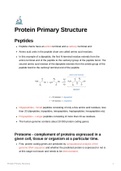
In this example of a dipeptide, the first N-terminal residue extends from the
amino terminal end of the peptide to the carbonyl group of the peptide bond. The
second amino acid residue of the dipeptide extends from the amide group of the
peptide bond to the carboxyl terminal end of the peptide.
Oligopeptides - Small peptides consisting of only a few amino acid residues, less
than 20 (dipeptides, tripeptides, tetrapeptides, heptapeptides, hexapeptides etc)
Polypeptides - Longer peptides consisting of more than 20 aa residues.
The human genome contains about 20 000 protein coding genes.
Proteome - complement of proteins expressed in a
given cell, tissue or organism at a particular time.
First, protein coding genes are predicted by computational analysis of the
genome DNA sequence and whether the predicted protein is expressed or not is
at this stage not known and needs to be demonstrated.
Protein Primary Structure 1
, Secondly, eukaryotic cells express at any given time only a small subset of their
genes and, therefore, only a small subset of proteins encoded in their genome.
An important aspect of this is that in multicellular organisms, different cell types
exist which can differ significantly in their morphology and function. These
differences result from the fact that these cell types express different sets of
proteins. It is therefore much more useful to define the term proteome as the
complement of proteins expressed in a given cell, tissue or organism at a
particular time.
Size of polypeptide chains that make up proteins can
differ significantly
Sarcolipin - very small protein that consists of a polypeptide chain containing
only 31 amino acids.
Titin - largest protein encoded by the human genome, consists of a polypeptide
chain containing more than 34 000 amino acid residues.
The average protein in cells contains around 400 to 500 amino acid residues.
Homologous proteins - Orthologous and Paralogous
A high degree of amino acid sequence similarity between proteins isolated from
different species is strong evidence that these proteins have evolved from a
common ancestral sequence. The similarity between amino acid sequences is
called sequence homology and proteins sharing a high degree of amino acid
sequence similarity are called homologous proteins or protein homologs.
Orthologous - Homologous proteins isolated from two different species are
called protein orthologs. Evolved from a common ancestral gene by speciation;
generally retain the same or a similar function.
Paralogous - Homologous proteins isolated from the same organism. This type
of homologous protein arises from gene duplication events, after which the two
genes evolve differentially, meaning they acquire different mutations over time.
These changes in amino acid sequence can lead to paralogous proteins with
different functions.
Protein Primary Structure 2
Protein Primary Structure
Peptides
Peptide chains have an amino terminal and a carboxyl terminal end.
Amino acid units in the peptide chain are called amino acid residues.
In this example of a dipeptide, the first N-terminal residue extends from the
amino terminal end of the peptide to the carbonyl group of the peptide bond. The
second amino acid residue of the dipeptide extends from the amide group of the
peptide bond to the carboxyl terminal end of the peptide.
Oligopeptides - Small peptides consisting of only a few amino acid residues, less
than 20 (dipeptides, tripeptides, tetrapeptides, heptapeptides, hexapeptides etc)
Polypeptides - Longer peptides consisting of more than 20 aa residues.
The human genome contains about 20 000 protein coding genes.
Proteome - complement of proteins expressed in a
given cell, tissue or organism at a particular time.
First, protein coding genes are predicted by computational analysis of the
genome DNA sequence and whether the predicted protein is expressed or not is
at this stage not known and needs to be demonstrated.
Protein Primary Structure 1
, Secondly, eukaryotic cells express at any given time only a small subset of their
genes and, therefore, only a small subset of proteins encoded in their genome.
An important aspect of this is that in multicellular organisms, different cell types
exist which can differ significantly in their morphology and function. These
differences result from the fact that these cell types express different sets of
proteins. It is therefore much more useful to define the term proteome as the
complement of proteins expressed in a given cell, tissue or organism at a
particular time.
Size of polypeptide chains that make up proteins can
differ significantly
Sarcolipin - very small protein that consists of a polypeptide chain containing
only 31 amino acids.
Titin - largest protein encoded by the human genome, consists of a polypeptide
chain containing more than 34 000 amino acid residues.
The average protein in cells contains around 400 to 500 amino acid residues.
Homologous proteins - Orthologous and Paralogous
A high degree of amino acid sequence similarity between proteins isolated from
different species is strong evidence that these proteins have evolved from a
common ancestral sequence. The similarity between amino acid sequences is
called sequence homology and proteins sharing a high degree of amino acid
sequence similarity are called homologous proteins or protein homologs.
Orthologous - Homologous proteins isolated from two different species are
called protein orthologs. Evolved from a common ancestral gene by speciation;
generally retain the same or a similar function.
Paralogous - Homologous proteins isolated from the same organism. This type
of homologous protein arises from gene duplication events, after which the two
genes evolve differentially, meaning they acquire different mutations over time.
These changes in amino acid sequence can lead to paralogous proteins with
different functions.
Protein Primary Structure 2


