Week 7 – Governance of Virtual Worlds
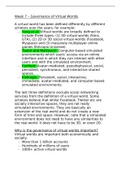
A virtual world has been defined differently by different
scholars over the years, for example:
- Yang et al: Virtual worlds are broadly defined to
include three types: (1) 3D virtual worlds (Sims,
GTA), (2) 2D or 3D social virtual worlds (Facebook,
Myspace) and (3) massively multiplayer online
games (Entropia Universe).
- Taylor and Matteucci: Computer-based simulated
environments which users’ access via an online
interface and in which they can interact with other
users and with the simulated environment.
- Fairfield: Avatar-mediated, pseudophysical, social,
persistent, synchronous, and interactive shared
spaces.
- Kinikoglu: Persistent, social, interactive,
immediate, avatar-mediated, and computer-based
simulated environments.
The last three definitions exclude social networking
services from the definition of a virtual world. Some
scholars believe that whilst Facebook, Twitter etc are
socially interactive spaces, they are not really
simulated environments. They are basically an
extension of the real world and do not create a new
form of time and space. However, note that a simulated
environment does not need to have any similarities to
the real-world. It does not have to be 3D, or even 2D.
Why is the governance of virtual worlds important?
Virtual worlds are important both economically and
socially:
- More than 1 billion accounts
- Hundreds of millions of users
- 1000+ active virtual worlds
A virtual world has been defined differently by different
scholars over the years, for example:
- Yang et al: Virtual worlds are broadly defined to
include three types: (1) 3D virtual worlds (Sims,
GTA), (2) 2D or 3D social virtual worlds (Facebook,
Myspace) and (3) massively multiplayer online
games (Entropia Universe).
- Taylor and Matteucci: Computer-based simulated
environments which users’ access via an online
interface and in which they can interact with other
users and with the simulated environment.
- Fairfield: Avatar-mediated, pseudophysical, social,
persistent, synchronous, and interactive shared
spaces.
- Kinikoglu: Persistent, social, interactive,
immediate, avatar-mediated, and computer-based
simulated environments.
The last three definitions exclude social networking
services from the definition of a virtual world. Some
scholars believe that whilst Facebook, Twitter etc are
socially interactive spaces, they are not really
simulated environments. They are basically an
extension of the real world and do not create a new
form of time and space. However, note that a simulated
environment does not need to have any similarities to
the real-world. It does not have to be 3D, or even 2D.
Why is the governance of virtual worlds important?
Virtual worlds are important both economically and
socially:
- More than 1 billion accounts
- Hundreds of millions of users
- 1000+ active virtual worlds