13/09
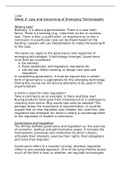
Week 2: Law and Governing of Emerging Technologies
What is Law?
Basically, it is about argumentation. There is a case (with
facts). There is a backing (e.g., rules from an Act or common
law). There is then a justification, an argument as to why a
conclusion in a particular case can be drawn based on the
backing. Lawyers will use interpretation to make the backing fit
to the case.
The same can apply to the governance and regulation of
emerging technologies. A technology emerges. Governance
must then be considered:
a. Do nothing?
b. Raise awareness, self-regulation, standards etc.
c. Use the law. Either existing, or design new laws and
regulation.
In considering governance, it must be argued why a certain
form of governance is appropriate for the emerging technology.
During this course we will discuss elements to be used in this
argumentation.
Is there a need for more regulation?
Take e-commerce as an example. Is there anything new?
Buying products have gone from choosing out of a catalogue to
choosing from online. Why would new rules be needed? This
perhaps shows the importance of argumentation. It could be
argued that no new regulation was needed, but, overtime, new
regulation has emerged. So, there is clearly a counterargument
to the regulation of modern e-commerce.
Governance and regulation
The UN has defined governance and regulation as ‘the exercise
of economic, political and administrative power. It includes the
mechanisms, processes and institutions by which citizens
articulate their interests, exercise their rights, their obligations
and solve their disputes.’
Governance refers to a broader concept, whereas regulation
refers to one possible approach. One of the tying themes across
much of the field is how, or whether, we regulate technologies
Week 2: Law and Governing of Emerging Technologies
What is Law?
Basically, it is about argumentation. There is a case (with
facts). There is a backing (e.g., rules from an Act or common
law). There is then a justification, an argument as to why a
conclusion in a particular case can be drawn based on the
backing. Lawyers will use interpretation to make the backing fit
to the case.
The same can apply to the governance and regulation of
emerging technologies. A technology emerges. Governance
must then be considered:
a. Do nothing?
b. Raise awareness, self-regulation, standards etc.
c. Use the law. Either existing, or design new laws and
regulation.
In considering governance, it must be argued why a certain
form of governance is appropriate for the emerging technology.
During this course we will discuss elements to be used in this
argumentation.
Is there a need for more regulation?
Take e-commerce as an example. Is there anything new?
Buying products have gone from choosing out of a catalogue to
choosing from online. Why would new rules be needed? This
perhaps shows the importance of argumentation. It could be
argued that no new regulation was needed, but, overtime, new
regulation has emerged. So, there is clearly a counterargument
to the regulation of modern e-commerce.
Governance and regulation
The UN has defined governance and regulation as ‘the exercise
of economic, political and administrative power. It includes the
mechanisms, processes and institutions by which citizens
articulate their interests, exercise their rights, their obligations
and solve their disputes.’
Governance refers to a broader concept, whereas regulation
refers to one possible approach. One of the tying themes across
much of the field is how, or whether, we regulate technologies