How secure was the USSR’s control over eastern
Europe, 1948 - 1983?
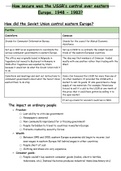
How did the Soviet Union control eastern Europe?
Factfile
Cominform Comecon
Stands for Communist Information Bureau Stands for the council for Mutual Economic
Assistance
Set up in 1947 as an organisation to coordinate the Set up in 1949 to co-ordinate the industries and
various communist governments in eastern Europe. trade of the eastern European countries.
The office was originally based in Belgrade in The idea was that members of Comecon traded
Yugoslavia but moved to Bucharest in Romania in mostly with one another rather than trading with the
1948 after Yugoslavia was expelled by Stalin West.
because it would not do what the Soviet Union told it
to do.
Cominform and meetings and sent out instructions to Comic-Con favoured the USSR far more than any of
communist governments about what the Soviet Union its other members. It provided the USSR with a
wanted them to do stop market to sell its goods. It also guaranteed a cheap
supply of raw materials. For example, Poland was
forced to sell it's cold to the USSR at one-tenth of
the price that it could have gotten by selling it to
the open market.
It set up a bank for socialist countries in 1964.
The impact on ordinary people
➢ Freedom:
○ Lost ability to criticise government
○ Newspapers censored
○ Non-communists imprisoned for criticising government
○ People forbidden to travel to countries in western Europe
○ Protests crushed by security forces
➢ Wealth
○ Between 1945 and 1955, eastern Europe economies did begin to recover, but
soon wages in eastern Europe fell behind wages in other countries.
○ People short of coal
○ Clothing and shoes are very expensive.
➢ Consumer goods:
○ People couldn’t buy western consumer goods (radios, electric kettles,
televisions, etc). Instead factories produces industrial items (machinery etc)
Europe, 1948 - 1983?
How did the Soviet Union control eastern Europe?
Factfile
Cominform Comecon
Stands for Communist Information Bureau Stands for the council for Mutual Economic
Assistance
Set up in 1947 as an organisation to coordinate the Set up in 1949 to co-ordinate the industries and
various communist governments in eastern Europe. trade of the eastern European countries.
The office was originally based in Belgrade in The idea was that members of Comecon traded
Yugoslavia but moved to Bucharest in Romania in mostly with one another rather than trading with the
1948 after Yugoslavia was expelled by Stalin West.
because it would not do what the Soviet Union told it
to do.
Cominform and meetings and sent out instructions to Comic-Con favoured the USSR far more than any of
communist governments about what the Soviet Union its other members. It provided the USSR with a
wanted them to do stop market to sell its goods. It also guaranteed a cheap
supply of raw materials. For example, Poland was
forced to sell it's cold to the USSR at one-tenth of
the price that it could have gotten by selling it to
the open market.
It set up a bank for socialist countries in 1964.
The impact on ordinary people
➢ Freedom:
○ Lost ability to criticise government
○ Newspapers censored
○ Non-communists imprisoned for criticising government
○ People forbidden to travel to countries in western Europe
○ Protests crushed by security forces
➢ Wealth
○ Between 1945 and 1955, eastern Europe economies did begin to recover, but
soon wages in eastern Europe fell behind wages in other countries.
○ People short of coal
○ Clothing and shoes are very expensive.
➢ Consumer goods:
○ People couldn’t buy western consumer goods (radios, electric kettles,
televisions, etc). Instead factories produces industrial items (machinery etc)