Restrictive Covenants – Problem Questions – Answer Outline
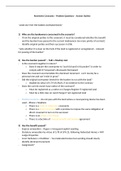
*LOOK OUT FOR THE WORDS COVENANT(ED)(S)*
1) Who are the landowners concerned in the scenario?
- If not the original parties to the covenant, it must be considered whether the benefit
and the burden have passed to the current landowners (no more privity of contract)
- Identify original parties and their successors in title
*note whether it is clear on the facts if the land is registered or unregistered – relevant
for passing of the burden*
2) Has the burden passed? - Tulk v Muxhay test
- Is the covenant negative in nature?
o Does it require the covenantor to “put his hand in his pocket” in order to
comply with it? Haywood v Brunswick Permanent
- Does the covenant accommodate the dominant tenement - can’t merely be a
personal one and can’t exist in gross?
- Did the original covenantor intend for the burden to run with the land?
o Implied by virtue of S.79 of LPA25, if no evidence to the contrary
- Does the current owner have notice of the covenant?
o Must be registered as a notice on Charges Register if registered land
o Must be a D(ii) class on Land Charge if not registered land
- Positive burdens – do not pass with the land unless a conveyancing device has been
used – Rhone v Stephens
o There is a chain of indemnity covenants
o There is a direct covenant with a promise to impose the same obligation of
direct covenant in turn on his successor
o There is an estate rent charge
o There is a doctrine of mutual benefit and burden agreement
3) Has the benefit passed?
- Express annexation – Rogers v Hosegood explicit wording
- Statutory annexation by virtue of S.78 of LPA 25, following Federated Homes v Mill
Lodge Properties
- Crest Nicholson v McAllister – Yes Federated Homes but wording should clearly
identify dominant tenement
- Assignment?
*LOOK OUT FOR THE WORDS COVENANT(ED)(S)*
1) Who are the landowners concerned in the scenario?
- If not the original parties to the covenant, it must be considered whether the benefit
and the burden have passed to the current landowners (no more privity of contract)
- Identify original parties and their successors in title
*note whether it is clear on the facts if the land is registered or unregistered – relevant
for passing of the burden*
2) Has the burden passed? - Tulk v Muxhay test
- Is the covenant negative in nature?
o Does it require the covenantor to “put his hand in his pocket” in order to
comply with it? Haywood v Brunswick Permanent
- Does the covenant accommodate the dominant tenement - can’t merely be a
personal one and can’t exist in gross?
- Did the original covenantor intend for the burden to run with the land?
o Implied by virtue of S.79 of LPA25, if no evidence to the contrary
- Does the current owner have notice of the covenant?
o Must be registered as a notice on Charges Register if registered land
o Must be a D(ii) class on Land Charge if not registered land
- Positive burdens – do not pass with the land unless a conveyancing device has been
used – Rhone v Stephens
o There is a chain of indemnity covenants
o There is a direct covenant with a promise to impose the same obligation of
direct covenant in turn on his successor
o There is an estate rent charge
o There is a doctrine of mutual benefit and burden agreement
3) Has the benefit passed?
- Express annexation – Rogers v Hosegood explicit wording
- Statutory annexation by virtue of S.78 of LPA 25, following Federated Homes v Mill
Lodge Properties
- Crest Nicholson v McAllister – Yes Federated Homes but wording should clearly
identify dominant tenement
- Assignment?