Who was to blame for the Cold War?
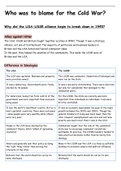
Why did the USA-USSR alliance begin to break down in 1945?
Allies against Hitler
The USA, USSR and Britain fought together as allies in WW2. Though it was a strategic
alliance, not one of brotherhood. The majority of politicians and business leaders in
Britain and the USA hated and feared communist ideas.
In the past, they helped the enemies of the communists. This made the USSR wary of
Britain and the USA.
Difference in Ideologies
The USA The USSR
The USA was capitalist. Business and property The USSR was communist. Industries all belonged and
were privately owned. were run by the state
It was a democracy. Governments were freely It was a one-party dictatorship. There were elections
elected by its people. but only for candidates that belonged to the
communist party.
For Americans, being free from control of the For the USSR, the state as a society was more
government was more important than everyone important than individuals so individuals' lives were
being equal. strictly controlled.
It was the world's wealthiest country. But as in It was an economic superpower because of the rapid
most capitalist countries, there were extremes growth between the 1920’s and 1930’s. Though the
- some people were very wealthy while others general standard of living was much lower than the
were very poor. USA. However unemployment was rare and extreme
poverty was much rarer than it was in the USA.
People in the USA were alarmed by the Communism taught that the role of the communist
communist theory, which talked of spreading state was to encourage communist revolutions
revolution worldwide. In practice, the USSR’s leaders tended to
take practical decisions rather than be led by this
ideology.
Americans generally saw their policy as doing Many in the USSR saw the USA's actions as selfishly
the ‘right thing’ rather than serving the building its economic empire and political influence.
interests of the USA.
Believed that the world should be run by its Believed that the world should be run by its own
same ideologies ideologies.
, Superpowers
The USA and the USSR had emerged from the war as the two world ‘Superpowers’.
Roosevelt had set the Americans firmly against a policy of isolation and this
effectively meant opposing communism. There would be no more appeasement of
dictators. From now on every communist action would be met by an American reaction.
Yalta Conference, February 1945
Agreements at Yalta
Stalin agreed to enter the war against Japan They agreed that Germany would be divided into 4
once Germany surrendered. zones: American, British, French, Soviet.
Agreed countries liberated from German control The Big Three all agreed to join the new United
would be able to hold free elections and choose Nations, which would aim to keep peace after the
their own government. war.
The Big Three promised to hunt down and punish The Big Three agreed that eastern Europe should be
war criminals who were responsible for the seen as a ‘Soviet sphere of influence’.
genocides.
Disagreements
Poland:
- Stalin wanted the border of the USSR to move westwards into Poland. Stalin argued that Poland,
in turn, could move its border westwards into German territory.
- Churchill didn’t approve of Stalin’s plans for Poland, but he also knew that he couldn’t do much
about it because Stalin’s Red Army was in total control of both Poland and Eastern Germany
- Roosevelt also did not like Stalin's plan but Churchill persuaded him to accept it, as long as the
USSR agreed not to interfere with Greece (where communists were trying to take over) Stalin
agreed to this.
Changes since Yalta
1. Stalin’s armies were occupying most of Eastern Europe
Stalin had liberated country after country in eastern Europe, but instead of withdrawing his
troops Stalin had left them there. Refugees were fleeing the countries in fear of a communist
takeover. Stalin set up a communist government in Poland, ignoring the wishes of the majority of
the Poles. He insisted that his takeover of Europe was a defensive measure against possible
future attacks.
2. America had a new president
12 April 1945, President Roosevelt died and was replaced by Harry Truman. Truman was much
more anticommunist than Roosevelt and very suspicious of Stalin. Truman and his advisers saw
Soviet actions in Eastern Europe as preparations for a Soviet take-over of the rest of Europe.
3. The allies had tested an atomic bomb
On 12 July 1945 the Americans successfully tested an Atomic Bomb at a desert site in the USA.
At the start of the Potsdam Conference, Truman informed Stalin about it.
Why did the USA-USSR alliance begin to break down in 1945?
Allies against Hitler
The USA, USSR and Britain fought together as allies in WW2. Though it was a strategic
alliance, not one of brotherhood. The majority of politicians and business leaders in
Britain and the USA hated and feared communist ideas.
In the past, they helped the enemies of the communists. This made the USSR wary of
Britain and the USA.
Difference in Ideologies
The USA The USSR
The USA was capitalist. Business and property The USSR was communist. Industries all belonged and
were privately owned. were run by the state
It was a democracy. Governments were freely It was a one-party dictatorship. There were elections
elected by its people. but only for candidates that belonged to the
communist party.
For Americans, being free from control of the For the USSR, the state as a society was more
government was more important than everyone important than individuals so individuals' lives were
being equal. strictly controlled.
It was the world's wealthiest country. But as in It was an economic superpower because of the rapid
most capitalist countries, there were extremes growth between the 1920’s and 1930’s. Though the
- some people were very wealthy while others general standard of living was much lower than the
were very poor. USA. However unemployment was rare and extreme
poverty was much rarer than it was in the USA.
People in the USA were alarmed by the Communism taught that the role of the communist
communist theory, which talked of spreading state was to encourage communist revolutions
revolution worldwide. In practice, the USSR’s leaders tended to
take practical decisions rather than be led by this
ideology.
Americans generally saw their policy as doing Many in the USSR saw the USA's actions as selfishly
the ‘right thing’ rather than serving the building its economic empire and political influence.
interests of the USA.
Believed that the world should be run by its Believed that the world should be run by its own
same ideologies ideologies.
, Superpowers
The USA and the USSR had emerged from the war as the two world ‘Superpowers’.
Roosevelt had set the Americans firmly against a policy of isolation and this
effectively meant opposing communism. There would be no more appeasement of
dictators. From now on every communist action would be met by an American reaction.
Yalta Conference, February 1945
Agreements at Yalta
Stalin agreed to enter the war against Japan They agreed that Germany would be divided into 4
once Germany surrendered. zones: American, British, French, Soviet.
Agreed countries liberated from German control The Big Three all agreed to join the new United
would be able to hold free elections and choose Nations, which would aim to keep peace after the
their own government. war.
The Big Three promised to hunt down and punish The Big Three agreed that eastern Europe should be
war criminals who were responsible for the seen as a ‘Soviet sphere of influence’.
genocides.
Disagreements
Poland:
- Stalin wanted the border of the USSR to move westwards into Poland. Stalin argued that Poland,
in turn, could move its border westwards into German territory.
- Churchill didn’t approve of Stalin’s plans for Poland, but he also knew that he couldn’t do much
about it because Stalin’s Red Army was in total control of both Poland and Eastern Germany
- Roosevelt also did not like Stalin's plan but Churchill persuaded him to accept it, as long as the
USSR agreed not to interfere with Greece (where communists were trying to take over) Stalin
agreed to this.
Changes since Yalta
1. Stalin’s armies were occupying most of Eastern Europe
Stalin had liberated country after country in eastern Europe, but instead of withdrawing his
troops Stalin had left them there. Refugees were fleeing the countries in fear of a communist
takeover. Stalin set up a communist government in Poland, ignoring the wishes of the majority of
the Poles. He insisted that his takeover of Europe was a defensive measure against possible
future attacks.
2. America had a new president
12 April 1945, President Roosevelt died and was replaced by Harry Truman. Truman was much
more anticommunist than Roosevelt and very suspicious of Stalin. Truman and his advisers saw
Soviet actions in Eastern Europe as preparations for a Soviet take-over of the rest of Europe.
3. The allies had tested an atomic bomb
On 12 July 1945 the Americans successfully tested an Atomic Bomb at a desert site in the USA.
At the start of the Potsdam Conference, Truman informed Stalin about it.