Sunday 1 November y
Financial management I
Chapter 1
Accounting is an information system that measures, processes and communicates
financial information about a business.
Economic entity is an unit that exists independently (business, hospital, governmental
body). Accounting’s role of measuring, processing an communicating financial
information is usually divided into financial accounting and managerial accounting.
- Financial accounting external decision makers use it to evaluate how well the
business has achieved its goals. you call these reports financial statements.
- Managerial accounting internal decision
makers use it to get information about
operation, investing and financing activities.
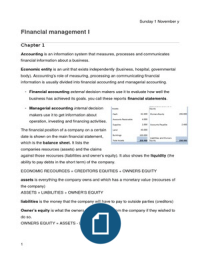
The financial position of a company on a certain
date is shown on the main financial statement,
which is the balance sheet. It lists the
companies resources (assets) and the claims
against those recourses (liabilities and owner’s equity). It also shows the liquidity (the
ability to pay debts in the short term) of the company.
ECONOMIC RECOURCES = CREDITORS EQUITIES + OWNERS EQUITY
assets is everything the company owns and which has a monetary value (recourses of
the company)
ASSETS = LIABILITIES + OWNER’S EQUITY
liabilities is the money that the company will have to pay to outside parties (creditors)
Owner’s equity is what the owners could withdraw from the company if they wished to
do so.
OWNERS EQUITY = ASSETS - LIABILITIES
1
, Sunday 1 November y
revenues are recourses the business earns through
business transactions, such as sales of products or services
(revenues INCREASE the value of the owner’s equity)
expenses are recourses the company sacrifices in order to
generate revenues. (expenses DECREASE the value of the
owner’s equity)
The income statement of profit and loss account summarizes the revenues earned and
expenses incurred during a certain period.
profit = revenues - expenses —> If the profit is negative, it is called ‘loss’
Corporation - separate legal entity having it’s own rights, privileges and liabilities
separate from it’s owners.
Partnership - owned by 2 or more owners. The owners share the profits and losses
Sole proprietorship - a business with only one owner and is not incorporated. The
owner takes all the profits or losses and is liable for all its obligations.
GAAP Generally Accepted Accounting Principles: A world wide agreement on the
theory and practice of accounting at a particular time
FASB Financial Accounting Standards Board: they establish these GAAP’s
CPA Certified Public Accountant: a person which is not an employee of the
company being audited who audits the financial statements of many
companies of all sizes.
IFRS International Financial reporting standards: a common global language for
business affairs
IASB International Accounting Standards Board: Sets these international
accounting standards (IFRS)
PCAOB Public Company Accounting Oversight Board: a governmental body
created by sarbanes-Oxley Act. They have powers to determine the
standards that auditors must follow.
AICPA American Institute of Certified Public Accountants: Influences accounting
standards through member CPAs
SEC Securities and Exchange Commission: responsible for enforcing the
2
Financial management I
Chapter 1
Accounting is an information system that measures, processes and communicates
financial information about a business.
Economic entity is an unit that exists independently (business, hospital, governmental
body). Accounting’s role of measuring, processing an communicating financial
information is usually divided into financial accounting and managerial accounting.
- Financial accounting external decision makers use it to evaluate how well the
business has achieved its goals. you call these reports financial statements.
- Managerial accounting internal decision
makers use it to get information about
operation, investing and financing activities.
The financial position of a company on a certain
date is shown on the main financial statement,
which is the balance sheet. It lists the
companies resources (assets) and the claims
against those recourses (liabilities and owner’s equity). It also shows the liquidity (the
ability to pay debts in the short term) of the company.
ECONOMIC RECOURCES = CREDITORS EQUITIES + OWNERS EQUITY
assets is everything the company owns and which has a monetary value (recourses of
the company)
ASSETS = LIABILITIES + OWNER’S EQUITY
liabilities is the money that the company will have to pay to outside parties (creditors)
Owner’s equity is what the owners could withdraw from the company if they wished to
do so.
OWNERS EQUITY = ASSETS - LIABILITIES
1
, Sunday 1 November y
revenues are recourses the business earns through
business transactions, such as sales of products or services
(revenues INCREASE the value of the owner’s equity)
expenses are recourses the company sacrifices in order to
generate revenues. (expenses DECREASE the value of the
owner’s equity)
The income statement of profit and loss account summarizes the revenues earned and
expenses incurred during a certain period.
profit = revenues - expenses —> If the profit is negative, it is called ‘loss’
Corporation - separate legal entity having it’s own rights, privileges and liabilities
separate from it’s owners.
Partnership - owned by 2 or more owners. The owners share the profits and losses
Sole proprietorship - a business with only one owner and is not incorporated. The
owner takes all the profits or losses and is liable for all its obligations.
GAAP Generally Accepted Accounting Principles: A world wide agreement on the
theory and practice of accounting at a particular time
FASB Financial Accounting Standards Board: they establish these GAAP’s
CPA Certified Public Accountant: a person which is not an employee of the
company being audited who audits the financial statements of many
companies of all sizes.
IFRS International Financial reporting standards: a common global language for
business affairs
IASB International Accounting Standards Board: Sets these international
accounting standards (IFRS)
PCAOB Public Company Accounting Oversight Board: a governmental body
created by sarbanes-Oxley Act. They have powers to determine the
standards that auditors must follow.
AICPA American Institute of Certified Public Accountants: Influences accounting
standards through member CPAs
SEC Securities and Exchange Commission: responsible for enforcing the
2