Lectures O&E
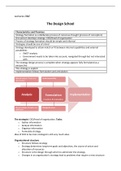
The Design School
Characteristics and Premises
Strategy formation as a deliberate process of conscious thought (process of conception)
One person develops strategy: CEO/Head of organization
Process of strategy formation should be simple and informal
Strategies should be one of a kind
Strategy developed to attain match or fit between internal capabilities and external
possibilities
o SWOT-analysis
o Environment needs to be taken into account, navigated through but not interacted
with
The strategy design process is complete when strategy appears fully formulated as a
perspective
This strategy is explicit
Implementation follows formulation and articulation
The strategist: CEO/head of organization. Tasks:
o Gather information
o Analyze information
o Organize information
o Formulate strategy
Idea of CEO to be main strategist is still very much alive.
Organizational structure
o Structure follows strategy
o Strategy determines long-term goals and objectives, the course of action and
allocation of resources
o Structure is the design through which to administer the strategy
o Changes in an organization’s strategy lead to problems that require a new structure
, Summary assumptions
The CEO/head of organization has complete and perfect information
The CEO/head of organization had the mental/cognitive capacity to accurately process all
information
The environment can always be understood
Situations and environment are predictable
All information is documented and available
Strategy is centrally formulated
Criticism/limitations
Structure follows strategy; unrealistic for most organizations
Assumption of universality
The capacity to learn is ignored by analytical assessment of environment and internal
capabilities
Promotion of inflexibility: hierarchical, centralized, and explicit strategy formation
Detachment of thinking from acting
CEO/head of organization is unlikely to have all and perfect information and the capacity
to process this information
Economic man/Homo economicus: agent who has complete information about the
options available for choice, perfect foresight of the consequences from choosing those
options, and the wherewithal to solve an optimization problem that identifies an option
which maximizes the agent’s personal utility.
Bounded rationality: rationality is limited, and individuals make imperfect decisions
o Difficulty of problem
o Boundaries to cognitive capability
o Limited time
Contributions of the Design School
o Vocabulary and tools
o Grand strategy
o Basic notion: fit between external environment and internal capabilities
o Started to promote the relevance of strategy in organizations and as a field of
research
, The Planning School
Planning: the establishment of goals, policies, and procedures for a social or economic unit
In strategy: a formalized procedure to produce articulated results by using an integrated
system of decisions.
Origins
o Military: organizations and military organization must adapt to change and
constantly improve to gain/maintain an advantage
o Strategy as a result of:
o Formal procedure
o Formal training
o Formal analysis
o Lots of numbers
o Difference: organization strategy assumes competition; military strategy assumes
conflict
Characteristics and premises
Strategy is driven by insights into regularities
Strategy formation is a conscious, formal, and controlled process
Strategy is decomposed into distinct steps
Strategy formation is supported by checklists and analytical techniques
Rational and systematic approach to strategy making – affected by scientific management
Organizations are like machines
Organizations have a clear-cut system of values, competencies, and reward system
These are easy to recognize
Responsibilities are divided
Planning and implementation are separate, consecutive steps
The environment is stable and predictable
Scientific Management
o Theory of management that focuses on increasing economic efficiency, based on a
logic of science
o Pioneered in the 1880s and 1890s by Taylor (Taylorism)
o Managerial control to secure labor productivity
o Predecessor of: industrial engineering, operations management, total quality
management, six sigma etc.
, Operational planning
o Strategic goals linked to tactical goals and objectives
o Elements:
o Milestones;
o Conditions for success;
o Phasing
o Specifies the activities of the organization and resources required
o Establishes budgets and activities for each part of the organization for the next 1-3
years
Managing the future
o Strategy making as a formal process that conceives strategy as a plan: consciously
intended course of action to deal with a situation
o Planning for the future:
o Scenario planning
o Real options
Scenario planning
If the future cannot be predicted, then by speculation on varieties of the future the
organization can prepare itself. Multiple scenarios, bet on:
o Probability;
o Profitability
o Hedge;
o Flexibility
o Make one happen
Shell à breaking the habit to assume that the future will look like the present. A scenario is
not a forecast. Scenario planning or ‘strategic foresight’ adds value through:
o Capacity to perceive change;
o Interpret and respond to change;
o Influence on third parties;
o Enhanced capacity for organizational learning.
Scenarios create discontinuities: stories of the future that are not extrapolated from the
past. Beyond predicting and quantifying these futures storytelling is key. Storytelling creates
alternative realities that are persuasive and create interpretation frames. Scenarios are
temporary.
Real options
Proactive actions to prepare for possible future(s). Options are contracts that specify a price
at which the holder of the option can buy or sell an asset such as shares at a particular time
in the future. The holder of an option does not have the obligation to exercise the option but
has the right to exercise the option. The holder pays to obtain this right. The right can be to:
o Defer;
o Grow;
o Contract;
o Shut down & restart
o Abandon;
o Expand;
The Design School
Characteristics and Premises
Strategy formation as a deliberate process of conscious thought (process of conception)
One person develops strategy: CEO/Head of organization
Process of strategy formation should be simple and informal
Strategies should be one of a kind
Strategy developed to attain match or fit between internal capabilities and external
possibilities
o SWOT-analysis
o Environment needs to be taken into account, navigated through but not interacted
with
The strategy design process is complete when strategy appears fully formulated as a
perspective
This strategy is explicit
Implementation follows formulation and articulation
The strategist: CEO/head of organization. Tasks:
o Gather information
o Analyze information
o Organize information
o Formulate strategy
Idea of CEO to be main strategist is still very much alive.
Organizational structure
o Structure follows strategy
o Strategy determines long-term goals and objectives, the course of action and
allocation of resources
o Structure is the design through which to administer the strategy
o Changes in an organization’s strategy lead to problems that require a new structure
, Summary assumptions
The CEO/head of organization has complete and perfect information
The CEO/head of organization had the mental/cognitive capacity to accurately process all
information
The environment can always be understood
Situations and environment are predictable
All information is documented and available
Strategy is centrally formulated
Criticism/limitations
Structure follows strategy; unrealistic for most organizations
Assumption of universality
The capacity to learn is ignored by analytical assessment of environment and internal
capabilities
Promotion of inflexibility: hierarchical, centralized, and explicit strategy formation
Detachment of thinking from acting
CEO/head of organization is unlikely to have all and perfect information and the capacity
to process this information
Economic man/Homo economicus: agent who has complete information about the
options available for choice, perfect foresight of the consequences from choosing those
options, and the wherewithal to solve an optimization problem that identifies an option
which maximizes the agent’s personal utility.
Bounded rationality: rationality is limited, and individuals make imperfect decisions
o Difficulty of problem
o Boundaries to cognitive capability
o Limited time
Contributions of the Design School
o Vocabulary and tools
o Grand strategy
o Basic notion: fit between external environment and internal capabilities
o Started to promote the relevance of strategy in organizations and as a field of
research
, The Planning School
Planning: the establishment of goals, policies, and procedures for a social or economic unit
In strategy: a formalized procedure to produce articulated results by using an integrated
system of decisions.
Origins
o Military: organizations and military organization must adapt to change and
constantly improve to gain/maintain an advantage
o Strategy as a result of:
o Formal procedure
o Formal training
o Formal analysis
o Lots of numbers
o Difference: organization strategy assumes competition; military strategy assumes
conflict
Characteristics and premises
Strategy is driven by insights into regularities
Strategy formation is a conscious, formal, and controlled process
Strategy is decomposed into distinct steps
Strategy formation is supported by checklists and analytical techniques
Rational and systematic approach to strategy making – affected by scientific management
Organizations are like machines
Organizations have a clear-cut system of values, competencies, and reward system
These are easy to recognize
Responsibilities are divided
Planning and implementation are separate, consecutive steps
The environment is stable and predictable
Scientific Management
o Theory of management that focuses on increasing economic efficiency, based on a
logic of science
o Pioneered in the 1880s and 1890s by Taylor (Taylorism)
o Managerial control to secure labor productivity
o Predecessor of: industrial engineering, operations management, total quality
management, six sigma etc.
, Operational planning
o Strategic goals linked to tactical goals and objectives
o Elements:
o Milestones;
o Conditions for success;
o Phasing
o Specifies the activities of the organization and resources required
o Establishes budgets and activities for each part of the organization for the next 1-3
years
Managing the future
o Strategy making as a formal process that conceives strategy as a plan: consciously
intended course of action to deal with a situation
o Planning for the future:
o Scenario planning
o Real options
Scenario planning
If the future cannot be predicted, then by speculation on varieties of the future the
organization can prepare itself. Multiple scenarios, bet on:
o Probability;
o Profitability
o Hedge;
o Flexibility
o Make one happen
Shell à breaking the habit to assume that the future will look like the present. A scenario is
not a forecast. Scenario planning or ‘strategic foresight’ adds value through:
o Capacity to perceive change;
o Interpret and respond to change;
o Influence on third parties;
o Enhanced capacity for organizational learning.
Scenarios create discontinuities: stories of the future that are not extrapolated from the
past. Beyond predicting and quantifying these futures storytelling is key. Storytelling creates
alternative realities that are persuasive and create interpretation frames. Scenarios are
temporary.
Real options
Proactive actions to prepare for possible future(s). Options are contracts that specify a price
at which the holder of the option can buy or sell an asset such as shares at a particular time
in the future. The holder of an option does not have the obligation to exercise the option but
has the right to exercise the option. The holder pays to obtain this right. The right can be to:
o Defer;
o Grow;
o Contract;
o Shut down & restart
o Abandon;
o Expand;