

[Chemistry practice questions]
Agribusiness (Robert Gomani +265999941099)
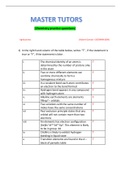
1) In the right hand column of the table below, writes “T” , if the statement is
true or “F”, if the statement is false .
i. The chemical identity of an atom is T
determined by the number of protons only
in the atom
ii. Two or more different elements can F
combine chemically to form a
homogenous mixture
iii. In a covalent bond each atom contributes F
an electron to the bond formed
iv. Hydrogen bond appears in any compound F
with hydrogen atom
v. Alkaline earth elements are elements F
filling f – orbitals
vi Two solutions with the same number of F
moles have the same concentrations
vii Paul exclusion principle states that any T
orbital will not contain more than two
electrons
viii An elements has electron configuration T
[Xe]6s2 4f14 5d10 6p2. This element is likely
to be in group 4A
ix CH3NH2 is likely to exhibit hydrogen T
bonding in liquid state
x Transition elements are found in the d – T
block of periodic table
,2) What type of intermolecular force is responsible for attraction between a
polar molecules that induces a charge on non-polar molecule?
Dipole – induced dipole
3) Which intermolecular force is incorrectly assigned as the principal force in
the compound given?
a) CCl4 London
b) NH3 London
c) HF H− bonding
d) HBr Dipole – dipole
4) Draw electronic structure for atom with atomic number 35?
1s2 2s2 2p6 3s2 3p6 4s2 3d10 4p5
5) The different types of subshells and corresponding number of orbitals is ?
a) S:2 p:6 d:10 f:14
b) S:2 p:3 d:5 f:7
c) S:1 p:3 d:5 f:7
d) S:1 p:6 d:10 f:14
6) Why does the size of an atom decrease as you move to the right across
rows of the periodic table
a) They have more electrons which increases the size of the atom
b) They have less electrons because they tend to lose electrons
c) They have more protons resulting in more pull towards the centre
d) They have more neutron which make the atom more compact
7) Given that 1amu = 1.66 x 10⁻²⁴ g and that the mass of an electron is 9.108 x
10−28g , what is the mass of an electron in amu ?
5.49 x 10⁻⁴
8) Phosphorus and nitrogen are in the same group of the periodic table. The
boiling point of phosphine (PH3, −85oC) is much lower than that of ammonia
(NH3, −33.5oC). In just one statement give a reason for this different in
boiling points
NH3 molecules makes strong intermolecular H− Bonding between
themselves while PH3 molecules they cannot form hydrogen bonding
, between themselves instead there is weak London dispersion force
between themselves so due to greater attraction in NH3 molecules, they
are tightly held. So the boiling point is greater than PH3
9) Two atoms L and M have electronic configurations 1s2 2s2 2p6 and 1s2 2s2
2p6 3s1 respectively. The first ionization energy of one is 2080KJ/mol, and
that of the other is 496KJ/mol. Match each ionization energy with one of
the given electron configurations. Justify your choice
L=2080 Kj/mol
M=496 KJ/mol
Explanation: 1s2 2s2 2p6 has the configuration of a noble gas. A full outer
octect electrons. It will take more energy to ionize
1s2 2s2 2p6 3s1 Will need less energy to ionize to obtain full outer octect like
a noble gas
10) State the intermolecular forces that exist between the
following pairs of molecules.
a) NH3 and H2O
b) l2 and H2
c) SO2 and H2O
d) SO2 and H2S
e) CH3CH3 and CH4
f) Cl2 and CCl4
g) Br2 and CCl4
h) KCl and H2O
i) CH3CH2OH and H2O
Solution
a) NH3 and H2O London dispersion forces , dipole – dipole forces
and hydrogen bonds
b) I2 and H2 hydrogen bonds
c) SO2 and H2O London /dispersion forces, hydrogen bonding
Agribusiness (Robert Gomani +265999941099)
1) In the right hand column of the table below, writes “T” , if the statement is
true or “F”, if the statement is false .
i. The chemical identity of an atom is T
determined by the number of protons only
in the atom
ii. Two or more different elements can F
combine chemically to form a
homogenous mixture
iii. In a covalent bond each atom contributes F
an electron to the bond formed
iv. Hydrogen bond appears in any compound F
with hydrogen atom
v. Alkaline earth elements are elements F
filling f – orbitals
vi Two solutions with the same number of F
moles have the same concentrations
vii Paul exclusion principle states that any T
orbital will not contain more than two
electrons
viii An elements has electron configuration T
[Xe]6s2 4f14 5d10 6p2. This element is likely
to be in group 4A
ix CH3NH2 is likely to exhibit hydrogen T
bonding in liquid state
x Transition elements are found in the d – T
block of periodic table
,2) What type of intermolecular force is responsible for attraction between a
polar molecules that induces a charge on non-polar molecule?
Dipole – induced dipole
3) Which intermolecular force is incorrectly assigned as the principal force in
the compound given?
a) CCl4 London
b) NH3 London
c) HF H− bonding
d) HBr Dipole – dipole
4) Draw electronic structure for atom with atomic number 35?
1s2 2s2 2p6 3s2 3p6 4s2 3d10 4p5
5) The different types of subshells and corresponding number of orbitals is ?
a) S:2 p:6 d:10 f:14
b) S:2 p:3 d:5 f:7
c) S:1 p:3 d:5 f:7
d) S:1 p:6 d:10 f:14
6) Why does the size of an atom decrease as you move to the right across
rows of the periodic table
a) They have more electrons which increases the size of the atom
b) They have less electrons because they tend to lose electrons
c) They have more protons resulting in more pull towards the centre
d) They have more neutron which make the atom more compact
7) Given that 1amu = 1.66 x 10⁻²⁴ g and that the mass of an electron is 9.108 x
10−28g , what is the mass of an electron in amu ?
5.49 x 10⁻⁴
8) Phosphorus and nitrogen are in the same group of the periodic table. The
boiling point of phosphine (PH3, −85oC) is much lower than that of ammonia
(NH3, −33.5oC). In just one statement give a reason for this different in
boiling points
NH3 molecules makes strong intermolecular H− Bonding between
themselves while PH3 molecules they cannot form hydrogen bonding
, between themselves instead there is weak London dispersion force
between themselves so due to greater attraction in NH3 molecules, they
are tightly held. So the boiling point is greater than PH3
9) Two atoms L and M have electronic configurations 1s2 2s2 2p6 and 1s2 2s2
2p6 3s1 respectively. The first ionization energy of one is 2080KJ/mol, and
that of the other is 496KJ/mol. Match each ionization energy with one of
the given electron configurations. Justify your choice
L=2080 Kj/mol
M=496 KJ/mol
Explanation: 1s2 2s2 2p6 has the configuration of a noble gas. A full outer
octect electrons. It will take more energy to ionize
1s2 2s2 2p6 3s1 Will need less energy to ionize to obtain full outer octect like
a noble gas
10) State the intermolecular forces that exist between the
following pairs of molecules.
a) NH3 and H2O
b) l2 and H2
c) SO2 and H2O
d) SO2 and H2S
e) CH3CH3 and CH4
f) Cl2 and CCl4
g) Br2 and CCl4
h) KCl and H2O
i) CH3CH2OH and H2O
Solution
a) NH3 and H2O London dispersion forces , dipole – dipole forces
and hydrogen bonds
b) I2 and H2 hydrogen bonds
c) SO2 and H2O London /dispersion forces, hydrogen bonding


