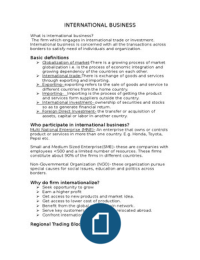
INTERNATIONAL BUSINESS
What is international business?
The firm which engages in international trade or investment.
International business is concerned with all the transactions across
borders to satisfy need of individuals and organization.
Basic definitions
Globalization of market-There is a growing process of market
globalization i.e. is the process of economic integration and
growing dependency of the countries on each other.
International trade-There is exchange of goods and services
through exporting and importing.
Exporting- exporting refers to the sale of goods and service to
different countries from the home country.
Importing- Importing is the process of getting the product
and services form suppliers outside the country.
International investment- ownership of securities and stocks
so as to generate financial return.
Foreign Direct Investment- the transfer or acquisition of
assets, capital or labor in another country.
Who participate in international business?
Multi National Enterprise (MNE)- An enterprise that owns or controls
product or services in more than one country. E.g. Honda, Toyota,
Pepsi etc.
Small and Medium Sized Enterprise(SME)- these are companies with
employees <500 and a limited number of resources. These firms
constitute about 90% of the firms in different countries.
Non-Governmental Organization (NGO)- these organization pursue
special causes for social issues, education and politics across
borders.
Why do firm internationalize?
Seek opportunity to grow
Earn a higher profit
Get access to new products and market idea.
Get access to lower cost of production.
Benefit from the global supply chain network.
Serve key customers that may have relocated abroad.
Confront international competitors.
Regional Trading Bloc
, It is a geographical area consisting of countries, which have agreed
to pursue economic integration by reducing tariff rates, and other
barriers so as to allow free flow of products, services and labour.
Bloc countries become a part of a free trade agreement which
eliminates tariff quotes etc. e.g. NAFTA, EU etc.
BUSINESS ENVIRONMENT
Business environment consists of many aspects. i.e. Cultural
environment, Social environment, Political environment, legal
environment, technology and innovation ad financial.
Cultural Environment
National cultures
Religion and values
Organizational cultures
Social environment
Social class, societies, populating etc
Political environment
The way in which political forces effect business.
Legal environment
The legal system
International contacts
Human rights
Financial
The global capital markets
World bank, IMF
Technology and innovation
Transfer of technology i.e. joint ventures, licensing
Innovation and patents
International business and risk
When the companies venture abroad they encounter four types of
risk such as cross-cultural risk, country risk, currency risk and
commercial risk. These kind of risk are always present but these
could be managed. Managers are the ones who can minimize the
volatility in the case of risky situation.
Cross cultural risks
Cultural differences
Decision making styles
What is international business?
The firm which engages in international trade or investment.
International business is concerned with all the transactions across
borders to satisfy need of individuals and organization.
Basic definitions
Globalization of market-There is a growing process of market
globalization i.e. is the process of economic integration and
growing dependency of the countries on each other.
International trade-There is exchange of goods and services
through exporting and importing.
Exporting- exporting refers to the sale of goods and service to
different countries from the home country.
Importing- Importing is the process of getting the product
and services form suppliers outside the country.
International investment- ownership of securities and stocks
so as to generate financial return.
Foreign Direct Investment- the transfer or acquisition of
assets, capital or labor in another country.
Who participate in international business?
Multi National Enterprise (MNE)- An enterprise that owns or controls
product or services in more than one country. E.g. Honda, Toyota,
Pepsi etc.
Small and Medium Sized Enterprise(SME)- these are companies with
employees <500 and a limited number of resources. These firms
constitute about 90% of the firms in different countries.
Non-Governmental Organization (NGO)- these organization pursue
special causes for social issues, education and politics across
borders.
Why do firm internationalize?
Seek opportunity to grow
Earn a higher profit
Get access to new products and market idea.
Get access to lower cost of production.
Benefit from the global supply chain network.
Serve key customers that may have relocated abroad.
Confront international competitors.
Regional Trading Bloc
, It is a geographical area consisting of countries, which have agreed
to pursue economic integration by reducing tariff rates, and other
barriers so as to allow free flow of products, services and labour.
Bloc countries become a part of a free trade agreement which
eliminates tariff quotes etc. e.g. NAFTA, EU etc.
BUSINESS ENVIRONMENT
Business environment consists of many aspects. i.e. Cultural
environment, Social environment, Political environment, legal
environment, technology and innovation ad financial.
Cultural Environment
National cultures
Religion and values
Organizational cultures
Social environment
Social class, societies, populating etc
Political environment
The way in which political forces effect business.
Legal environment
The legal system
International contacts
Human rights
Financial
The global capital markets
World bank, IMF
Technology and innovation
Transfer of technology i.e. joint ventures, licensing
Innovation and patents
International business and risk
When the companies venture abroad they encounter four types of
risk such as cross-cultural risk, country risk, currency risk and
commercial risk. These kind of risk are always present but these
could be managed. Managers are the ones who can minimize the
volatility in the case of risky situation.
Cross cultural risks
Cultural differences
Decision making styles