
NURS 2209B OB Exam 2
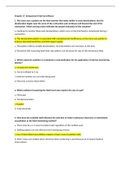
NURS 2209B OB Exam 2 Chapter 17: Intrapartum Fetal Surveillance 1. The nurse sees a pattern on the fetal monitor that looks similar to early decelerations, but the deceleration begins near the acme of the contraction and continues well beyond the end of the contraction. Which nursing action indicates the proper evaluation of this situation? a. Continue to monitor these early decelerations, which occur as the fetal head is compressed during a contraction. b. This deceleration pattern is associated with uteroplacental insufficiency, so the nurse acts quickly to improve placental blood flow and fetal oxygen supply. c. This pattern reflects variable decelerations. No interventions are necessary at this time. d. Document this reassuring fetal heart rate pattern, but decrease the rate of the intravenous fluid. 2. Which maternal condition is considered a contraindication for the application of internal monitoring devices? a. Unruptured membranes b. Cervix is dilated to 4 cm c. External monitors are currently being used d. Fetus has a known heart defect 3. Which method of assessing the fetal heart rate requires the use of a gel? a. Fetoscope b. Tocodynamometer c. Doppler d. Scalp electrode 4. How does the available staff influence the selection of either continuous electronic or intermittent auscultation as the fetal-monitoring method? a. There must be a 1:1 nurse-to-patient ratio regardless of the method used. b. Staffing patterns do not influence fetal monitoring choices. c. Use of intermittent auscultation requires a lower nurse-to-patient ratio. d. More nurses are needed when electronic fetal monitoring is used because of increased medical interventions 5. The nurse knows that proper placement of the tocotransducer for electronic fetal monitoring is a. Over the uterine fundus b. On the fetal scalp c. Inside uterus d. Over the mothers lower abdomen 6. Perinatal nurses are legally responsible for a. Correctly interpreting FHR patterns, initiating appropriate nursing interventions, and documenting the outcomes b. Greeting the patient on arrival, assessing her, and starting an IV line c. Applying the external fetal monitor and notifying the care provider d. Making sure the woman is comfortable 7. Which is the most appropriate method of intrapartum fetal monitoring when a woman has a history of hypertension during pregnancy? a. Continuous auscultation with a fetoscope b. Continuous electronic fetal monitoring c. Intermittent assessment with a Doppler transducer d. Intermittent electronic fetal monitoring for 15 minutes each hour 8. Why is continuous electronic fetal monitoring usually used when oxytocin is administered? a. The mother may become hypotensive. b. Uteroplacental exchange may be compromised c. Maternal fluid volume deficit may occur. d. Fetal chemoreceptors are stimulated 9. The nurse-midwife is concerned that a womans uterine activity is too intense and that her obesity is preventing accurate assessment of the actual intrauterine pressure. On the basis of this information, the nurse should obtain a(n) a. Tocotransducer b. Scalp electrode c. Intrauterine pressure catheter d. Doppler transducer 10. In which situation is a baseline fetal heart rate of 160 to 170 beats per minute be considered a normal finding? a. The fetus is at 28 weeks of gestation. b. The mother has been given an epidural block. c. The mother has a history of fast labors. d. The mother has mild preeclampsia but is not in labor. 11. When the deceleration pattern of the fetal heart rate mirrors the uterine contraction, which nursing action is indicated? a. Administer oxygen by nasal cannula. b. Reposition the woman. c. Apply a fetal scalp electrode. d. Record this reassuring pattern. 12. When the mothers membranes rupture during active labor, the fetal heart rate should be observed for the occurrence of which periodic pattern? a. Increase in baseline variability b. Nonperiodic accelerations c. Early decelerations d. Variable decelerations 13. The fetal heart rate baseline increases 15 beats per minute after vibroacoustic stimulation. The best interpretation of this is that the fetus is showing a. A reassuring response b. Progressive acidosis c. Parasympathetic stimulation d. A worsening hypoxia 14. When a non-reassuring pattern of the fetal heart rate is noted and the mother is lying on her left side, what nursing action is indicated? a. Lower the head of the bed. b. Place the mother in a Trendelenburg position. c. Change her position to the right side. d. Place a wedge under the left hip. 15. The nurse notes a pattern of late decelerations on the fetal monitor. The most appropriate action is to a. Continue observation of this reassuring pattern. b. Notify the physician or nurse-midwife. c. Give the woman oxygen by face mask. d. Place the woman in a Trendelenburg position. 16. Increasing the infusion rate of nonadditive intravenous fluids can increase fetal oxygenation primarily by a. Maintaining normal maternal temperature b. Preventing normal maternal hypoglycemia c. Increasing the oxygen-carrying capacity of the maternal blood d. Expanding maternal blood volume 17. Which nursing action is correct when initiating electronic fetal monitoring? a. Lubricate the tocotransducer with an ultrasound gel. b. Inform the patient that she should remain in the semi-Fowlers position. c. Securely apply the tocotransducer with a strap or belt. d. Determine the position of the fetus before attaching the electrode to the maternal abdomen. 18. Which statement correctly describes the nurses responsibility related to electronic monitoring? a. Teach the woman and her support person about the monitoring equipment and discuss any questions they have. b. Report abnormal findings to the physician before initiating corrective actions. c. Inform the support person that the nurse will be responsible for all comfort measures when the electronic equipment is in place. d. Document the frequency, duration, and intensity of contractions measured by the external device. 19. When using IA for FHR, nurses should be aware that a. They can be expected to cover only two or three patients when IA is the primary method of fetal assessment. b. The best course is to use the descriptive terms associated with EFM when documenting results. c. If the heartbeat cannot be found immediately, a shift must be made to electronic monitoring. d. Ultrasound can be used to find the fetal heartbeat and reassure the mother if initial difficulty was a factor. 20. The nurse caring for the woman in labor should understand that absent or minimal variability is classified as either abnormal or indeterminate. Which condition related to decreased variability is considered benign? a. A periodic fetal sleep state b. Extreme prematurity c. Fetal hypoxemia d. Pre-existing neurologic injury 21. A nurse might be called on to stimulate the fetal scalp a. As part of fetal scalp blood sampling b. In response to tocolysis c. In preparation for fetal oxygen saturation monitoring d. To elicit an acceleration in the FHR 22. An important part of fetal surveillance is assessment and documentation of the fetal heart rate during the first stage of labor. In the low-risk patient assessments for variability and periodic changes if using the fetal monitor should be done a. Every 15-30 minutes b. Every 5-15 minutes c. Every 30-60 minutes d. Only before and after ambulation MULTIPLE RESPONSE 1. Labor is very stressful for the fetus. It is important for the intrapartum nurse to be knowledgeable regarding the mechanisms that regulate the fetal heart rate and keep the brain well oxygenated. When evaluating the patients progress, the nurse knows that four of the five fetal factors that interact to regulate the heart rate are the a. Uterine activity b. Autonomic nervous system c. Baroreceptors d. Chemoreceptors e. Adrenal glands 2. The baseline fetal heart rate (FHR) is the average rate during a 10-minute segment. Changes in FHR are categorized as periodic or episodic. These patterns include both accelerations and decelerations. The labor nurse is evaluating the patients most recent 10-minute segment on the monitor strip and notes a late deceleration. This is likely to be caused by which physiologic alteration? Select all that apply. a. Spontaneous fetal movement b. Compression of the fetal head c. Placental abruption d. Cord around the baby’s neck e. Maternal supine hypotension 3. According to the NICHD Three-Tier System of Fetal Heart Rate Classification, Category III tracings include all FHR tracings not categorized as Category I or II. Which characteristics of the fetal heart belong in Category III? Select all that apply. a. Baseline rate of 110 to 160 bpm b. Tachycardia c. Absent baseline variability NOT accompanied by recurrent decelerations d. Variable decelerations with other characteristics such as shoulders or overshoots e. Absent baseline variability with recurrent variable decelerations f. Bradycardia
Document information
- Uploaded on
- June 6, 2022
- Number of pages
- 55
- Written in
- 2020/2021
- Type
- Exam (elaborations)
- Contains
- Questions & answers


