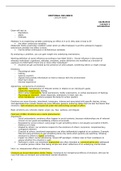
EMOTIONAL INFLUENCE
Lecture notes
10/28/2019
Lecture 1
Introduction
Exam will test to:
- Reproduce
- Apply
- Evaluate
Mediator is an explaining variable underlying an effect of A on B. Why does A lead to B?
Are often continuous variables.
Moderator holds a particular condition under which an effect between A and B is allowed to happen.
Determines whether the effect is there.
Can be either continuous or dichotomous variables.
By analyzing a condition, you can gain insight into underlying mechanisms.
Working definition of social influence according to Van Kleef (2011): “Social influence is the process
whereby individuals’ cognitions, attitudes, emotions, and/or behaviors are modified as a function of
exposure to (information from) one or more other individuals”.
Anytime we get confronted by the presence of other people, something within us might change.
Emotions:
- Physiological state
- Feeling
- Valence reaction
- Signals that provide information on how to interact with the environment
- Short term state
- Internal experience
Agreed key components of emotions:
- Appraisals: interpretation of relevant events in relation to an individual’s goals.
- Subjective experiences: feeling.
- (Non) verbal expressions: facial expressions, bodily expressions, or verbal expressions of feelings.
- Physiological reactions: sweat responses, alterations in heart rate, etc.
- Action tendencies: emotions prepare the body for action (useful).
Emotions are more discrete, intentional, temporary, intense and associated with specific desires, drives,
and appraisals than moods. Moods are more diffused, general, enduring states that are less functional than
emotions. Both emotions and moods fall under the overarching concept of affect.
Basic emotions are culturally stable: anger, joy, fear, sadness, and disgust.
Parkinson (1996): Emotions are a social phenomenon.
Arguments:
- Social antecedents: emotions often happen in social contexts, because relationships are of relevant
concern to our goals and wellbeing (chance at survival).
- Regulated by social context: using anger to get something done is not equally successful in North-
America or in Asia.
- Shaped by others: our emotions respond to the emotions of others; reciprocal, complementary,
contagious element.
- Directed at others: emotional expressions are often deliberately targeted at an audience. Example
little kid using emotions to get something done only works when parents are watching. Showing
emotions to others to signal something.
- Impact on others: social referencing. Visual cliff paradigm: children look at their caretakers to
assess whether the situation is safe.
Parkinson’s claim: our emotional expressions are often intended as communicative acts addressed
to another person rather than being simple and direct reflections of an underlying mental state.
Intra- vs. interpersonal effects of emotions.
Emotions as Social Information (EASI) Theory: framework for interpersonal effects of emotions. We look for
cues that help us interpret and understand (social) situations.
1
Lecture notes
10/28/2019
Lecture 1
Introduction
Exam will test to:
- Reproduce
- Apply
- Evaluate
Mediator is an explaining variable underlying an effect of A on B. Why does A lead to B?
Are often continuous variables.
Moderator holds a particular condition under which an effect between A and B is allowed to happen.
Determines whether the effect is there.
Can be either continuous or dichotomous variables.
By analyzing a condition, you can gain insight into underlying mechanisms.
Working definition of social influence according to Van Kleef (2011): “Social influence is the process
whereby individuals’ cognitions, attitudes, emotions, and/or behaviors are modified as a function of
exposure to (information from) one or more other individuals”.
Anytime we get confronted by the presence of other people, something within us might change.
Emotions:
- Physiological state
- Feeling
- Valence reaction
- Signals that provide information on how to interact with the environment
- Short term state
- Internal experience
Agreed key components of emotions:
- Appraisals: interpretation of relevant events in relation to an individual’s goals.
- Subjective experiences: feeling.
- (Non) verbal expressions: facial expressions, bodily expressions, or verbal expressions of feelings.
- Physiological reactions: sweat responses, alterations in heart rate, etc.
- Action tendencies: emotions prepare the body for action (useful).
Emotions are more discrete, intentional, temporary, intense and associated with specific desires, drives,
and appraisals than moods. Moods are more diffused, general, enduring states that are less functional than
emotions. Both emotions and moods fall under the overarching concept of affect.
Basic emotions are culturally stable: anger, joy, fear, sadness, and disgust.
Parkinson (1996): Emotions are a social phenomenon.
Arguments:
- Social antecedents: emotions often happen in social contexts, because relationships are of relevant
concern to our goals and wellbeing (chance at survival).
- Regulated by social context: using anger to get something done is not equally successful in North-
America or in Asia.
- Shaped by others: our emotions respond to the emotions of others; reciprocal, complementary,
contagious element.
- Directed at others: emotional expressions are often deliberately targeted at an audience. Example
little kid using emotions to get something done only works when parents are watching. Showing
emotions to others to signal something.
- Impact on others: social referencing. Visual cliff paradigm: children look at their caretakers to
assess whether the situation is safe.
Parkinson’s claim: our emotional expressions are often intended as communicative acts addressed
to another person rather than being simple and direct reflections of an underlying mental state.
Intra- vs. interpersonal effects of emotions.
Emotions as Social Information (EASI) Theory: framework for interpersonal effects of emotions. We look for
cues that help us interpret and understand (social) situations.
1