MIP2601
Assignment 02
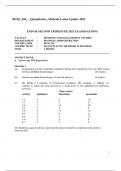
,MIP2601 ASSIGNMENT 2 MEMORANDUM TOTAL=100 marks
QUESTION 1 POLICY MATTERS
REFER TO CAPS INTERMEDIATE PHASE document Page 21-29
Content area: Space and shape (Geometry)
1.1 (a). Properties of 2-D shape
The focus is on the range of shapes and characteristics in all the grades. Grade 5 and
6, the drawing of shapes was introduced with the addition of heptagon and octagon.
Grade 6 learners are given activities to draw circles, patterns in circles using a pair of
compasses. The progression provides a fair amount of cognitive and conceptual
challenge at these grades.
(b) Properties of 3-D shape
All the grades learners work with real objects by identifying and knowing them using
drawing. The Grade 5 learners has to compare objects by describing and identifying the
number of flat and curved surfaces, and Grade 6, number of curved vertices and edges
as well as creating 3-D models using real life objects. Progression is just right for the
learners as they progress from one grade to the other.
(c) Symmetry
All grades learners need to recognize, draw and describe lines of symmetry in 2-D
shapes. The information is too much for grade 4 learners, the describing should start in
grade 5.
(d) Transformations
Learners in grade 4 build 2-D shapes, pack out 2-D shapes using tessellation patterns
as well as describing patterns in nature, modern everyday life and cultural heritage.
Grade 5 learners must make models of composite shapes, make tessellation by tracing
and moving 2-D shapes by rotation, reflecting and translation. Grade 6 must draw
enlargement and reductions of 2-D shapes to compare size and shape of triangles and
quadrilaterals and describe patterns. The information is too little as this topic should be
used as foundation for transformation geometry at the higher grades.
(e ) Viewing of objects
The information to be taught in grade 4 is too much as the topic on spatial sense is very
challenging even to learners at high school. Grade 4 learners have to match and identify
, different views of everyday objects. Grade 5 learners have to link the position of single
and collections of everyday objects as well as Grade 6 but the only difference is Grade
6 have to link the single or composite geometric objects.
(f) Position and movement
Learners in all the grades need to locate position of objects, draw or symbols on a grid
as well as locating positions of objects on a map by using alpha-numeric grid
references. Grade 5 and 6 learners will be able to follow directions to trace a path
between positions on a map. The progression is just right. (14)
1.2 (a). Length
The emphasis is on practically measuring of 2-D shapes and 3-D objects using
measuring instruments and the calculations of length/distance in all grades.Learners in
Grade 6 are using the same units of length they worked with in Grade 4 and 5.The only
difference in Grade 6 is decimals fractions have been introduced. The progression is
just right.
(b) Mass
The learners practically measure, identify measuring instruments and the units on
problem solving at all grade levels. The difference is decimal forms have been
introduced in Grade 6 and the levels are just right.
(c) Capacity / Volume
Learners in all grades can do practical measurements of 3-D objects. They can
identify the instruments used to measure mass and their units. They only difference in
Grade 6 is decimal forms has been introduced. Progression is just right.
(d) Time
Grade 4,5 and 6 learners read time and calendars, tell and write the time. Grade 4 is
limited to seconds, minutes and hours, while in grade 5 and 6 days, weeks, months, years
and decades are introduced. Calculations are also done in all grades and the history of
time. The information is just fine.
(e) Temperature
Grade 4 there is no information on temperature and learners need to learn about
temperature from this grade. The Grade 5 and 6 has been given an opportunity to do
practical measuring of temperature by estimating, measuring, comparing and ordering.
They also know the instrument to use for measuring temperature and do calculations.
(f) Perimeter, surface area and volume
The learners in grade 4 and 5 measure the perimeter, area and volume. The Grade 6
leaners examine the areas of regular, irregular shapes and shapes with curves. They
Assignment 02
,MIP2601 ASSIGNMENT 2 MEMORANDUM TOTAL=100 marks
QUESTION 1 POLICY MATTERS
REFER TO CAPS INTERMEDIATE PHASE document Page 21-29
Content area: Space and shape (Geometry)
1.1 (a). Properties of 2-D shape
The focus is on the range of shapes and characteristics in all the grades. Grade 5 and
6, the drawing of shapes was introduced with the addition of heptagon and octagon.
Grade 6 learners are given activities to draw circles, patterns in circles using a pair of
compasses. The progression provides a fair amount of cognitive and conceptual
challenge at these grades.
(b) Properties of 3-D shape
All the grades learners work with real objects by identifying and knowing them using
drawing. The Grade 5 learners has to compare objects by describing and identifying the
number of flat and curved surfaces, and Grade 6, number of curved vertices and edges
as well as creating 3-D models using real life objects. Progression is just right for the
learners as they progress from one grade to the other.
(c) Symmetry
All grades learners need to recognize, draw and describe lines of symmetry in 2-D
shapes. The information is too much for grade 4 learners, the describing should start in
grade 5.
(d) Transformations
Learners in grade 4 build 2-D shapes, pack out 2-D shapes using tessellation patterns
as well as describing patterns in nature, modern everyday life and cultural heritage.
Grade 5 learners must make models of composite shapes, make tessellation by tracing
and moving 2-D shapes by rotation, reflecting and translation. Grade 6 must draw
enlargement and reductions of 2-D shapes to compare size and shape of triangles and
quadrilaterals and describe patterns. The information is too little as this topic should be
used as foundation for transformation geometry at the higher grades.
(e ) Viewing of objects
The information to be taught in grade 4 is too much as the topic on spatial sense is very
challenging even to learners at high school. Grade 4 learners have to match and identify
, different views of everyday objects. Grade 5 learners have to link the position of single
and collections of everyday objects as well as Grade 6 but the only difference is Grade
6 have to link the single or composite geometric objects.
(f) Position and movement
Learners in all the grades need to locate position of objects, draw or symbols on a grid
as well as locating positions of objects on a map by using alpha-numeric grid
references. Grade 5 and 6 learners will be able to follow directions to trace a path
between positions on a map. The progression is just right. (14)
1.2 (a). Length
The emphasis is on practically measuring of 2-D shapes and 3-D objects using
measuring instruments and the calculations of length/distance in all grades.Learners in
Grade 6 are using the same units of length they worked with in Grade 4 and 5.The only
difference in Grade 6 is decimals fractions have been introduced. The progression is
just right.
(b) Mass
The learners practically measure, identify measuring instruments and the units on
problem solving at all grade levels. The difference is decimal forms have been
introduced in Grade 6 and the levels are just right.
(c) Capacity / Volume
Learners in all grades can do practical measurements of 3-D objects. They can
identify the instruments used to measure mass and their units. They only difference in
Grade 6 is decimal forms has been introduced. Progression is just right.
(d) Time
Grade 4,5 and 6 learners read time and calendars, tell and write the time. Grade 4 is
limited to seconds, minutes and hours, while in grade 5 and 6 days, weeks, months, years
and decades are introduced. Calculations are also done in all grades and the history of
time. The information is just fine.
(e) Temperature
Grade 4 there is no information on temperature and learners need to learn about
temperature from this grade. The Grade 5 and 6 has been given an opportunity to do
practical measuring of temperature by estimating, measuring, comparing and ordering.
They also know the instrument to use for measuring temperature and do calculations.
(f) Perimeter, surface area and volume
The learners in grade 4 and 5 measure the perimeter, area and volume. The Grade 6
leaners examine the areas of regular, irregular shapes and shapes with curves. They