
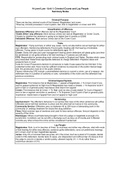
A-Level Law - Unit 1: Criminal Courts and Lay People
Summary Notes
Criminal Process-
There are two key criminal courts of first interest- Magistrates’ and crown
Three key criminal processes in court system- bail, trial in magistrates’ or crown and CPS
Classification of Offences-
Summary Offences: Minor offences start at the Magistrates’ Court
Triable either- way offences: More serious crimes can start at Magistrates’ or Crown Courts.
Chosen by whether the sentence is going to be higher than 6 months or £5000
Indictable Offences: Most serious crimes start at the Crown Court
Trials-
Magistrates’: Trying summary or either way cases. Carry out plea before venue hearings for either
way offenders. Sentencing defendants if found guilty. Dealing with first hearing of indictable
offences. Trying cases in youth courts for defendants aged 10-17
Crown: Starts with plea and case management hearing where defendant will plead guilty (and then
be sentenced) or not guilty (where a full trial involving a 12 person jury will start).
CPS: Responsible for prosecuting most criminal cases in England and Wales. Decides which cases
are prosecuted. Determines appropriate defences to charge defendant. Prepares cases and
presents them in court.
Code for Crown Prosecutors decision to prosecute is made if case pases the two fold test 1) the
evidential burden test- there must be sufficient evidence to prosecute 2) the public interest stage
test- the prosecution must be in the public interest.
Factors influencing CPS include: a premeditated decision to commit a crime, use of a weapon, the
defendant was in a position of authority or care, vulnerability of the victim and the defendant has
previous convictions.
Criminal Appeal System-
Magistrates: First instance trial at Magistrates -> appeal at Magistrates -> To Crown Court if you
want to appeal sentence/ to High Court if Magistrates has made a mistake -> To Supreme Court if
point of law or of general public importance need leave from appeal
Crown: First instance trial at Crown -> To High court by way of case stated/ To Court of Appeal if
error in law or against conviction or sentence -> To Supreme Court if point of law or general public
importance- needs leave of appeal from court of appeal or high court
Sentencing-
Imprisonment: The offender's behaviour is so serious that none of the other sentences will suffice.
Offenders serve half their sentence in prison and the other half on licence in the community.
Community Service: Offenders carry out between 40 to 300 hours of demanding work in the
community or undergo treatment for issues like drug addiction.
Fines: Most common type of sentence and used for less serious offences. Amount depends on the
severity of the crime.
Discharges: Where court feels being brought in front of a judge or magistrate is enough of a
punishment. Conditions can be set with a discharge such as stay out of trouble,and if offender
commits any other crimes first crime will be considered if sentenced.
Lay People-
Magistrates: Role: to sit in benches of three, try summary and either way offences, deal with mode
of trial hearing for either way offences, sentence guilty defendants, carry out preliminary hearings,
sit in crown court to hear magistrates appeals.
Juries: Only 2% of criminal trials use juries, sit in the crown court as a panel of 12 people, decide
verdict of the defendant, decide facts of cases, are independent and without fear of pressure from
the judge to convict or decide a verdict quickly, allowed majority (11-1, 10-2) rather than a
unanimous decision (12-0)
Summary Notes
Criminal Process-
There are two key criminal courts of first interest- Magistrates’ and crown
Three key criminal processes in court system- bail, trial in magistrates’ or crown and CPS
Classification of Offences-
Summary Offences: Minor offences start at the Magistrates’ Court
Triable either- way offences: More serious crimes can start at Magistrates’ or Crown Courts.
Chosen by whether the sentence is going to be higher than 6 months or £5000
Indictable Offences: Most serious crimes start at the Crown Court
Trials-
Magistrates’: Trying summary or either way cases. Carry out plea before venue hearings for either
way offenders. Sentencing defendants if found guilty. Dealing with first hearing of indictable
offences. Trying cases in youth courts for defendants aged 10-17
Crown: Starts with plea and case management hearing where defendant will plead guilty (and then
be sentenced) or not guilty (where a full trial involving a 12 person jury will start).
CPS: Responsible for prosecuting most criminal cases in England and Wales. Decides which cases
are prosecuted. Determines appropriate defences to charge defendant. Prepares cases and
presents them in court.
Code for Crown Prosecutors decision to prosecute is made if case pases the two fold test 1) the
evidential burden test- there must be sufficient evidence to prosecute 2) the public interest stage
test- the prosecution must be in the public interest.
Factors influencing CPS include: a premeditated decision to commit a crime, use of a weapon, the
defendant was in a position of authority or care, vulnerability of the victim and the defendant has
previous convictions.
Criminal Appeal System-
Magistrates: First instance trial at Magistrates -> appeal at Magistrates -> To Crown Court if you
want to appeal sentence/ to High Court if Magistrates has made a mistake -> To Supreme Court if
point of law or of general public importance need leave from appeal
Crown: First instance trial at Crown -> To High court by way of case stated/ To Court of Appeal if
error in law or against conviction or sentence -> To Supreme Court if point of law or general public
importance- needs leave of appeal from court of appeal or high court
Sentencing-
Imprisonment: The offender's behaviour is so serious that none of the other sentences will suffice.
Offenders serve half their sentence in prison and the other half on licence in the community.
Community Service: Offenders carry out between 40 to 300 hours of demanding work in the
community or undergo treatment for issues like drug addiction.
Fines: Most common type of sentence and used for less serious offences. Amount depends on the
severity of the crime.
Discharges: Where court feels being brought in front of a judge or magistrate is enough of a
punishment. Conditions can be set with a discharge such as stay out of trouble,and if offender
commits any other crimes first crime will be considered if sentenced.
Lay People-
Magistrates: Role: to sit in benches of three, try summary and either way offences, deal with mode
of trial hearing for either way offences, sentence guilty defendants, carry out preliminary hearings,
sit in crown court to hear magistrates appeals.
Juries: Only 2% of criminal trials use juries, sit in the crown court as a panel of 12 people, decide
verdict of the defendant, decide facts of cases, are independent and without fear of pressure from
the judge to convict or decide a verdict quickly, allowed majority (11-1, 10-2) rather than a
unanimous decision (12-0)


