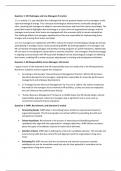
The Coding, Capacity and Duration of Memory
Coding – Baddeley (1966) Capacity – Jacobs (1966) Digit Span Duration STM – Peterson + Peterson (1959)
Acoustic + Semantic Consonant syllables
Procedure - Researcher reads
Procedure: 4 digits until participants can’t Procedure - students were given a
Acoustically similar (cat, recall it consonant syllable (e.g. YCG) to recall + a 3
cab, can) or dissimilar (pit, o Final number = digit span digit number to count back from
few, cow) Findings – 9 no. + 5 words o Retention interval varied
Semantically similar (great, could be repeated in correct Findings – after 3 secs – average recall was
large, big) or dissimilar order 80% approx.. STM duration without rehearsal
(good, huge, hot) = 18 secs or over
Findings Duration LTM – Bahrick et al (1975) Yearbook
Miller (1956) Chunking + Memory
Immediate recall was worse Strengths Weaknesses Photos
Span
with acoustically
Research support similar Studies don’t use everyday /meaningful information
Procedure – American participants age 17-74
words, Procedure
o Baddeley (1966) found we tend to mix up words – observed daily o Used onlyodigits/letters (Jacobs) or meaningful
Recognition test – 50 pics form high
o that
STM sound
= acoustic
similar when using STMspractise
(STMeg
is things that come in
acoustic) consonant syllables (Petersons)
school yearbook
Recallbut mix
after 20up those
mins was 7 (dayswhen
th
with similar meanings of the week, music
using May o not
Freeberecall
a valid model
test = doesn’t
– participant listed
LTMs (LTM is
worse with semanticallysemantic) scale) represent real life
names of graduating class
Supports MSM view that these
similar words 2 memory
Findings – span of STM = 7 There is evidence suggesting there is more than one
Findings – recall was mostly accurate
stores
o LTM = semantic are separate + independent
items STM store o Recognition test – 90% accurate after
Research is often done through lab studies o Chunking makes it easier o KF had amnesia (Shallice and Washington 1970),
Acoustic osimilarity of the words 15 yrs, 70% after 48 yrs
Much evidence comes from lab studies(grouping= reliablethings
and into STM for recall was poor but was better when
confuse thecanSTMbewhen it’s trying o Free recall test – 60% after 15 yrs, 30%
replicated – more valid meaningful units) reading. Other studies confirm there is another STM
to encode information (+ vice after 48 yrs
for noises
versa for LTM) Wrong to claim there is only one STM store
processing different types of information
Strength – Identified difference of 2 Strength – Jacobs’ study can be replicated Strength – Bahrick studied meaningful memories - appliable
memory stores
Lacked adequate controls (confounding Meaningless pictures were remembered, recall rates were
STM = mostly acoustic + LTM = variables – being distracted lower (Sheperd 1967)
mostly semantic o Digit span could be affected as o Reflects a more realistic estimate of the duration of
o Led to multi-store memory participants could be distracted LTM
model during testing
Weakness – the Petersons’ study was artificial
Weakness – used artificial stimuli Weakness – Miller may have overestimated STM
capacity Sometimes we recall meaningless things – not completely
Words had no personal meaning – irrelevant
can’t be generalised to daily life Cowan (2001) concluded STM capacity is o Recalling consonant syllables doesn’t reflect
only 4 chunks
, Types of Long-Term Memory
LTM Store 1 : Episodic Buffer Strengths
Stores events (episodes) from our lives = like a Case study evidence of different types of LTM
diary of daily personal experiences o Clinical studies of amnesia (Clive Wearing) showed
Episodic memories are complex = they are time- that patient had difficulty recalling events that had
stamped (you remember what happens + how they happened to them in the past (episodic memory)
relate in time o Semantic memory were mostly unaffected +
o Involves several elements – people, places, procedural memory was intact (Clive still played
objects, behaviours are woven into one memory piano)
There are different memory stores in LTM as
o You have to make a conscious effort to recall
one was damaged whilst other were intact
Practical use => helps people with memory problems
o Old age memory loss is specific to episodic memory
LTM Store 2 : Semantic Memory (hard to recall recent memories but older ones are
intact)
Stores our knowledge of the world= it’s like an
encyclopaedia/dictionary
Semantic memories are not time-stamped = less
personal than episodic memories and are more about Weaknesses
facts/knowledge we all share
Clinical studies lack control
o Researchers don’t know anything about the person’s
memory before brain damage
Clinical studies are limited in what they tell us
about different LTM types
There are conflicted findings about LTM types and brain
areas
o Buckner and Petersen (1996) reviewed findings
LTM Store 3 : Procedural Memory and concluded that semantic memory is in the left
Stores memories for actions and skills = memories prefrontal cortex and episodic is in the right
of how we do things Other studies (Tulving et al 1994) show
Recall occurs without awareness or effort = these semantic memory is in the right and left for
skills/actions become automatic with practise (E.g. episodic memory
changing gears in a car) Challenges neurophysiological evidence
to support memory types due to poor
agreement on when these types are
Coding – Baddeley (1966) Capacity – Jacobs (1966) Digit Span Duration STM – Peterson + Peterson (1959)
Acoustic + Semantic Consonant syllables
Procedure - Researcher reads
Procedure: 4 digits until participants can’t Procedure - students were given a
Acoustically similar (cat, recall it consonant syllable (e.g. YCG) to recall + a 3
cab, can) or dissimilar (pit, o Final number = digit span digit number to count back from
few, cow) Findings – 9 no. + 5 words o Retention interval varied
Semantically similar (great, could be repeated in correct Findings – after 3 secs – average recall was
large, big) or dissimilar order 80% approx.. STM duration without rehearsal
(good, huge, hot) = 18 secs or over
Findings Duration LTM – Bahrick et al (1975) Yearbook
Miller (1956) Chunking + Memory
Immediate recall was worse Strengths Weaknesses Photos
Span
with acoustically
Research support similar Studies don’t use everyday /meaningful information
Procedure – American participants age 17-74
words, Procedure
o Baddeley (1966) found we tend to mix up words – observed daily o Used onlyodigits/letters (Jacobs) or meaningful
Recognition test – 50 pics form high
o that
STM sound
= acoustic
similar when using STMspractise
(STMeg
is things that come in
acoustic) consonant syllables (Petersons)
school yearbook
Recallbut mix
after 20up those
mins was 7 (dayswhen
th
with similar meanings of the week, music
using May o not
Freeberecall
a valid model
test = doesn’t
– participant listed
LTMs (LTM is
worse with semanticallysemantic) scale) represent real life
names of graduating class
Supports MSM view that these
similar words 2 memory
Findings – span of STM = 7 There is evidence suggesting there is more than one
Findings – recall was mostly accurate
stores
o LTM = semantic are separate + independent
items STM store o Recognition test – 90% accurate after
Research is often done through lab studies o Chunking makes it easier o KF had amnesia (Shallice and Washington 1970),
Acoustic osimilarity of the words 15 yrs, 70% after 48 yrs
Much evidence comes from lab studies(grouping= reliablethings
and into STM for recall was poor but was better when
confuse thecanSTMbewhen it’s trying o Free recall test – 60% after 15 yrs, 30%
replicated – more valid meaningful units) reading. Other studies confirm there is another STM
to encode information (+ vice after 48 yrs
for noises
versa for LTM) Wrong to claim there is only one STM store
processing different types of information
Strength – Identified difference of 2 Strength – Jacobs’ study can be replicated Strength – Bahrick studied meaningful memories - appliable
memory stores
Lacked adequate controls (confounding Meaningless pictures were remembered, recall rates were
STM = mostly acoustic + LTM = variables – being distracted lower (Sheperd 1967)
mostly semantic o Digit span could be affected as o Reflects a more realistic estimate of the duration of
o Led to multi-store memory participants could be distracted LTM
model during testing
Weakness – the Petersons’ study was artificial
Weakness – used artificial stimuli Weakness – Miller may have overestimated STM
capacity Sometimes we recall meaningless things – not completely
Words had no personal meaning – irrelevant
can’t be generalised to daily life Cowan (2001) concluded STM capacity is o Recalling consonant syllables doesn’t reflect
only 4 chunks
, Types of Long-Term Memory
LTM Store 1 : Episodic Buffer Strengths
Stores events (episodes) from our lives = like a Case study evidence of different types of LTM
diary of daily personal experiences o Clinical studies of amnesia (Clive Wearing) showed
Episodic memories are complex = they are time- that patient had difficulty recalling events that had
stamped (you remember what happens + how they happened to them in the past (episodic memory)
relate in time o Semantic memory were mostly unaffected +
o Involves several elements – people, places, procedural memory was intact (Clive still played
objects, behaviours are woven into one memory piano)
There are different memory stores in LTM as
o You have to make a conscious effort to recall
one was damaged whilst other were intact
Practical use => helps people with memory problems
o Old age memory loss is specific to episodic memory
LTM Store 2 : Semantic Memory (hard to recall recent memories but older ones are
intact)
Stores our knowledge of the world= it’s like an
encyclopaedia/dictionary
Semantic memories are not time-stamped = less
personal than episodic memories and are more about Weaknesses
facts/knowledge we all share
Clinical studies lack control
o Researchers don’t know anything about the person’s
memory before brain damage
Clinical studies are limited in what they tell us
about different LTM types
There are conflicted findings about LTM types and brain
areas
o Buckner and Petersen (1996) reviewed findings
LTM Store 3 : Procedural Memory and concluded that semantic memory is in the left
Stores memories for actions and skills = memories prefrontal cortex and episodic is in the right
of how we do things Other studies (Tulving et al 1994) show
Recall occurs without awareness or effort = these semantic memory is in the right and left for
skills/actions become automatic with practise (E.g. episodic memory
changing gears in a car) Challenges neurophysiological evidence
to support memory types due to poor
agreement on when these types are