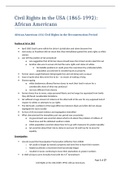
Civil Rights in the USA (1865-1992):
African Americans
African American (AA) Civil Rights in the Reconstruction Period
Position of AA in 1865
April 1865 South came within the Union’s jurisdiction and slaves became free
new status as freedmen did not mean that they immediately gained the same rights as white
owners
war left the position of AA unresolved
o one suggestion that all former slaves should leave the US but Lincoln ruled this out
o Another idea was to ensure AA had the same rights and status of whites
formidable problems in south given the resentment by a defeated white
population accustomed to considering AA as property
Former slaves caught between being legally free and not being seen as equal
Issue of quite what they were free to do – no means of making a living
Sharecropping
o white landowners allowed former slaves to work their land in return for a
considerable share of what was produced
o not very different from slavery
former slaves free to move, enjoy personal liberty and no longer be separated from family
they still faced considerable limitations
AA suffered a huge amount of violence in the aftermath of the war for any supposed lack of
respect to whites or attempts to use rights
The Old South, confident of the legal difference between black and white did not always
segregate the races socially
As fear of AA increased violence and segregation intensified
What characterised the immediate post war period was uncertainty
o Us government was uncertain about what to do about the problem of millions of
freed slave and the defeated southern rebels
o white population uncertain about how far to go with measures for greater equality
o AA uncertain about their role & status in post war US and how far to press for
equality
Emancipation
Lincoln issued the Emancipation Proclamation (effective from 18630
o AA could no longer by owned a property and were free to leave their masters
o helped accelerate a movement that had already begun
o resulted in slaves continuing to leave their plantations in greater numbers
In 1865 all slaves were formally freed with the 13 th Amendment
Page 1 of 37
Civil Rights in the USA (1865-1992): African Americans
, o turning point in AA progress towards securing a better life
o established freedom law and provided basic human rights
AA had right to
o legalise plantation marriages, worship, property, education and travel
unleashing 3.5 million former slaves into society made the nature of emancipation &
question of CR a major issue
the uncertainties that lay were compounded with Lincoln’s assassination
Situation in south in 1865
period following civil war crucial in determining future prospects for AA
short term gains in this period largely came as a result of the ruling of the Republican
government
o some were lost
most lasting gains achieved were a result of the efforts of AA
At end of civil ware southern states devastated
o infrastructure destroyed and low& order not restored for months/years
from time of Emancipation proclamation it was clear the military victory for the north would
involve them forcibly imposing the abolition of slavery on the defeated south
slavery was a major part of southern society so its removal meant significant changes to the
way of life
CHANGES IN THE LEGAL AND POLITICAL STATUS OF AA AFTER 1865
Prospects for AA CR in 1865
What rights would be given apart from the abolition of slavery?
o Right to vote? equal under law? Equal employment opportunities?
o Integration into south on equal basis?
o Rights implied by Emancipation proclamation & 13 th Amendment materialise?
What means would these rights be granted?
o How would north control south & try to reconstruct south society w/out slavery?
o Would federal system return & states regain independence on domestic affairs?
o would congress or president determine the settlement
Before congress recommenced its duties in Nov 1865 development of AA CR looked limited
o attitude of Pres Johnson
congress would win in subsequent struggle with Johnson
Reconstruction - Amendments and laws passed to aid CR
14th Amendment 1868
o gave all freed blacks their US citizenship & equal protection under law
th
15 Amendment 1870
o forbade the denial of the vote to any man on basis of race
Civil rights Act 1866
o excluded NA but asserted all other races i.e. AA were full US citizens – legal equality
Military construction act
Page 2 of 37
Civil Rights in the USA (1865-1992): African Americans
, o divided south into military districts
constitutional conventions would set up new state governments
In theory AA possessed civil rights needed to make progress
o freedom of movement, employment, right to vote & equality under law
Who was Responsible for the Reconstruction Policy?
initiative taken by radical wing of Republican party
Congressmen e.g. Thaddeus Stevens & Charles Summer acknowledged AA played vital part
in economy
o role must be now be accepted
o felt Reconstruction must be controlled by north
o feared southerners would control reconstruction if Johnson’s policy followed
o detriment to AA welfare
President Johnson’s policy differed from radical republicans
o wanted to readmit southern states to union
o return to pre-war relations with haste
Radical republicans had a powerful principle on their side
o all had the right to live out the ‘American dream’
o promoted their belief that this should apply to former slaves
o everyone should be given right to vote, own land, be educated & legal equality
Johnson issued thousands of pardons to southern farmers
o able to reassert authority
Johnson insisted on ratifying the abolition of slavery but said nothing about AA CR and
allowed the development of the black codes
Why did Johnson’s policy of Reconstruction fail?
northern politicians saw political advantage in smashing power of southern landowners who
supported the democrats
Moderate republicans not as passionately in favour of AA CR but were happy to go along
with it if it brought political advantage
o enfranchised blacks vote republican
Johnson could not prevent the passing of any constitutional amendments he exercised his
presidential veto on all major congressional legislation
opponents so strong that the vetoes were overridden w/ 2/3 majorities in congress
Congress’ attempts to impeach Johnson failed but weakened him politically – quiet in final
year of presidency
Reconstruction could continue in the way radical republicans wished
ADJUSTING TO FREEDOM
How far did AA gain political rights?
over 700,000 AA enrolled to vote
o major role in electing members to conventions set up by congress
By spring 1868 these organisation had established CR for AA on equal terms with whites
Page 3 of 37
Civil Rights in the USA (1865-1992): African Americans
, Black representatives in position of possessing real political power, sharing it with pro
northern scallywags and carpetbaggers
By end of 1860 AA gained from Republican policies
However real political power was limited as they were not elected in proportion to their
numbers#
Were civil rights more apparent in the north?
majority of AA still in south despite some movement
less than 5% of northern population up to 1877
right to vote & equality of opportunity sometimes remained theoretical
arguably the importance was the acknowledgement of human equality
some had their lives transformed from freedoms and this served as an inspiration for
southern AA
northern AA could take advantage of opportunities in politics
o 22 blacks elected to congress in 1870s
o 20 elected to house of representatives
o 2 to senate
Most black politicians lacked support and failed to increase CR e.g. Blanche Bruce
Only Frederick Douglas had a substantial national reputation but he never had the impact
after 1865 that he had before the civil war
arguably, black leader in important political positions an essential precondition of sustained
AA CR progress
The Freedman’s Bureau
apart from voting most AA had no part in political process
progress of a few freedmen in government contrasted w/ condition of the rest
o many free but homeless & unemployed
set up by the federal government in March 1865 to support freed slaves in the short term to
provide a basis for long term security
supported the work of black self-help groups in providing educated and financial support by
philanthropic northern organisations
performed surprisingly well in difficult circumstances
Its head General Oliver Howard proved a forceful leader
train lawyers, scientists & teachers (indirectly future black leaders)
educational advances only for a minority of AA
by 1890 65% of AA school aged children unable to write (15% of white)
lack of equality in educational opportunity
Did AA lack land?
land frequently lacking as capital was in short supply and only white merchants and planters
possessed the necessary outside links to obtain it
many AA became wage earning labourers
o industrial development slow compared to north
o AA lacked experience and education for anything more ambitious
Page 4 of 37
Civil Rights in the USA (1865-1992): African Americans
African Americans
African American (AA) Civil Rights in the Reconstruction Period
Position of AA in 1865
April 1865 South came within the Union’s jurisdiction and slaves became free
new status as freedmen did not mean that they immediately gained the same rights as white
owners
war left the position of AA unresolved
o one suggestion that all former slaves should leave the US but Lincoln ruled this out
o Another idea was to ensure AA had the same rights and status of whites
formidable problems in south given the resentment by a defeated white
population accustomed to considering AA as property
Former slaves caught between being legally free and not being seen as equal
Issue of quite what they were free to do – no means of making a living
Sharecropping
o white landowners allowed former slaves to work their land in return for a
considerable share of what was produced
o not very different from slavery
former slaves free to move, enjoy personal liberty and no longer be separated from family
they still faced considerable limitations
AA suffered a huge amount of violence in the aftermath of the war for any supposed lack of
respect to whites or attempts to use rights
The Old South, confident of the legal difference between black and white did not always
segregate the races socially
As fear of AA increased violence and segregation intensified
What characterised the immediate post war period was uncertainty
o Us government was uncertain about what to do about the problem of millions of
freed slave and the defeated southern rebels
o white population uncertain about how far to go with measures for greater equality
o AA uncertain about their role & status in post war US and how far to press for
equality
Emancipation
Lincoln issued the Emancipation Proclamation (effective from 18630
o AA could no longer by owned a property and were free to leave their masters
o helped accelerate a movement that had already begun
o resulted in slaves continuing to leave their plantations in greater numbers
In 1865 all slaves were formally freed with the 13 th Amendment
Page 1 of 37
Civil Rights in the USA (1865-1992): African Americans
, o turning point in AA progress towards securing a better life
o established freedom law and provided basic human rights
AA had right to
o legalise plantation marriages, worship, property, education and travel
unleashing 3.5 million former slaves into society made the nature of emancipation &
question of CR a major issue
the uncertainties that lay were compounded with Lincoln’s assassination
Situation in south in 1865
period following civil war crucial in determining future prospects for AA
short term gains in this period largely came as a result of the ruling of the Republican
government
o some were lost
most lasting gains achieved were a result of the efforts of AA
At end of civil ware southern states devastated
o infrastructure destroyed and low& order not restored for months/years
from time of Emancipation proclamation it was clear the military victory for the north would
involve them forcibly imposing the abolition of slavery on the defeated south
slavery was a major part of southern society so its removal meant significant changes to the
way of life
CHANGES IN THE LEGAL AND POLITICAL STATUS OF AA AFTER 1865
Prospects for AA CR in 1865
What rights would be given apart from the abolition of slavery?
o Right to vote? equal under law? Equal employment opportunities?
o Integration into south on equal basis?
o Rights implied by Emancipation proclamation & 13 th Amendment materialise?
What means would these rights be granted?
o How would north control south & try to reconstruct south society w/out slavery?
o Would federal system return & states regain independence on domestic affairs?
o would congress or president determine the settlement
Before congress recommenced its duties in Nov 1865 development of AA CR looked limited
o attitude of Pres Johnson
congress would win in subsequent struggle with Johnson
Reconstruction - Amendments and laws passed to aid CR
14th Amendment 1868
o gave all freed blacks their US citizenship & equal protection under law
th
15 Amendment 1870
o forbade the denial of the vote to any man on basis of race
Civil rights Act 1866
o excluded NA but asserted all other races i.e. AA were full US citizens – legal equality
Military construction act
Page 2 of 37
Civil Rights in the USA (1865-1992): African Americans
, o divided south into military districts
constitutional conventions would set up new state governments
In theory AA possessed civil rights needed to make progress
o freedom of movement, employment, right to vote & equality under law
Who was Responsible for the Reconstruction Policy?
initiative taken by radical wing of Republican party
Congressmen e.g. Thaddeus Stevens & Charles Summer acknowledged AA played vital part
in economy
o role must be now be accepted
o felt Reconstruction must be controlled by north
o feared southerners would control reconstruction if Johnson’s policy followed
o detriment to AA welfare
President Johnson’s policy differed from radical republicans
o wanted to readmit southern states to union
o return to pre-war relations with haste
Radical republicans had a powerful principle on their side
o all had the right to live out the ‘American dream’
o promoted their belief that this should apply to former slaves
o everyone should be given right to vote, own land, be educated & legal equality
Johnson issued thousands of pardons to southern farmers
o able to reassert authority
Johnson insisted on ratifying the abolition of slavery but said nothing about AA CR and
allowed the development of the black codes
Why did Johnson’s policy of Reconstruction fail?
northern politicians saw political advantage in smashing power of southern landowners who
supported the democrats
Moderate republicans not as passionately in favour of AA CR but were happy to go along
with it if it brought political advantage
o enfranchised blacks vote republican
Johnson could not prevent the passing of any constitutional amendments he exercised his
presidential veto on all major congressional legislation
opponents so strong that the vetoes were overridden w/ 2/3 majorities in congress
Congress’ attempts to impeach Johnson failed but weakened him politically – quiet in final
year of presidency
Reconstruction could continue in the way radical republicans wished
ADJUSTING TO FREEDOM
How far did AA gain political rights?
over 700,000 AA enrolled to vote
o major role in electing members to conventions set up by congress
By spring 1868 these organisation had established CR for AA on equal terms with whites
Page 3 of 37
Civil Rights in the USA (1865-1992): African Americans
, Black representatives in position of possessing real political power, sharing it with pro
northern scallywags and carpetbaggers
By end of 1860 AA gained from Republican policies
However real political power was limited as they were not elected in proportion to their
numbers#
Were civil rights more apparent in the north?
majority of AA still in south despite some movement
less than 5% of northern population up to 1877
right to vote & equality of opportunity sometimes remained theoretical
arguably the importance was the acknowledgement of human equality
some had their lives transformed from freedoms and this served as an inspiration for
southern AA
northern AA could take advantage of opportunities in politics
o 22 blacks elected to congress in 1870s
o 20 elected to house of representatives
o 2 to senate
Most black politicians lacked support and failed to increase CR e.g. Blanche Bruce
Only Frederick Douglas had a substantial national reputation but he never had the impact
after 1865 that he had before the civil war
arguably, black leader in important political positions an essential precondition of sustained
AA CR progress
The Freedman’s Bureau
apart from voting most AA had no part in political process
progress of a few freedmen in government contrasted w/ condition of the rest
o many free but homeless & unemployed
set up by the federal government in March 1865 to support freed slaves in the short term to
provide a basis for long term security
supported the work of black self-help groups in providing educated and financial support by
philanthropic northern organisations
performed surprisingly well in difficult circumstances
Its head General Oliver Howard proved a forceful leader
train lawyers, scientists & teachers (indirectly future black leaders)
educational advances only for a minority of AA
by 1890 65% of AA school aged children unable to write (15% of white)
lack of equality in educational opportunity
Did AA lack land?
land frequently lacking as capital was in short supply and only white merchants and planters
possessed the necessary outside links to obtain it
many AA became wage earning labourers
o industrial development slow compared to north
o AA lacked experience and education for anything more ambitious
Page 4 of 37
Civil Rights in the USA (1865-1992): African Americans