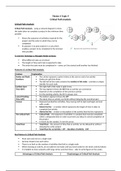
Caregiver-Infant Interactions
b
Strengths Weaknesses
• Filmed observation • Difficult to observe babies
o Babies don’t know they are being recorded => natural behaviour o Babies aren’t very co-ordinated => hard to interpret the meaning of
• Reliable + valid movements
▪ Can’t be certain that any particular interactions are meaningful
• Counterpoint – evidence from other sources =>
• Difficult to infer developmental importance
o Isabella et al (1989) - good levels of reciprocity/synchrony are
associated with good quality attachments
o Feldman (2012) – synchrony + reciprocity describe behaviours that
▪ Early interactions are likely to have importance for development occur at the same time
o Can be reliably observed but doesn’t tell us the purpose
▪ Cannot be certain that reciprocity/synchrony are important in
development
, Schaffer’s stages of attachment
Stage Age Characteristics
Asocial 0-6 weeks Short-lived, attention seeking behaviour (e.g. crying/smiling) is not directed at anyone –
suggests attachments can be made with anyone
Indiscriminate 6 weeks- 7 Child seeks attention from anyone but familiar faces elicit a greater response
Attachments months
Specific Attachments 7 months Child is primarily attached to the main caregiver – if they are separated the child becomes
onwards distressed + wary of strangers
Multiple Attachments 10/11 months Infant becomes more independent and forms several attachments
Schaffer + Emerson (1964) :
Procedure : researchers visited 60 babies from Glasgow every month for a year and again at 18 months
- Separation anxiety was measured by asking mothers about the child’s behaviour during everyday separations (e.g. leaving the room)
- Stranger anxiety was measured by asking mothers questions about their children’s anxiety responses to unfamiliar adults
Findings + conclusion : babies developed attachments through stages (asocial -> multiple attachments)
- Specific attachments tended to be with the person most interactive + sensitive to the babies’ signals and facial expressions (e.g. reciprocity)
Strengths Weaknesses
• External validity • Mother bias
o Observations were made from ordinary activities and then reported o Mothers may have been biased in what they reported (e.g.
▪ Natural behaviour was recorded - reliable misremembering/ not noticing signals)
• Real world application ▪ Behaviour may not have been accurately recorded
o E.g. day cares – in early stages (like asocial/indiscriminate) babies
can be comforted by any adult • Poor evidence for the Asocial stage
o If a child enrolls during specific attachments, unfamiliar adults could o Young babies may have poor co-ordination/ fairly immobile
bring distress o Difficult to accurately report signs of anxiety and attachments
▪ These stages can help parents making beneficial day care ▪ Babies could be social but due to flawed methods they appear
decisions asocial
b
Strengths Weaknesses
• Filmed observation • Difficult to observe babies
o Babies don’t know they are being recorded => natural behaviour o Babies aren’t very co-ordinated => hard to interpret the meaning of
• Reliable + valid movements
▪ Can’t be certain that any particular interactions are meaningful
• Counterpoint – evidence from other sources =>
• Difficult to infer developmental importance
o Isabella et al (1989) - good levels of reciprocity/synchrony are
associated with good quality attachments
o Feldman (2012) – synchrony + reciprocity describe behaviours that
▪ Early interactions are likely to have importance for development occur at the same time
o Can be reliably observed but doesn’t tell us the purpose
▪ Cannot be certain that reciprocity/synchrony are important in
development
, Schaffer’s stages of attachment
Stage Age Characteristics
Asocial 0-6 weeks Short-lived, attention seeking behaviour (e.g. crying/smiling) is not directed at anyone –
suggests attachments can be made with anyone
Indiscriminate 6 weeks- 7 Child seeks attention from anyone but familiar faces elicit a greater response
Attachments months
Specific Attachments 7 months Child is primarily attached to the main caregiver – if they are separated the child becomes
onwards distressed + wary of strangers
Multiple Attachments 10/11 months Infant becomes more independent and forms several attachments
Schaffer + Emerson (1964) :
Procedure : researchers visited 60 babies from Glasgow every month for a year and again at 18 months
- Separation anxiety was measured by asking mothers about the child’s behaviour during everyday separations (e.g. leaving the room)
- Stranger anxiety was measured by asking mothers questions about their children’s anxiety responses to unfamiliar adults
Findings + conclusion : babies developed attachments through stages (asocial -> multiple attachments)
- Specific attachments tended to be with the person most interactive + sensitive to the babies’ signals and facial expressions (e.g. reciprocity)
Strengths Weaknesses
• External validity • Mother bias
o Observations were made from ordinary activities and then reported o Mothers may have been biased in what they reported (e.g.
▪ Natural behaviour was recorded - reliable misremembering/ not noticing signals)
• Real world application ▪ Behaviour may not have been accurately recorded
o E.g. day cares – in early stages (like asocial/indiscriminate) babies
can be comforted by any adult • Poor evidence for the Asocial stage
o If a child enrolls during specific attachments, unfamiliar adults could o Young babies may have poor co-ordination/ fairly immobile
bring distress o Difficult to accurately report signs of anxiety and attachments
▪ These stages can help parents making beneficial day care ▪ Babies could be social but due to flawed methods they appear
decisions asocial