APPROACHES 16 MARKERS
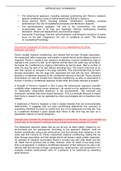
The behaviourist approach, including classical conditioning and Pavlov’s research,
operant conditioning, types of reinforcement and Skinner’s research.
Social learning theory including imitation, identification, modelling, vicarious
reinforcement, the role of mediational processes and Bandura’s research.
The psychodynamic approach: the role of the unconscious, the structure
of personality, that is Id, Ego and Superego, defence mechanisms including
repression, denial and displacement, psychosexual stages.
Humanistic Psychology: free will, self-actualisation and Maslow’s hierarchy of needs,
focus on the self, congruence, the role of conditions of worth. The influence
on counselling Psychology.
Discuss the contribution of Pavlov’s research to our understanding of human
behaviour. [8 marks]
Pavlov studied classical conditioning, and claimed that we learn through association.
He researched reflex responses, and whether a certain stimuli would always produce a
response. Pavlov’s research into classical conditioning involved conditioning dogs to
salivate to the sound of a bell, as he claimed animals learn the same way as humans.
He began the conditioning by ringing a bell before he fed his dogs. After a number of
trials, he rang the bell on its own without providing food. The sound of the bell on its
own then caused an increase in the dogs salivation. This demonstrated that we learn
through association, like the dogs who associated the bell with the food. Salivation
became a conditioned response to the conditioned stimulus of the bell. Pavlov showed
that phobias can also be created from classical conditioning, as after an association is
formed, it causes a conditioned response of fear when the phobic stimulus is present.
A strength of Pavlov’s research is that it gives the behaviourist approach scientific
credibility when explaining human behaviour. He carried out his research by focusing
on observable, measurable behaviour in lab environments. This removed any
extraneous variables that could impact behaviour. This is a strength because it means
that Pavlov’s research can be replicated by other psychologists and is therefore more
reliable.
A weakness of Pavlov’s research is that it creates theories that are environmentally
deterministic. It suggests that our past conditioning determines the outcome of
everything, therefore we have no control over any of our behaviours nor free will. This
is a weakness because it gives people less choice in life, and may be seen as a
pessimistic outlook on human behaviour.
Describe and evaluate the behaviourist approach in psychology. As part of your answer you
should refer to the research methods used by behaviourist psychologists [16 marks]
The behaviorist approach states that we are all born as blank slates, shaped by our
environment and our experiences. According to the approach, behavior must be
studied scientifically, using a lab environment, and that animals learn behaviors in the
same way that humans do. Pavlov researched classical conditioning, stating that we
learn through association and that certain stimuli will always create certain responses.
An example of research surrounding Pavlov’s concept was with Little Albert and the
rat. Albert had no previous fear of rates, however, when he heard a loud bang every
time a rat appeared, it created a conditioned response of fear whenever he saw a rat.
Skinner said that we learn through consequences, reinforcement, and punishment. For
example, positive reinforcement aims for a behavior to be reinforced by rewarding
good behavior.
, APPROACHES 16 MARKERS
A strength of the behaviorist approach is that it has scientific credibility. Both Pavlov
and skinner carried out their research by focusing on observable and measurable
behavior in lab environments. This removes extraneous variables which could affect
behavior. This is a strength for the approach because it allows the results from the
psychologists’ research to be replicated by others and therefore, they are more
reliable. As a result, the behaviorist approach gives psychology scientific credibility.
Another strength of the behaviorist approach is that it has real life applications. Token
economy is an example of this, which is a rewarding method based on operant
conditioning. This method is used for prisons, schools, and helping those with mental
disorders. This is a strength for the approach because it means that the theories
related to it are generalizable to the population and are able to help create better
people through rewarding behaviors.
A weakness of the behaviorists approach is its environmental determinism. The
approach states that humans have no free will, ad that all our behavior are determined
by our environment. This is a weakness of the approach because it means that less
people will want to take a behaviorist approach, as it means we have no choice in life,
and it is a very negative view on human behavior.
Outline Pavlov’s research into classical conditioning and describe how classical
conditioning might explain a child’s fear of school. [16 marks]
The behaviourist approach claims that humans are born as blank slates, shaped by
our environment. Pavlov studied classical conditioning, and claimed that we learn
through association. He researched reflex responses, and whether a certain stimuli
would always produce a response. Pavlov showed that phobias can be created from
classical conditioning, as after an association is formed, it causes a conditioned
response of fear when the phobic stimulus is present. For example, if a child is
experiencing being bullied in school, they would create an association of fear with
school. The unconditioned stimulus of being bullied combined with the neutral stimulus
of school creates an unconditioned response of fear. If the child is being continuously
bullied in school, this then creates a conditioned response of fear when the child is
exposed to the conditioned stimulus of school.
A strength of Pavlov’s research for the behaviourist approach is that it gives the
behaviourist approach scientific credibility when explaining human behaviour. He
carried out his research by focusing on observable, measurable behaviour in lab
environments. This removed any extraneous variables that could impact behaviour.
This is a strength because it means that Pavlov’s research can be replicated by other
psychologists and is therefore more reliable.
Another strength of Pavlov’s research into classical conditioning is that it has
supporting evidence from human research. Watson and Rayner studied Little Albert,
who before classical conditioning was not afraid of a rat. After making a loud noise
every time a white rat was present in front of Albert, the rat became the conditioned
stimulus for a conditioned response of fear of Albert. This supports the concept of
classical conditioning, as Albert’s phobia developed after associating the rat with a
loud bang.
A weakness of the behaviorists approach is its environmental determinism. The
approach states that humans have no free will, ad that all our behavior are determined
by our environment. This is a weakness of the approach because it means that less
people will want to take a behaviorist approach, as it means we have no choice in life,
and it is a very negative view on human behavior.
The behaviourist approach, including classical conditioning and Pavlov’s research,
operant conditioning, types of reinforcement and Skinner’s research.
Social learning theory including imitation, identification, modelling, vicarious
reinforcement, the role of mediational processes and Bandura’s research.
The psychodynamic approach: the role of the unconscious, the structure
of personality, that is Id, Ego and Superego, defence mechanisms including
repression, denial and displacement, psychosexual stages.
Humanistic Psychology: free will, self-actualisation and Maslow’s hierarchy of needs,
focus on the self, congruence, the role of conditions of worth. The influence
on counselling Psychology.
Discuss the contribution of Pavlov’s research to our understanding of human
behaviour. [8 marks]
Pavlov studied classical conditioning, and claimed that we learn through association.
He researched reflex responses, and whether a certain stimuli would always produce a
response. Pavlov’s research into classical conditioning involved conditioning dogs to
salivate to the sound of a bell, as he claimed animals learn the same way as humans.
He began the conditioning by ringing a bell before he fed his dogs. After a number of
trials, he rang the bell on its own without providing food. The sound of the bell on its
own then caused an increase in the dogs salivation. This demonstrated that we learn
through association, like the dogs who associated the bell with the food. Salivation
became a conditioned response to the conditioned stimulus of the bell. Pavlov showed
that phobias can also be created from classical conditioning, as after an association is
formed, it causes a conditioned response of fear when the phobic stimulus is present.
A strength of Pavlov’s research is that it gives the behaviourist approach scientific
credibility when explaining human behaviour. He carried out his research by focusing
on observable, measurable behaviour in lab environments. This removed any
extraneous variables that could impact behaviour. This is a strength because it means
that Pavlov’s research can be replicated by other psychologists and is therefore more
reliable.
A weakness of Pavlov’s research is that it creates theories that are environmentally
deterministic. It suggests that our past conditioning determines the outcome of
everything, therefore we have no control over any of our behaviours nor free will. This
is a weakness because it gives people less choice in life, and may be seen as a
pessimistic outlook on human behaviour.
Describe and evaluate the behaviourist approach in psychology. As part of your answer you
should refer to the research methods used by behaviourist psychologists [16 marks]
The behaviorist approach states that we are all born as blank slates, shaped by our
environment and our experiences. According to the approach, behavior must be
studied scientifically, using a lab environment, and that animals learn behaviors in the
same way that humans do. Pavlov researched classical conditioning, stating that we
learn through association and that certain stimuli will always create certain responses.
An example of research surrounding Pavlov’s concept was with Little Albert and the
rat. Albert had no previous fear of rates, however, when he heard a loud bang every
time a rat appeared, it created a conditioned response of fear whenever he saw a rat.
Skinner said that we learn through consequences, reinforcement, and punishment. For
example, positive reinforcement aims for a behavior to be reinforced by rewarding
good behavior.
, APPROACHES 16 MARKERS
A strength of the behaviorist approach is that it has scientific credibility. Both Pavlov
and skinner carried out their research by focusing on observable and measurable
behavior in lab environments. This removes extraneous variables which could affect
behavior. This is a strength for the approach because it allows the results from the
psychologists’ research to be replicated by others and therefore, they are more
reliable. As a result, the behaviorist approach gives psychology scientific credibility.
Another strength of the behaviorist approach is that it has real life applications. Token
economy is an example of this, which is a rewarding method based on operant
conditioning. This method is used for prisons, schools, and helping those with mental
disorders. This is a strength for the approach because it means that the theories
related to it are generalizable to the population and are able to help create better
people through rewarding behaviors.
A weakness of the behaviorists approach is its environmental determinism. The
approach states that humans have no free will, ad that all our behavior are determined
by our environment. This is a weakness of the approach because it means that less
people will want to take a behaviorist approach, as it means we have no choice in life,
and it is a very negative view on human behavior.
Outline Pavlov’s research into classical conditioning and describe how classical
conditioning might explain a child’s fear of school. [16 marks]
The behaviourist approach claims that humans are born as blank slates, shaped by
our environment. Pavlov studied classical conditioning, and claimed that we learn
through association. He researched reflex responses, and whether a certain stimuli
would always produce a response. Pavlov showed that phobias can be created from
classical conditioning, as after an association is formed, it causes a conditioned
response of fear when the phobic stimulus is present. For example, if a child is
experiencing being bullied in school, they would create an association of fear with
school. The unconditioned stimulus of being bullied combined with the neutral stimulus
of school creates an unconditioned response of fear. If the child is being continuously
bullied in school, this then creates a conditioned response of fear when the child is
exposed to the conditioned stimulus of school.
A strength of Pavlov’s research for the behaviourist approach is that it gives the
behaviourist approach scientific credibility when explaining human behaviour. He
carried out his research by focusing on observable, measurable behaviour in lab
environments. This removed any extraneous variables that could impact behaviour.
This is a strength because it means that Pavlov’s research can be replicated by other
psychologists and is therefore more reliable.
Another strength of Pavlov’s research into classical conditioning is that it has
supporting evidence from human research. Watson and Rayner studied Little Albert,
who before classical conditioning was not afraid of a rat. After making a loud noise
every time a white rat was present in front of Albert, the rat became the conditioned
stimulus for a conditioned response of fear of Albert. This supports the concept of
classical conditioning, as Albert’s phobia developed after associating the rat with a
loud bang.
A weakness of the behaviorists approach is its environmental determinism. The
approach states that humans have no free will, ad that all our behavior are determined
by our environment. This is a weakness of the approach because it means that less
people will want to take a behaviorist approach, as it means we have no choice in life,
and it is a very negative view on human behavior.