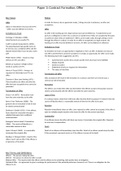
Paper 3; Contract Formation; Offer
Key Cases Notes
Offer In order for there to be an agreement made, 2 things must be in existence: an offer and
acceptance.
Gibson V Manchester City Council (1979)
– Offers must be definite in its terms. Offer
Invitations to Treat An offer is the starting part of a legal contract and can be defined as; “A statement by one
party of a willingness to enter into a contract on stated terms if they are accepted by the party
Partridge V Crittenden (1968) – or parties to whom they are addressed”. Offers can be made orally, through writing or even
Advertisements are usually ITTs through the offeror’s conduct. In order for an offer to recognised as a legal contract, the
wording of an offer must be definite in its terms. An offer can be bilateral or unilateral.
Carlill V Carbolic Smoke Ball Co (1893) –
The advertisement had specific terms to Invitation to Treat
be met (so was a unilateral offer) and the
deposit showed that it was not just a sales An invitation to treat is an opportunity to negotiate or form an offer. Invitations to treat are
puff. not offers and therefore cannot be accepted, it is simply an opportunity for offers to be made.
The following have been suggested to be ITTs:
PSGB V Boots (1953) – Goods on shop
shelves are ITTs not offers Advertisements (unless they contain specific terms that have to be fulfilled)
Display of goods
British Car Auctions V Wright (1972) – Goods at auction
Goods at auction are ITTs Statements of price or requests for information
Harvey V Facey (1893) – Answers to The status of machines
requests for information are ITTs not
Termination Of Offer
offers
Only acceptance will result in the formation of a contract, but there are several ways a
Thornton V Shoe Lane Parking (1971) –
contract can be terminated.
Ticket machines are offers and after the
offer has been accepted terms cannot be Revocation
presented
The offeror can revoke their offer any time before the offeree accept it. Revocation must be
Termination of Offer clearly communicated with the offeree and with the same notoriety.
Shuey V US (1875) – Revocation must Lapse of Time
have the same notoriety as the offer
If a contract states a time limit it will close after the time limit has passed. If it doesn’t then the
Byrne V Van Tienhoven (1880) – The courts will decide what is a reasonable amount of time for the offer to be open.
general rule on revocation is that it must
be clearly communicated Rejection
Dickinson V Dodds (1876) – If the offeree Rejection immediately closes an offer, once rejected an offer cannot be accepted. If the offer is
hears about the revocation through a open to multiple people rejection only closes the offer for the person rejecting it.
reliable third party that is sufficient Counteroffer
communication
If an offeree returns the offer with their own terms, it terminates the original offer. Requests
Ramsgate Victoria Hotel V Montefiore for info aren’t counteroffers.
(1866) – The courts will decide on a
reasonable amount of time Death
Hyde V Wrench (1840) – A counteroffer Death of an offeree will immediately close the offer. Death of an offeror would close the offer
terminated the original offer if they promised a personal service or if the offeree is aware of his death
Bradbury V Morgan (1862) – Death of the
offeror won’t end an offer if the offeree is
in ignorance of his death
Key Terms and Definitions
Offeror – The person making the offer
Offeree – The person to whom the offer is made
Bilateral Offer – This requires both the offeror and the offeree to do something; both parties have an obligation.
Unilateral Offer – An agreement to give in exchange for performance if the potential performer chooses to act. There is no obligation for the
offeree to act.
Key Cases Notes
Offer In order for there to be an agreement made, 2 things must be in existence: an offer and
acceptance.
Gibson V Manchester City Council (1979)
– Offers must be definite in its terms. Offer
Invitations to Treat An offer is the starting part of a legal contract and can be defined as; “A statement by one
party of a willingness to enter into a contract on stated terms if they are accepted by the party
Partridge V Crittenden (1968) – or parties to whom they are addressed”. Offers can be made orally, through writing or even
Advertisements are usually ITTs through the offeror’s conduct. In order for an offer to recognised as a legal contract, the
wording of an offer must be definite in its terms. An offer can be bilateral or unilateral.
Carlill V Carbolic Smoke Ball Co (1893) –
The advertisement had specific terms to Invitation to Treat
be met (so was a unilateral offer) and the
deposit showed that it was not just a sales An invitation to treat is an opportunity to negotiate or form an offer. Invitations to treat are
puff. not offers and therefore cannot be accepted, it is simply an opportunity for offers to be made.
The following have been suggested to be ITTs:
PSGB V Boots (1953) – Goods on shop
shelves are ITTs not offers Advertisements (unless they contain specific terms that have to be fulfilled)
Display of goods
British Car Auctions V Wright (1972) – Goods at auction
Goods at auction are ITTs Statements of price or requests for information
Harvey V Facey (1893) – Answers to The status of machines
requests for information are ITTs not
Termination Of Offer
offers
Only acceptance will result in the formation of a contract, but there are several ways a
Thornton V Shoe Lane Parking (1971) –
contract can be terminated.
Ticket machines are offers and after the
offer has been accepted terms cannot be Revocation
presented
The offeror can revoke their offer any time before the offeree accept it. Revocation must be
Termination of Offer clearly communicated with the offeree and with the same notoriety.
Shuey V US (1875) – Revocation must Lapse of Time
have the same notoriety as the offer
If a contract states a time limit it will close after the time limit has passed. If it doesn’t then the
Byrne V Van Tienhoven (1880) – The courts will decide what is a reasonable amount of time for the offer to be open.
general rule on revocation is that it must
be clearly communicated Rejection
Dickinson V Dodds (1876) – If the offeree Rejection immediately closes an offer, once rejected an offer cannot be accepted. If the offer is
hears about the revocation through a open to multiple people rejection only closes the offer for the person rejecting it.
reliable third party that is sufficient Counteroffer
communication
If an offeree returns the offer with their own terms, it terminates the original offer. Requests
Ramsgate Victoria Hotel V Montefiore for info aren’t counteroffers.
(1866) – The courts will decide on a
reasonable amount of time Death
Hyde V Wrench (1840) – A counteroffer Death of an offeree will immediately close the offer. Death of an offeror would close the offer
terminated the original offer if they promised a personal service or if the offeree is aware of his death
Bradbury V Morgan (1862) – Death of the
offeror won’t end an offer if the offeree is
in ignorance of his death
Key Terms and Definitions
Offeror – The person making the offer
Offeree – The person to whom the offer is made
Bilateral Offer – This requires both the offeror and the offeree to do something; both parties have an obligation.
Unilateral Offer – An agreement to give in exchange for performance if the potential performer chooses to act. There is no obligation for the
offeree to act.