

Test Bank of Exploring Sociology A Canadian Perspective 3rd Edition by Ravelli
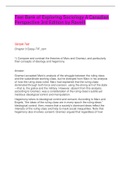
Test Bank of Exploring Sociology A Canadian Perspective 3rd Edition by Ravelli Test Bank of Exploring Sociology A Canadian Perspective 3rd Edition by Ravelli Sample Test Chapter 3 Essay-TIF_csm 1) Compare and contrast the theories of Marx and Gramsci, and particularly their concepts of ideology and hegemony. Answer: Gramsci accepted Marx’s analysis of the struggle between the ruling class and the subordinate working class, but he diverged from Marx in his analysis of how the ruling class ruled. Marx had explained that the ruling class dominated through both force and coercion, using the strong arm of the state —that is, the police and the military. However, absent from this analysis, according to Gramsci, was a consideration of the ruling class’s subtle yet insidious ideological control and manipulation. Hegemony refers to ideological control and consent. According to Marx and Engels, “the ideas of the ruling class are in every epoch the ruling ideas.” Ideological control, then, means that a society’s dominant ideas reflect the interests of the ruling class and help to mask social inequalities. Note that hegemony also involves consent. Gramsci argued that regardless of how authoritarian a regime may be, no regime would be able to maintain its rule by relying principally on organized state power and armed force. Rather, to enjoy longevity and stability of rule, a regime must have the allegiance of the masses. So, the hegemony of the dominant group’s ideas and cultural forms works by bringing about the consent of the subordinate class. Diff: Challenging Type: ES Page Reference: 68-70 Skill: Conceptual Objective: Describe Antonio Gramsci’s Marxist concept of hegemony. 2) Compare and contrast Smith’s and Marx’s ideas of ruling relations and where the power lies in society. Answer: Marx argued that the ruling class dominated through both force and coercion, using the strong arm of the state—that is, the police and the military, as well as through ideological control; the ruling ideas. He and Engels stated that, “the ideas of the ruling class are in every epoch the ruling ideas.” Ideological control, then, means that a society’s dominant ideas reflect the interests of the ruling class and help to mask social inequalities. Smith argues that experiences are often the result of ruling relations in everyday circumstances. She uses the concept of ruling to indicate the “socially-organized exercise of power that shapes people’s actions and their lives.” Ruling relations are the abstract, conceptual, and “extra-locally organized relations of state, professions, corporations, academic discourses, mass media and so on.” These ruling relations exist in a generalized form and work to coordinate, from outside the local sites of our bodies, what people do (their actions). After all, our experiences are not entirely shaped by daily interactions; rather, our experiences are often the result of ruling relations in everyday circumstances. Diff: Challenging Type: ES Page Reference: 68-73 Skill: Conceptual Objective: Describe Antonio Gramsci’s Marxist concept of hegemony; outline second- and third-wave feminist thinking using the examples of Dorothy Smith and bell hooks. 3) Develop an essay in which you discuss the US government’s response to Hurricane Katrina in New Orleans from a critical race theory perspective. Answer: Critical race theory allows us to view contemporary social situations through a lens of historical racism. In this way, we can connect historical inequities to contemporary practices and situations. Hurricane Katrina hit the Gulf Coast of the United States in August 2005, and the vast majority of those affected were poor and African-American. Many social scientists have focused on how the relations between race and social class were implicated in the evacuation of citizens, rescue efforts, and governmental action and inaction. After the hurricane, there was a lack of an organized government rescue response for citizens trapped in New Orleans because of flooding. Those who had made their way to the Superdome stadium lived in appalling conditions in terms of food and sanitation. Many social theorists argue that the “natural” disaster of Hurricane Katrina was so devastating precisely because of decades of institutionalized racial inequality. Hurricane Katrina revealed for the world the enduring effects of racial segregation and racial inequalities in housing and occupation. Diff: Moderate Type: ES Page Reference: 84-85 Skill: Applied Objective: Define the principal tenets of critical race theory and the approach to “whiteness” as a racial identity.
Document information
- Uploaded on
- May 22, 2022
- Number of pages
- 41
- Written in
- 2021/2022
- Type
- Exam (elaborations)
- Contains
- Questions & answers


