

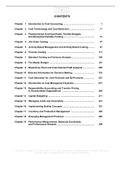
CONTENTS
Chapter 1 Introduction to Cost Accounting................................................... 1
Chapter 2 Cost Terminology and Cost Behaviors......................................... 11
Chapter 3 Predetermined Overhead Rated, Flexible Budgets,
and Absorption/Variable Costing .................................................. 31
Chapter 4 Job Order Costing ......................................................................... 57
Chapter 5 Activity-Based Management and Activity-Based Costing.......... 87
Chapter 6 Process Costing ............................................................................ 111
Chapter 7 Standard Costing and Variance Analysis..................................... 145
Chapter 8 The Master Budget ........................................................................ 181
Chapter 9 Break-Even Point and Cost-Volume-Profit Analysis ................... 205
Chapter 10 Relevant Information for Decision Making.................................... 233
Chapter 11 Cost Allocation for Joint Products and By-Products.................. 251
Chapter 12 Introduction to Cost Management Systems................................. 277
Chapter 13 Responsibility Accounting and Transfer Pricing
in Decentralized Organizations .................................................... 285
Chapter 14 Capital Budgeting .......................................................................... 311
Chapter 15 Managing Costs and Uncertainty ................................................. 331
Chapter 16 Implementing Quality Concepts ................................................... 351
Chapter 17 Inventory and Production Management ...................................... 369
Chapter 18 Emerging Management Practices ................................................ 385
Chapter 19 Performance Measurement, Balanced Scorecards,
and Performance Rewards ............................................................ 399
This edition is intended for use outside of the U.S. only, with content that may be different from the U.S. Edition. This may not
be resold, copied, or distributed without the prior consent of the publisher.
, CHAPTER 1
Introduction to Cost Accounting
QUESTIONS
1. Management accounting stresses the infor- veer away from its “view of itself” and find
mational needs of internal users over those that it is engaging in activities that are not,
of external users (the focus of financial ac- and can never be, part of what it wants to
counting). Because of this perspective, do.
management accounting provides informa-
tion in a format that is flexible and relevant 4. Organizational strategy is the link between a
to a particular manager’s usage. Financial firm’s goals and objectives and its opera-
accounting, on the other hand, must provide tional plans. Strategy is therefore a specifi-
some uniformity in the manner in which in- cation of how a firm intends to compete and
formation is presented for it to be compara- survive. Each organization will have a
ble among companies and in compliance unique strategy because it has unique
with generally accepted accounting princi- goals, objectives, opportunities, and con-
ples. straints.
5. Core competencies are the special profi-
2. Operating in a global environment means
ciencies possessed and valued by an or-
that more decision and control variables
ganization. If a particular strategy requires
must be tracked. For example, a firm operat-
core competencies that are not possessed
ing in many countries must track variables
by a firm, executing such a strategy would
such as national rules of income taxation,
be very difficult. For example, a strategy of
national corporate governance laws, sets of
diversification would be impossible to exe-
local laws of commerce, production and
cute in a firm that does not possess core
sourcing sites, and currencies. In addition,
competencies in mergers, acquisitions, and
the multinational firm must monitor markets
constraints.
in many countries, deal with a multitude of
local cultures and customs, and communi-
6. The value chain of an organization is the set
cate in several languages.
of processes that converts inputs into prod-
Some other valuable information for the ucts and services for the firm’s customers.
global firm would be: currency exchange The value chain includes both internal and
rates; national inflation rates; details of im- supplier processes, and it creates the foun-
port/export laws; prices for commodities in dation of strategic resource management
likely sourcing sites; distribution costs for (SRM) which involves the deployment of or-
various modes of moving goods, compo- ganizational resources. The linkage be-
nents, equipment, and materials; political is- tween SRM and the value chain is that op-
sues in all relevant markets; and competi- timizing value is the objective of SRM. Thus,
tors’ prices in all markets. These types of value chain effects are the concern of man-
information are important to generate an op- agers in the strategic deployment of organ-
timal return on capital. izational resources.
3. A mission statement is important to an or- 7. The balanced scorecard is a framework that
ganization because it provides a clearly restates on organization’s strategy into clear
worded view of what the organization wants and objective performance measures. The
to accomplish and how the organization balanced scorecard is used to evaluate per-
uniquely meets its targeted customers’ formance from four perspectives: learning
needs with products and services. Without and growth, internal business, customer
a mission statement an organization may values, and financial. These perspectives
1
This edition is intended for use outside of the U.S. only, with content that may be different from the U.S. Edition. This
may not be resold, copied, or distributed without the prior consent of the publisher.
,2 Chapter 1
include financial, quantitative, lead and lag 9. The purpose of this question is to get stu-
indicators, short run and long run measures. dents to think about the role of laws and eth-
Managers choosing to apply the balanced ics in conducting business. Among the im-
scorecard are demonstrating a belief that portant points that should be made in the
traditional financial performance measures, position papers include: whether the laws in
such as ROI, alone are insufficient to assess the firm’s home country or local foreign law
how the firm is doing and what specific ac- should govern the actions of firms; whether
tions must be taken to improve perform- ethics or law should be the standard govern-
ance. ing actions in foreign jurisdictions; and the
extent to which “being competitive” should
be a criterion in choosing a business course
8. Authority is the right, generally because of
of actions. (Interesting article: Reed & Por-
position or rank, to use resources to accom-
tanger, “Bribery, Corruption Are Rampant in
plish a task or achieve an objective. Re-
Eastern Europe, Survey Finds,” The Wall
sponsibility is the obligation to accomplish a
Street Journal, November 9, 1999.)
task or achieve an objective. Authority can
be delegated, but responsibility must be as-
sumed and maintained by the person to
whom it is assigned. However, sufficient au-
thority must accompany responsibility or the
assignment of responsibility cannot endure.
This edition is intended for use outside of the U.S. only, with content that may be different from the U.S. Edition. This
may not be resold, copied, or distributed without the prior consent of the publisher.
, Chapter 1 3
EXERCISES
10. a. The bank would want information about the firm’s ability to repay the
loan. Potentially, the loan could be repaid from either of two sources:
(1) by liquidating an asset that is not crucial to business operations or
(2) from future operating cash flows. Useful information for the bank
would allow the loan officer to evaluate the probability that the firm
could repay the loan from either of these sources. Consequently, the
most useful items of information would be a balance sheet, income
statement, statement of cash flows, and perhaps a cash budget. The
balance sheet provides information about the types of assets owned
by the firm and the cash commitments for debt repayments and pay-
ments to suppliers. The income statement is useful for assessing
profitability and projecting future cash flows. The statement of cash
flows and the cash budget provide information about the sources and
uses of cash.
Information about accounts receivable turnover, or the average time to
collect accounts receivable, can be determined by examining the his-
tory of accounts receivable collections. How readily accounts receiv-
able can be collected can be assessed by determining the extent to
which the accounts receivable are past due.
A trend for supplier price and labor cost increases can be assessed by
examining purchases and salaries over time. Reading Journal of Ac-
countancy and Strategic Finance will provide information about salary
trends. Prices of specific, routine inputs can be obtained from sup-
plier invoices and purchase order data.
Qualitative information that would interest the bank might include the
borrower’s character, his or her history in handling borrowed funds,
management skills in the firm, stability of business conditions, work
backlog, financial strength of large-volume customers, and supplier
willingness to provide favorable credit terms on purchases.
b. An example of accumulating the information to address customers’
complaints regarding delays in completing the audit, financial plan-
ning and tax jobs can be found on the customer order documents.
The customer order document should be designed to capture the
promised time of completion of the job and also to capture the actual
completion time. The time variance can be accumulated systemati-
cally on a log or, alternatively, can be determined by inspection of the
customer order documents. In this way, these documents, that com-
prise part of the accounting system, can be used to track such non-
financial data.
This edition is intended for use outside of the U.S. only, with content that may be different from the U.S. Edition. This
may not be resold, copied, or distributed without the prior consent of the publisher.
Chapter 1 Introduction to Cost Accounting................................................... 1
Chapter 2 Cost Terminology and Cost Behaviors......................................... 11
Chapter 3 Predetermined Overhead Rated, Flexible Budgets,
and Absorption/Variable Costing .................................................. 31
Chapter 4 Job Order Costing ......................................................................... 57
Chapter 5 Activity-Based Management and Activity-Based Costing.......... 87
Chapter 6 Process Costing ............................................................................ 111
Chapter 7 Standard Costing and Variance Analysis..................................... 145
Chapter 8 The Master Budget ........................................................................ 181
Chapter 9 Break-Even Point and Cost-Volume-Profit Analysis ................... 205
Chapter 10 Relevant Information for Decision Making.................................... 233
Chapter 11 Cost Allocation for Joint Products and By-Products.................. 251
Chapter 12 Introduction to Cost Management Systems................................. 277
Chapter 13 Responsibility Accounting and Transfer Pricing
in Decentralized Organizations .................................................... 285
Chapter 14 Capital Budgeting .......................................................................... 311
Chapter 15 Managing Costs and Uncertainty ................................................. 331
Chapter 16 Implementing Quality Concepts ................................................... 351
Chapter 17 Inventory and Production Management ...................................... 369
Chapter 18 Emerging Management Practices ................................................ 385
Chapter 19 Performance Measurement, Balanced Scorecards,
and Performance Rewards ............................................................ 399
This edition is intended for use outside of the U.S. only, with content that may be different from the U.S. Edition. This may not
be resold, copied, or distributed without the prior consent of the publisher.
, CHAPTER 1
Introduction to Cost Accounting
QUESTIONS
1. Management accounting stresses the infor- veer away from its “view of itself” and find
mational needs of internal users over those that it is engaging in activities that are not,
of external users (the focus of financial ac- and can never be, part of what it wants to
counting). Because of this perspective, do.
management accounting provides informa-
tion in a format that is flexible and relevant 4. Organizational strategy is the link between a
to a particular manager’s usage. Financial firm’s goals and objectives and its opera-
accounting, on the other hand, must provide tional plans. Strategy is therefore a specifi-
some uniformity in the manner in which in- cation of how a firm intends to compete and
formation is presented for it to be compara- survive. Each organization will have a
ble among companies and in compliance unique strategy because it has unique
with generally accepted accounting princi- goals, objectives, opportunities, and con-
ples. straints.
5. Core competencies are the special profi-
2. Operating in a global environment means
ciencies possessed and valued by an or-
that more decision and control variables
ganization. If a particular strategy requires
must be tracked. For example, a firm operat-
core competencies that are not possessed
ing in many countries must track variables
by a firm, executing such a strategy would
such as national rules of income taxation,
be very difficult. For example, a strategy of
national corporate governance laws, sets of
diversification would be impossible to exe-
local laws of commerce, production and
cute in a firm that does not possess core
sourcing sites, and currencies. In addition,
competencies in mergers, acquisitions, and
the multinational firm must monitor markets
constraints.
in many countries, deal with a multitude of
local cultures and customs, and communi-
6. The value chain of an organization is the set
cate in several languages.
of processes that converts inputs into prod-
Some other valuable information for the ucts and services for the firm’s customers.
global firm would be: currency exchange The value chain includes both internal and
rates; national inflation rates; details of im- supplier processes, and it creates the foun-
port/export laws; prices for commodities in dation of strategic resource management
likely sourcing sites; distribution costs for (SRM) which involves the deployment of or-
various modes of moving goods, compo- ganizational resources. The linkage be-
nents, equipment, and materials; political is- tween SRM and the value chain is that op-
sues in all relevant markets; and competi- timizing value is the objective of SRM. Thus,
tors’ prices in all markets. These types of value chain effects are the concern of man-
information are important to generate an op- agers in the strategic deployment of organ-
timal return on capital. izational resources.
3. A mission statement is important to an or- 7. The balanced scorecard is a framework that
ganization because it provides a clearly restates on organization’s strategy into clear
worded view of what the organization wants and objective performance measures. The
to accomplish and how the organization balanced scorecard is used to evaluate per-
uniquely meets its targeted customers’ formance from four perspectives: learning
needs with products and services. Without and growth, internal business, customer
a mission statement an organization may values, and financial. These perspectives
1
This edition is intended for use outside of the U.S. only, with content that may be different from the U.S. Edition. This
may not be resold, copied, or distributed without the prior consent of the publisher.
,2 Chapter 1
include financial, quantitative, lead and lag 9. The purpose of this question is to get stu-
indicators, short run and long run measures. dents to think about the role of laws and eth-
Managers choosing to apply the balanced ics in conducting business. Among the im-
scorecard are demonstrating a belief that portant points that should be made in the
traditional financial performance measures, position papers include: whether the laws in
such as ROI, alone are insufficient to assess the firm’s home country or local foreign law
how the firm is doing and what specific ac- should govern the actions of firms; whether
tions must be taken to improve perform- ethics or law should be the standard govern-
ance. ing actions in foreign jurisdictions; and the
extent to which “being competitive” should
be a criterion in choosing a business course
8. Authority is the right, generally because of
of actions. (Interesting article: Reed & Por-
position or rank, to use resources to accom-
tanger, “Bribery, Corruption Are Rampant in
plish a task or achieve an objective. Re-
Eastern Europe, Survey Finds,” The Wall
sponsibility is the obligation to accomplish a
Street Journal, November 9, 1999.)
task or achieve an objective. Authority can
be delegated, but responsibility must be as-
sumed and maintained by the person to
whom it is assigned. However, sufficient au-
thority must accompany responsibility or the
assignment of responsibility cannot endure.
This edition is intended for use outside of the U.S. only, with content that may be different from the U.S. Edition. This
may not be resold, copied, or distributed without the prior consent of the publisher.
, Chapter 1 3
EXERCISES
10. a. The bank would want information about the firm’s ability to repay the
loan. Potentially, the loan could be repaid from either of two sources:
(1) by liquidating an asset that is not crucial to business operations or
(2) from future operating cash flows. Useful information for the bank
would allow the loan officer to evaluate the probability that the firm
could repay the loan from either of these sources. Consequently, the
most useful items of information would be a balance sheet, income
statement, statement of cash flows, and perhaps a cash budget. The
balance sheet provides information about the types of assets owned
by the firm and the cash commitments for debt repayments and pay-
ments to suppliers. The income statement is useful for assessing
profitability and projecting future cash flows. The statement of cash
flows and the cash budget provide information about the sources and
uses of cash.
Information about accounts receivable turnover, or the average time to
collect accounts receivable, can be determined by examining the his-
tory of accounts receivable collections. How readily accounts receiv-
able can be collected can be assessed by determining the extent to
which the accounts receivable are past due.
A trend for supplier price and labor cost increases can be assessed by
examining purchases and salaries over time. Reading Journal of Ac-
countancy and Strategic Finance will provide information about salary
trends. Prices of specific, routine inputs can be obtained from sup-
plier invoices and purchase order data.
Qualitative information that would interest the bank might include the
borrower’s character, his or her history in handling borrowed funds,
management skills in the firm, stability of business conditions, work
backlog, financial strength of large-volume customers, and supplier
willingness to provide favorable credit terms on purchases.
b. An example of accumulating the information to address customers’
complaints regarding delays in completing the audit, financial plan-
ning and tax jobs can be found on the customer order documents.
The customer order document should be designed to capture the
promised time of completion of the job and also to capture the actual
completion time. The time variance can be accumulated systemati-
cally on a log or, alternatively, can be determined by inspection of the
customer order documents. In this way, these documents, that com-
prise part of the accounting system, can be used to track such non-
financial data.
This edition is intended for use outside of the U.S. only, with content that may be different from the U.S. Edition. This
may not be resold, copied, or distributed without the prior consent of the publisher.


