Respiration
Introduction
The bulk of the energy we consume originates from glucose molecules produced by plants during
photosynthesis, and we employ cellular respiration to release this energy. Which is an exothermic
process that continually occurs in our living cells and transfers energy from glucose. Breaking up
glucose molecules to liberate energy held within the cell is called cellular respiration. Because no
energy is created, it is just transferred from the glucose molecules, and all exothermic reactions
are defined by the reaction that believes in its own energy.
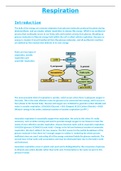
There are two types of
respiration, aerobic
respiration and
anaerobic respiration.
The most prevalent kind of respiration is aerobic, which occurs when there is adequate oxygen in
the body. This is the most effective route for glucose to be converted into energy, and it occurs in
four phases in the human body. Glucose and oxygen are combined to generate carbon dioxide and
water in aerobic respiration. C6H12O6 (Glucose) + 6O2 (Oxygen) 6CO2 (Carbon Dioxide) + 6H2O
(Water)+ energy is the entire, balanced reaction of aerobic respiration (as ATP.)
Anaerobic respiration is essentially oxygen-free respiration. We only do this when it's really
necessary, such as while running and need to provide enough oxygen to our tissues to meet the
needs of more effective aerobic respiration. Glucose becomes lactic acid in anaerobic respiration.
C6H12O6 (glucose) 2C3H6O3 (Lactic Acid) + Energy is the full and balanced reaction of anaerobic
respiration. We don't utilize it for two reasons. The first reason for the partial breakdown of the
glucose molecule is that there isn't enough oxygen to oxidize it, rendering the whole process
inefficient since we aren't extracting all of the energy contained inside the glucose molecule. The
second issue is that lactic acid accumulates and must be eliminated later due to the body's lactic
acid tolerance.
Anaerobic respiration occurs in plants and yeast and is distinguished by the conversion of glucose
to ethanol and carbon dioxide rather than lactic acid. Fermentation is the name we give to this
process in yeast.
, Respiration
The structure and function of ATP
Adenosine triphosphate (ATP) is a
key component in the chemical
energy transmission inside cells. It
has the ability to absorb energy
and transmit it to another
chemical activity. Cells
manufacture ATP on a constant
basis, storing little quantities but
utilising it almost instantly.
Because it comprises a 5 carbon
sugar, a nitrogenous base, and a
string of three phosphate groups,
ATP is classified as a nucleotide.
The nitrogenous base is adenine,
and the 5 carbon sugar is ribose;
the two combined are known as
adenosine. Adenosine
triphosphate is made up of three
phosphates linked to adenosine. A
high-energy connection exists between phosphate groups 2 and 3 in an ATP molecule. When this
link is broken during chemical processes, ATP transforms into ADP (adenosine diphosphate) and a
phosphate is released. The released energy is utilised by the cell to carry out its operations. ADP
and phosphate may be resynthesized into ATP with the aid of food energy.
, Respiration
Glycolysis
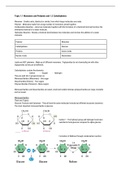
Within cells, anaerobic respiration takes place. It all begins with
glycolysis in the cell's cytosol. It subsequently moves into the
matrix of the mitochondria through the link reaction. Within the
mitochondria matrix, it next proceeds through the citric acid cycle.
The energy is then produced in the form of ATP by passing via the
electron transport chain and chemiosmosis in the inner mitochondrial
membrane.
Introduction
The bulk of the energy we consume originates from glucose molecules produced by plants during
photosynthesis, and we employ cellular respiration to release this energy. Which is an exothermic
process that continually occurs in our living cells and transfers energy from glucose. Breaking up
glucose molecules to liberate energy held within the cell is called cellular respiration. Because no
energy is created, it is just transferred from the glucose molecules, and all exothermic reactions
are defined by the reaction that believes in its own energy.
There are two types of
respiration, aerobic
respiration and
anaerobic respiration.
The most prevalent kind of respiration is aerobic, which occurs when there is adequate oxygen in
the body. This is the most effective route for glucose to be converted into energy, and it occurs in
four phases in the human body. Glucose and oxygen are combined to generate carbon dioxide and
water in aerobic respiration. C6H12O6 (Glucose) + 6O2 (Oxygen) 6CO2 (Carbon Dioxide) + 6H2O
(Water)+ energy is the entire, balanced reaction of aerobic respiration (as ATP.)
Anaerobic respiration is essentially oxygen-free respiration. We only do this when it's really
necessary, such as while running and need to provide enough oxygen to our tissues to meet the
needs of more effective aerobic respiration. Glucose becomes lactic acid in anaerobic respiration.
C6H12O6 (glucose) 2C3H6O3 (Lactic Acid) + Energy is the full and balanced reaction of anaerobic
respiration. We don't utilize it for two reasons. The first reason for the partial breakdown of the
glucose molecule is that there isn't enough oxygen to oxidize it, rendering the whole process
inefficient since we aren't extracting all of the energy contained inside the glucose molecule. The
second issue is that lactic acid accumulates and must be eliminated later due to the body's lactic
acid tolerance.
Anaerobic respiration occurs in plants and yeast and is distinguished by the conversion of glucose
to ethanol and carbon dioxide rather than lactic acid. Fermentation is the name we give to this
process in yeast.
, Respiration
The structure and function of ATP
Adenosine triphosphate (ATP) is a
key component in the chemical
energy transmission inside cells. It
has the ability to absorb energy
and transmit it to another
chemical activity. Cells
manufacture ATP on a constant
basis, storing little quantities but
utilising it almost instantly.
Because it comprises a 5 carbon
sugar, a nitrogenous base, and a
string of three phosphate groups,
ATP is classified as a nucleotide.
The nitrogenous base is adenine,
and the 5 carbon sugar is ribose;
the two combined are known as
adenosine. Adenosine
triphosphate is made up of three
phosphates linked to adenosine. A
high-energy connection exists between phosphate groups 2 and 3 in an ATP molecule. When this
link is broken during chemical processes, ATP transforms into ADP (adenosine diphosphate) and a
phosphate is released. The released energy is utilised by the cell to carry out its operations. ADP
and phosphate may be resynthesized into ATP with the aid of food energy.
, Respiration
Glycolysis
Within cells, anaerobic respiration takes place. It all begins with
glycolysis in the cell's cytosol. It subsequently moves into the
matrix of the mitochondria through the link reaction. Within the
mitochondria matrix, it next proceeds through the citric acid cycle.
The energy is then produced in the form of ATP by passing via the
electron transport chain and chemiosmosis in the inner mitochondrial
membrane.