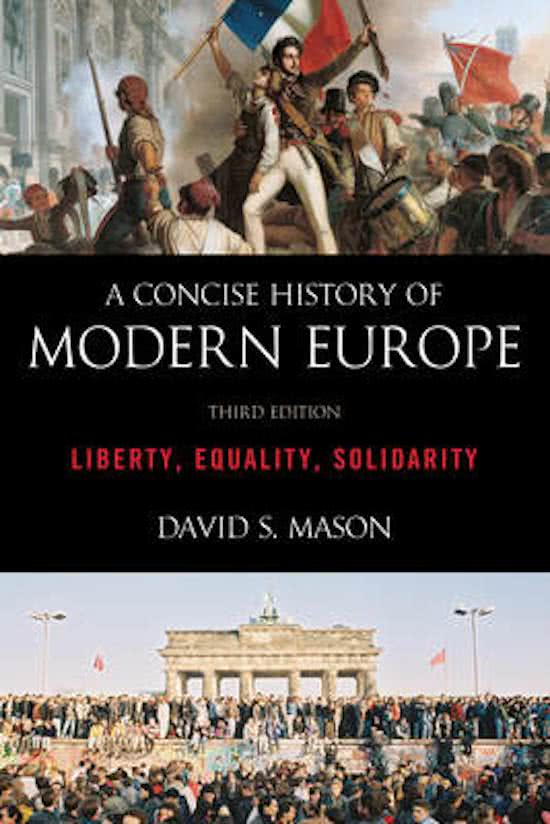
A Concise History of Modern Europe – David S. Mason
P. 1-22 1. The Old Regime and the Enlightenment
- 1789: Overturned the monarchy in France, institutionalized the ideas of the
Enlightenment, unleashed the forces of nationalism, revolution and
democracy all over Europe.
- 1989: Communism collapsed in Eastern Europe. The ending of the division
of Europe between Eastern and Western, communist and capitalist, allowed
for further movement toward unity and integration, marked by the
expansion of the EU from 15 to 28 countries.
- Progress of the continent: collection of states characterized by absolute
monarchy, rigid social hierarchy, peasant agriculture, endemic warfare
incipient European community of 28 states committed to democracy,
human rights, welfare capitalism, free movement of goods and people and
peaceful interaction.
- 1688: Glorious Revolution in England; absolute monarchy replaced with
a constitutional monarchy in which laws limited the monarch’s powers.
- Development of manufacturing and trade led to the growth of a new social
class, bourgeoisie
- Mercantilism: emphasis on precious metals and government regulation
- John Locke (1632-1704): ‘Reason and knowledge are derived from
experience’. It’s possible to produce a better society. Natural and
inalienable rights to life, liberty and property.
- Montesquieu (1689-1755): critic of absolutist government. – Separation
of power.
- Jean-Jacques Rousseau (1712-1778): ‘Man is born free’ – Social
contract.
- Adam Smith (1723-1790): Government interference in the economy
violated the interplay of natural forces of competition and supply and
demand. – Self-interest worked for the common good ‘Invisible hand’
laissez faire (government abstained from interfering in the economy)
Capitalism.
- Due to the ideas from philosophes , a new phenomenon arose: public
opinion and the idea of government and politics as something ‘public’.
- The tenor of the Enlightenment laid the foundation for human rights,
popular sovereignty, tolerance, and respect for law (values at the core of
the modern European society).
P. 23-36 2. The French Revolution and Napoleon
- Causes of the French Revolution included long-term and structural factors,
as well as more immediate events: socioeconomic changes of the 18 th
century, the ideas of the Enlightenment and weaknesses in the monarchy.
Short-term: economic; government debt, financial crisis, bad harvest
year meeting of the Estates General in 1789.
- Due to printing press wide dissemination of new ideas created a public
opinion
, - Problems: inefficient system of taxation, financial and material aid for
America (against England), due to economic growth (silver) the cost of
living increased, worst grain harvest -> famine, weakness of the monarchy.
- 1792: New Elections were called (Louis in collusion with Prussia and
Austria?); newly elected National Convention scrapped the recent
constitution, abolished the monarchy, declared the establishment of the
first French Republic.
- Combined threats of counterrevolution and foreign war strengthened the
hand of more radical factions within the National Convention: a Committee
of Public Safety (to defend gains of the Revolution and eliminate its
enemies) Robbespierre Terror Dead New constitution; five man
Directory supported a coup d’état by Napoleon in 1799.
- Napoleon tried to preserve the major gains of the Revolution, but avoided
a return to radicalism or to monarchy.
- With the defeat of Napoleon, European monarchs attempted a restoration
of the old order in France: Congress of Vienna (1814-1815).
- First modern revolution : 1789. First modern experiment with democracy in
Europe: 1792 inspired democrats, liberals, socialists, revolutionaries.
- Napoleon spread idea of democracy, liberty and equality, planted seeds of
representative government. Even Russia affected: Decembrist revolt
1825; attempt to establish a constitutional monarchy inspiration for the
next great modern revolution in 1917.
P. 37-46 3. The Industrial Revolution and the Birth of Capitalism
- Industrial Revolution: economic production shifted from the use of hand
tools to the use of power machinery, fueled by coal and steam between
1750-1850.
- Consequences: huge increase in productivity and economic output. Social
and political: assembly-line factories, urbanization, transformation of the
family, rise of new (urban working) social class: the proletariat.
- Island nation had an educated and mobile population, ready supply of coal
and iron, small internal differences, extensive trade network of rivers etc.,
growing population, political stability.
- Two changes in agriculture (1. New agricultural techniques which improved
productivity, made it possible to feed the growing population. 2. Ownership
of land became concentrated in the hands of few wealthy landlords due to
the enclosement of land by fences) had major consequences with fewer
people working on the land, many left the countryside to find work in the
cities and the more efficient farms produced more food for the urban
markets fueled urbanization and industrialization.
- New cities were set up for industrial production. Most of them didn’t have
representation in the national parliament few financial and
administrative resources to provide basic urban services like police
protection, water and sewer or garbage disposal.
- Workers organized labor unions (illegal) ideas of socialism and
revolutionary overthrow of capitalism.
- 1848: Communist Manifesto; Engels and Marx 1917: Russian
Revolution.
P. 1-22 1. The Old Regime and the Enlightenment
- 1789: Overturned the monarchy in France, institutionalized the ideas of the
Enlightenment, unleashed the forces of nationalism, revolution and
democracy all over Europe.
- 1989: Communism collapsed in Eastern Europe. The ending of the division
of Europe between Eastern and Western, communist and capitalist, allowed
for further movement toward unity and integration, marked by the
expansion of the EU from 15 to 28 countries.
- Progress of the continent: collection of states characterized by absolute
monarchy, rigid social hierarchy, peasant agriculture, endemic warfare
incipient European community of 28 states committed to democracy,
human rights, welfare capitalism, free movement of goods and people and
peaceful interaction.
- 1688: Glorious Revolution in England; absolute monarchy replaced with
a constitutional monarchy in which laws limited the monarch’s powers.
- Development of manufacturing and trade led to the growth of a new social
class, bourgeoisie
- Mercantilism: emphasis on precious metals and government regulation
- John Locke (1632-1704): ‘Reason and knowledge are derived from
experience’. It’s possible to produce a better society. Natural and
inalienable rights to life, liberty and property.
- Montesquieu (1689-1755): critic of absolutist government. – Separation
of power.
- Jean-Jacques Rousseau (1712-1778): ‘Man is born free’ – Social
contract.
- Adam Smith (1723-1790): Government interference in the economy
violated the interplay of natural forces of competition and supply and
demand. – Self-interest worked for the common good ‘Invisible hand’
laissez faire (government abstained from interfering in the economy)
Capitalism.
- Due to the ideas from philosophes , a new phenomenon arose: public
opinion and the idea of government and politics as something ‘public’.
- The tenor of the Enlightenment laid the foundation for human rights,
popular sovereignty, tolerance, and respect for law (values at the core of
the modern European society).
P. 23-36 2. The French Revolution and Napoleon
- Causes of the French Revolution included long-term and structural factors,
as well as more immediate events: socioeconomic changes of the 18 th
century, the ideas of the Enlightenment and weaknesses in the monarchy.
Short-term: economic; government debt, financial crisis, bad harvest
year meeting of the Estates General in 1789.
- Due to printing press wide dissemination of new ideas created a public
opinion
, - Problems: inefficient system of taxation, financial and material aid for
America (against England), due to economic growth (silver) the cost of
living increased, worst grain harvest -> famine, weakness of the monarchy.
- 1792: New Elections were called (Louis in collusion with Prussia and
Austria?); newly elected National Convention scrapped the recent
constitution, abolished the monarchy, declared the establishment of the
first French Republic.
- Combined threats of counterrevolution and foreign war strengthened the
hand of more radical factions within the National Convention: a Committee
of Public Safety (to defend gains of the Revolution and eliminate its
enemies) Robbespierre Terror Dead New constitution; five man
Directory supported a coup d’état by Napoleon in 1799.
- Napoleon tried to preserve the major gains of the Revolution, but avoided
a return to radicalism or to monarchy.
- With the defeat of Napoleon, European monarchs attempted a restoration
of the old order in France: Congress of Vienna (1814-1815).
- First modern revolution : 1789. First modern experiment with democracy in
Europe: 1792 inspired democrats, liberals, socialists, revolutionaries.
- Napoleon spread idea of democracy, liberty and equality, planted seeds of
representative government. Even Russia affected: Decembrist revolt
1825; attempt to establish a constitutional monarchy inspiration for the
next great modern revolution in 1917.
P. 37-46 3. The Industrial Revolution and the Birth of Capitalism
- Industrial Revolution: economic production shifted from the use of hand
tools to the use of power machinery, fueled by coal and steam between
1750-1850.
- Consequences: huge increase in productivity and economic output. Social
and political: assembly-line factories, urbanization, transformation of the
family, rise of new (urban working) social class: the proletariat.
- Island nation had an educated and mobile population, ready supply of coal
and iron, small internal differences, extensive trade network of rivers etc.,
growing population, political stability.
- Two changes in agriculture (1. New agricultural techniques which improved
productivity, made it possible to feed the growing population. 2. Ownership
of land became concentrated in the hands of few wealthy landlords due to
the enclosement of land by fences) had major consequences with fewer
people working on the land, many left the countryside to find work in the
cities and the more efficient farms produced more food for the urban
markets fueled urbanization and industrialization.
- New cities were set up for industrial production. Most of them didn’t have
representation in the national parliament few financial and
administrative resources to provide basic urban services like police
protection, water and sewer or garbage disposal.
- Workers organized labor unions (illegal) ideas of socialism and
revolutionary overthrow of capitalism.
- 1848: Communist Manifesto; Engels and Marx 1917: Russian
Revolution.