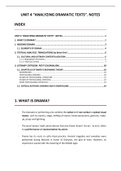
UNIT 4 “ANALYZING DRAMATIC TEXTS”. NOTES
INDEX
UNIT 4 “ANALYZING DRAMATIC TEXTS”. NOTES................................................................. 1
1. WHAT IS DRAMA?.......................................................................................................... 1
1. READING DRAMA .......................................................................................................... 3
1.1. ELEMENTS OF DRAMA ......................................................................................................... 4
2. TEXTUAL ANALYSIS. TRANSLATIONS by Brian Friel ......................................................... 6
2.1. CULTURAL AND LITERARY CONTEXTUALIZATION ................................................................. 6
2.1.1. Biographical information .................................................................................................................... 6
2.1.2. Historical context ............................................................................................................................... 7
3. LITERARY CRITICISM. POST-COLONIALISM.................................................................... 18
3.1. CHAPTER 10 OF BARRY’S BEGINNING THEORY ....................................................................18
BACKGROUND ............................................................................................................................................ 18
POSTCOLONIAL READING ........................................................................................................................... 20
STAGES OF POSTCOLONIAL LITERATURE .................................................................................................... 21
STAGES OF POSTCOLONIAL CRITICISM ....................................................................................................... 22
WHAT POSTCOLONIAL CRITICS DO............................................................................................................. 23
3.2. CRITICAL AUTHORS: EDWARD SAID’S ORIENTALISM ...........................................................24
1. WHAT IS DRAMA?
- The dramatic or performing arts combine the verbal with non-verbal or optical visual
means, such as scenery, stage, shifting of scenes, facial expressions, gestures, make-
up, props and lightning.
- The word ‘drama’ itself, which derives from the Greek ‘draein’ (‘to do’, ‘to act’), refers
to a performance or representation by actors.
- Drama has its roots in cultic-ritual practice. Ancient tragedies and comedies were
performed during festivals in honor of Dionysos, the god of wine. However, its
importance waned with the dawning of the Middle Ages.
, - After the return of the milleniun, however, simple forms of drama re-emerged. In
mystery and miracle plays, religious, allegorical or biblical themes were adapted from
Christian liturgy and dramatized for performance in front of churches and in the yards
of inns.
- These medieval plays + the classical Roman plays by Plautus and Seneca = influenced
later Renaissance drama, which reached its first peak in England with Shakespeare and
his contemporaries.
ANCIENT GREECE
ARISTOTLE dealt extensively with the general elements and features of TRAGEDY
o In the sixth book of The Poetics , he characterizes TRAGEDY as “a
representation of an action that is heroic and complete” and which
“represents men in action and does not use narrative, through pity and fear
it effects relief”.
COMEDY , on the other hand, has humorous themes intended to entertain the audience.
It is often regarded as “the stylized continuation of primitive regeneration cults, such as the
symbolic expulsion of winter by spring”.
RENAISSANCE HISTORY PLAYS
o Shakespeare’s Richard II (1597) or Henry IV (c. 1597), adapt English history for
stage performance.
o These plays portray a historical event or figure but with the addition of
contemporary references, transcend the historical dimension and MAKE
GENERAL STATEMENTS about HUMAN WEAKNESSES AND VIRTUES.
o In many cases, the author chooses a historical pretext in order to COMMENT
ON CONTEMPORARY SOCIO-POLITICAL MISERY while minimizing the risk of
censorship.
WILLIAM SHAKESPEARE AND CHRISTOPHER MARLOWE (1564-93)
- They revived and developed classical forms of drama (such as tragedy and comedy).
- They were among the first to reflect on different dramatic genres.
- Shakespeare parodied various mixed forms which, can be reduced to the THREE BASIC
FORMS OF TRAGEDY, COMEDY AND HISTORY PLAY.
2
, When the Puritans under the rule of Oliver Cromwell and his Commonwealth (*gobierno
republicano que gobernó inicialmente Inglaterra (incluido Gales) y posteriormente Irlanda
y Escocia) (1649-60) shut down English theaters on moral and religious grounds, drama lost
its status as a major genre.
Because of the prominent position of Puritanism in America, drama was almost non-existent
and was only re-established as a serious genre in the beginning of the twentieth century.
RESTORATION PERIOD (late seventeenth century)
- The COMEDY OF MANNERS or RESTORATION COMEDY was very popular. It portrayed
citizens from the upper echelons of society in witty dialogues.
ROMANTIC PERIOD (early nineteenth century)
- England produced the CLOSET DRAMA, a special form of drama which was not meant
to ber performed on stage but rather to be read in private.
- Percy Bysshe Shelley’s Prometheus Unbound (1820) is an example of this unusual form
of drama.
- LATE NINETEENTH CENTURY: arrival of realism and naturalism. SOCIAL MISERY was
dealt with on a broader scale and DRAMA REGAINED ITS IMPORTANCE.
- George Bernard Shaw (1856-1950) and Oscar Wilde (1850-1900) were among the
most important playwrights of this period.
DEVELOPMENTS OF THE THEATRE. TWENTIETH CENTURY
- A realistic representation of life was favoured.
- THE EXPRESSIONIST THEATRE AND THE THEATRE OF ABSURD do away with the
illusion that reality can be truthfully portrayed on stage, emphasizing more abstract
and stylized modes of presentation.
- As with the POSTMODERN NOVEL, the parody of conventional forms and elements
has become a striking feature in many plays of the second half od the twentieth
century.
- POLITICAL THEATRE , characterized by social criticism, has become very influential.
1. READING DRAMA
In many aspects, reading drama is SIMILAR TO reading fiction. In BOTH CASES:
- We anticipate what will happen next
3
INDEX
UNIT 4 “ANALYZING DRAMATIC TEXTS”. NOTES................................................................. 1
1. WHAT IS DRAMA?.......................................................................................................... 1
1. READING DRAMA .......................................................................................................... 3
1.1. ELEMENTS OF DRAMA ......................................................................................................... 4
2. TEXTUAL ANALYSIS. TRANSLATIONS by Brian Friel ......................................................... 6
2.1. CULTURAL AND LITERARY CONTEXTUALIZATION ................................................................. 6
2.1.1. Biographical information .................................................................................................................... 6
2.1.2. Historical context ............................................................................................................................... 7
3. LITERARY CRITICISM. POST-COLONIALISM.................................................................... 18
3.1. CHAPTER 10 OF BARRY’S BEGINNING THEORY ....................................................................18
BACKGROUND ............................................................................................................................................ 18
POSTCOLONIAL READING ........................................................................................................................... 20
STAGES OF POSTCOLONIAL LITERATURE .................................................................................................... 21
STAGES OF POSTCOLONIAL CRITICISM ....................................................................................................... 22
WHAT POSTCOLONIAL CRITICS DO............................................................................................................. 23
3.2. CRITICAL AUTHORS: EDWARD SAID’S ORIENTALISM ...........................................................24
1. WHAT IS DRAMA?
- The dramatic or performing arts combine the verbal with non-verbal or optical visual
means, such as scenery, stage, shifting of scenes, facial expressions, gestures, make-
up, props and lightning.
- The word ‘drama’ itself, which derives from the Greek ‘draein’ (‘to do’, ‘to act’), refers
to a performance or representation by actors.
- Drama has its roots in cultic-ritual practice. Ancient tragedies and comedies were
performed during festivals in honor of Dionysos, the god of wine. However, its
importance waned with the dawning of the Middle Ages.
, - After the return of the milleniun, however, simple forms of drama re-emerged. In
mystery and miracle plays, religious, allegorical or biblical themes were adapted from
Christian liturgy and dramatized for performance in front of churches and in the yards
of inns.
- These medieval plays + the classical Roman plays by Plautus and Seneca = influenced
later Renaissance drama, which reached its first peak in England with Shakespeare and
his contemporaries.
ANCIENT GREECE
ARISTOTLE dealt extensively with the general elements and features of TRAGEDY
o In the sixth book of The Poetics , he characterizes TRAGEDY as “a
representation of an action that is heroic and complete” and which
“represents men in action and does not use narrative, through pity and fear
it effects relief”.
COMEDY , on the other hand, has humorous themes intended to entertain the audience.
It is often regarded as “the stylized continuation of primitive regeneration cults, such as the
symbolic expulsion of winter by spring”.
RENAISSANCE HISTORY PLAYS
o Shakespeare’s Richard II (1597) or Henry IV (c. 1597), adapt English history for
stage performance.
o These plays portray a historical event or figure but with the addition of
contemporary references, transcend the historical dimension and MAKE
GENERAL STATEMENTS about HUMAN WEAKNESSES AND VIRTUES.
o In many cases, the author chooses a historical pretext in order to COMMENT
ON CONTEMPORARY SOCIO-POLITICAL MISERY while minimizing the risk of
censorship.
WILLIAM SHAKESPEARE AND CHRISTOPHER MARLOWE (1564-93)
- They revived and developed classical forms of drama (such as tragedy and comedy).
- They were among the first to reflect on different dramatic genres.
- Shakespeare parodied various mixed forms which, can be reduced to the THREE BASIC
FORMS OF TRAGEDY, COMEDY AND HISTORY PLAY.
2
, When the Puritans under the rule of Oliver Cromwell and his Commonwealth (*gobierno
republicano que gobernó inicialmente Inglaterra (incluido Gales) y posteriormente Irlanda
y Escocia) (1649-60) shut down English theaters on moral and religious grounds, drama lost
its status as a major genre.
Because of the prominent position of Puritanism in America, drama was almost non-existent
and was only re-established as a serious genre in the beginning of the twentieth century.
RESTORATION PERIOD (late seventeenth century)
- The COMEDY OF MANNERS or RESTORATION COMEDY was very popular. It portrayed
citizens from the upper echelons of society in witty dialogues.
ROMANTIC PERIOD (early nineteenth century)
- England produced the CLOSET DRAMA, a special form of drama which was not meant
to ber performed on stage but rather to be read in private.
- Percy Bysshe Shelley’s Prometheus Unbound (1820) is an example of this unusual form
of drama.
- LATE NINETEENTH CENTURY: arrival of realism and naturalism. SOCIAL MISERY was
dealt with on a broader scale and DRAMA REGAINED ITS IMPORTANCE.
- George Bernard Shaw (1856-1950) and Oscar Wilde (1850-1900) were among the
most important playwrights of this period.
DEVELOPMENTS OF THE THEATRE. TWENTIETH CENTURY
- A realistic representation of life was favoured.
- THE EXPRESSIONIST THEATRE AND THE THEATRE OF ABSURD do away with the
illusion that reality can be truthfully portrayed on stage, emphasizing more abstract
and stylized modes of presentation.
- As with the POSTMODERN NOVEL, the parody of conventional forms and elements
has become a striking feature in many plays of the second half od the twentieth
century.
- POLITICAL THEATRE , characterized by social criticism, has become very influential.
1. READING DRAMA
In many aspects, reading drama is SIMILAR TO reading fiction. In BOTH CASES:
- We anticipate what will happen next
3