Synthesis lab 1b (MOL126)
Preparation form experiment 4.1
Lisa Verhoeven, s1014716
13-2-2022
Isomerisation of eugenol to
isoeugenol
Experimental aim
The aim of this experiment is to isomerise eugenol (4-allyl-2-methoxyphenol) to isoeugenol by
hydroxide catalysis, to purify isoeugenol, to determine the reaction’s pseudo-first-order rate
constant, and to analyse the obtained sample by EI-MS, IR and 1H-NMR spectroscopy.
Background
Eugenol (4-allyl-2-methoxyphenol) is an organic compound that is isolated from cloves, and is
frequently used in the perfume industry. Eugenol and its derivative acetyl eugenol form are the main
substances present in crude clove oil. Eugenol’s conjugated system can undergo a hydroxide-
catalysed isomerisation to yield isoeugenol when heated. As isoeugenol is an internal alkene, the
isomerisation yields both the E and Z isomer, although E-isoeugenol will be the major product as it is
more stable than Z-isoeugenol.
The isomerisation of eugenol to isoeugenol proceeds via a dianion mechanism, because the
phenolic hydrogen is more acidic than the hydrogen at the benzylic position and will therefore be
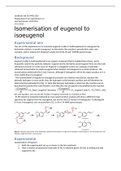
abstracted by hydroxide first (fig. 1). Note that because hydroxide is reformed, the reaction can be
described by pseudo-first order kinetics, such that the rate of eugenol consumption by the reaction
−d [eugenol ] −d [eugenol]
=k 2 [ base ] [eugenol ] becomes =k 1 [ eugenol ] with k 1 =k 2 [base ]. With
dt dt
this rate equation, one can plot the fraction of eugenol converted as a function of time.
EI-MS (electron ionisation followed by mass spectrometry) analysis will show a different mass
spectrum for eugenol than for isoeugenol, but not for the E/Z-isomers of isoeugenol. To distinguish
E- from Z-isoeugenol, one must perform GC, or IR or 1H-NMR spectroscopy.
Figure 1. Reaction mechanism of the hydroxide-catalysed isomerisation of eugenol to isoeugenol. Isomerisation is not stereoselective and
therefore yields both the E- and Z-isomer.
Experimental
Isomerisation of Eugenol
1. Build the experimental set up as shown in the lab notebook.
2. Heat a solution of potassium hydroxide (4 M) in ethylene glycol (30 mL) to boiling and add
eugenol (6 mL).
, 3. Remove aliquots of 1 mL from the reaction mixture at 15 min intervals, remove the heat
source.
4. Neutralise the aliquots by adding dilute hydrochloric acid (4 M, 2.5 mL), extract it with diethyl
ether (2x1 mL) in small reaction tubes, and dry it over sodium sulphate.
5. Dilute 10 μL of the ether fraction to a final volume of 1 mL and subject it to GC analysis. Use
these results to determine the rate constant of the reaction.
6. Add water (30 mL) to the reaction mixture after it has completed. Adjust the pH to 9 by drop-
wise addition of concentrated hydrochloric acid.
7. Extract the product from the aqueous layer with dichloromethane (DCM) (3x20 mL).
8. Dry the combined organic layers over magnesium sulphate.
9. Remove the solvent (DCM) by rotary evaporation (atm pressure; 50 ◦C bath).
10. Analyse the obtained oil using EI-MS analysis, IR and 1H-NMR spectroscopy.
Expected result(s)
The oil obtained from the hydroxide-catalysed isomerisation reaction is expected to contain eugenol,
E- and Z-isoeugenol. The pseudo first-order rate constant of the reaction (k 1) is expected to be
approximately 0.05 min-1 ≈ 8.3 x 10⁻⁴ s-1.
Expected spectra:
EI-MS
IR spectroscopy
1
H-NMR spectroscopy
Preparation form experiment 4.1
Lisa Verhoeven, s1014716
13-2-2022
Isomerisation of eugenol to
isoeugenol
Experimental aim
The aim of this experiment is to isomerise eugenol (4-allyl-2-methoxyphenol) to isoeugenol by
hydroxide catalysis, to purify isoeugenol, to determine the reaction’s pseudo-first-order rate
constant, and to analyse the obtained sample by EI-MS, IR and 1H-NMR spectroscopy.
Background
Eugenol (4-allyl-2-methoxyphenol) is an organic compound that is isolated from cloves, and is
frequently used in the perfume industry. Eugenol and its derivative acetyl eugenol form are the main
substances present in crude clove oil. Eugenol’s conjugated system can undergo a hydroxide-
catalysed isomerisation to yield isoeugenol when heated. As isoeugenol is an internal alkene, the
isomerisation yields both the E and Z isomer, although E-isoeugenol will be the major product as it is
more stable than Z-isoeugenol.
The isomerisation of eugenol to isoeugenol proceeds via a dianion mechanism, because the
phenolic hydrogen is more acidic than the hydrogen at the benzylic position and will therefore be
abstracted by hydroxide first (fig. 1). Note that because hydroxide is reformed, the reaction can be
described by pseudo-first order kinetics, such that the rate of eugenol consumption by the reaction
−d [eugenol ] −d [eugenol]
=k 2 [ base ] [eugenol ] becomes =k 1 [ eugenol ] with k 1 =k 2 [base ]. With
dt dt
this rate equation, one can plot the fraction of eugenol converted as a function of time.
EI-MS (electron ionisation followed by mass spectrometry) analysis will show a different mass
spectrum for eugenol than for isoeugenol, but not for the E/Z-isomers of isoeugenol. To distinguish
E- from Z-isoeugenol, one must perform GC, or IR or 1H-NMR spectroscopy.
Figure 1. Reaction mechanism of the hydroxide-catalysed isomerisation of eugenol to isoeugenol. Isomerisation is not stereoselective and
therefore yields both the E- and Z-isomer.
Experimental
Isomerisation of Eugenol
1. Build the experimental set up as shown in the lab notebook.
2. Heat a solution of potassium hydroxide (4 M) in ethylene glycol (30 mL) to boiling and add
eugenol (6 mL).
, 3. Remove aliquots of 1 mL from the reaction mixture at 15 min intervals, remove the heat
source.
4. Neutralise the aliquots by adding dilute hydrochloric acid (4 M, 2.5 mL), extract it with diethyl
ether (2x1 mL) in small reaction tubes, and dry it over sodium sulphate.
5. Dilute 10 μL of the ether fraction to a final volume of 1 mL and subject it to GC analysis. Use
these results to determine the rate constant of the reaction.
6. Add water (30 mL) to the reaction mixture after it has completed. Adjust the pH to 9 by drop-
wise addition of concentrated hydrochloric acid.
7. Extract the product from the aqueous layer with dichloromethane (DCM) (3x20 mL).
8. Dry the combined organic layers over magnesium sulphate.
9. Remove the solvent (DCM) by rotary evaporation (atm pressure; 50 ◦C bath).
10. Analyse the obtained oil using EI-MS analysis, IR and 1H-NMR spectroscopy.
Expected result(s)
The oil obtained from the hydroxide-catalysed isomerisation reaction is expected to contain eugenol,
E- and Z-isoeugenol. The pseudo first-order rate constant of the reaction (k 1) is expected to be
approximately 0.05 min-1 ≈ 8.3 x 10⁻⁴ s-1.
Expected spectra:
EI-MS
IR spectroscopy
1
H-NMR spectroscopy