Synthesis lab 1b (MOL126)
Preparation form experiment 4.3b (LJV010)
Lisa Verhoeven, s1014716
27-2-2022
Synthesis of 1-bromo-1,2-
diphenylethene by
dehydrobromination of meso-
stilbene dibromide
Experimental aim
The aim of this experiment is to synthesise 1-bromo-1,2-diphenylethene by dehydrobromination of
meso-stilbene dibromide and to analyse it by means of TLC, melting point analysis, IR, H- and C-NMR
spectroscopy.
Background
Meso-stilbene dibromide can be de-hydrobrominated via an E2 reaction with a strong, non-
nucleophilic base such as hydroxide. As E2 reactions only proceed if the leaving group and
eliminating group can attain an anti-periplanar geometry, the de-hydrobromination of both
diastereomers of stilbene dibromide will yield (E)-1-bromo-1,2-diphenylethene. It could, however, be
that a small fraction of the meso-stilbene dibromide reacts via the E1 mechanism. As this E1
mechanism puts no constraint on the geometry of the transition state, also a very small fraction of
(Z)-1-bromo-1,2-diphenylethene might be formed. Hydroxide is very suitable for performing
elimination reactions because it is non-nucleophilic, as this minimises the extent to which the
competing SN2 reaction proceeds. The choice of solvent is very important to successfully synthesise
1-bromo-1,2-diphenylethene, as it is crucial to limit double dehydrobrominations and the resultant
synthesis of 1,2-diphenylethyne. As a much higher temperature is required for a second
dehydrobromination reaction to proceed because of its increased activation energy with respect to
the first dehydrobromination, solvents with a relatively low boiling point such as ethanol for example
(78◦C) are very suitable.
The dehydrobromination reaction can be monitored by means of TLC, as 1-bromo-1,2-
diphenylethene is less polar than meso-stilbene dibromide.
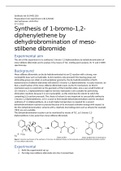
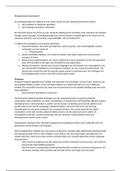
Figure 1. Reaction mechanism of the synthesis of 1-bromo-1,2-diphenyl ethene via the hydroxide-mediated dehydrobromination reaction
on meso-stilbene dibromide.
Experimental
1. Build the experimental set up
2. Put 0.8g meso-stilbene dibromide into the 3-necked flask
Preparation form experiment 4.3b (LJV010)
Lisa Verhoeven, s1014716
27-2-2022
Synthesis of 1-bromo-1,2-
diphenylethene by
dehydrobromination of meso-
stilbene dibromide
Experimental aim
The aim of this experiment is to synthesise 1-bromo-1,2-diphenylethene by dehydrobromination of
meso-stilbene dibromide and to analyse it by means of TLC, melting point analysis, IR, H- and C-NMR
spectroscopy.
Background
Meso-stilbene dibromide can be de-hydrobrominated via an E2 reaction with a strong, non-
nucleophilic base such as hydroxide. As E2 reactions only proceed if the leaving group and
eliminating group can attain an anti-periplanar geometry, the de-hydrobromination of both
diastereomers of stilbene dibromide will yield (E)-1-bromo-1,2-diphenylethene. It could, however, be
that a small fraction of the meso-stilbene dibromide reacts via the E1 mechanism. As this E1
mechanism puts no constraint on the geometry of the transition state, also a very small fraction of
(Z)-1-bromo-1,2-diphenylethene might be formed. Hydroxide is very suitable for performing
elimination reactions because it is non-nucleophilic, as this minimises the extent to which the
competing SN2 reaction proceeds. The choice of solvent is very important to successfully synthesise
1-bromo-1,2-diphenylethene, as it is crucial to limit double dehydrobrominations and the resultant
synthesis of 1,2-diphenylethyne. As a much higher temperature is required for a second
dehydrobromination reaction to proceed because of its increased activation energy with respect to
the first dehydrobromination, solvents with a relatively low boiling point such as ethanol for example
(78◦C) are very suitable.
The dehydrobromination reaction can be monitored by means of TLC, as 1-bromo-1,2-
diphenylethene is less polar than meso-stilbene dibromide.
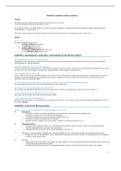
Figure 1. Reaction mechanism of the synthesis of 1-bromo-1,2-diphenyl ethene via the hydroxide-mediated dehydrobromination reaction
on meso-stilbene dibromide.
Experimental
1. Build the experimental set up
2. Put 0.8g meso-stilbene dibromide into the 3-necked flask