Fundamentals of International Finance – FIF1 – Exam Notes
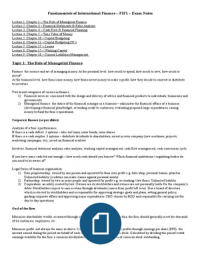
Lecture 1: Chapter 1 – The Role of Managerial Finance
Lecture 2: Chapter 3 – Financial Statements & Ratio Analysis
Lecture 3: Chapter 4 – Cash Flow & Financial Planning
Lecture 4: Chapter 5 – Time Value of Money
Lecture 5: Chapter 10 – Capital Budgeting
Lecture 6: Chapter 11 – Capital Budgeting CF’s
Lecture 7: Chapter 17 – Leases
Lecture 8: Chapter 15 – Working Capital
Lecture 9: Chapter 16 – Current Liabilities Management
Topic 1: The Role of Managerial Finance
Finance: the science and art of managing money. At the personal level: how much to spend, how much to save, how much to
invest?
At the business level: how firms raise money, how firms invest money to make a profit, how they decide to reinvest or distribute
to investors.
Two broad categories of careers in finance:
1) Financial services: concerned with the design and delivery of advice and financial products to individuals, businesses and
governments.
2) Managerial finance: the duties of the financial manager in a business – administer the financial affairs of a business
(developing a financial plan/budget, extending credit to customers, evaluating proposed large expenditures, raising
money to fund the firm’s operations).
Corporate finance (as per slides)
Analysis of a firm’s performance.
If there is a cash deficit: 3 options – take out loans, issue bonds, issue shares
If there is a cash surplus: 3 options – distribute dividends to shareholders, invest in own company (new machines, projects,
marketing campaigns, etc), invest on financial markets
Involves: financial statement analysis, ratio analysis, working capital management, cash flow management, cash conversion cycle
If you have some cash but not enough – how much cash should you borrow? Which financial institutions / regulating bodies do
you need to be aware of?
Legal forms of business organisation:
1) Sole proprietorship: owned by one person and operated for their own profit e.g. bike shop, personal trainer, plumber.
Unlimited liability (creditors can make claims against personal assets).
2) Partnership: owned by two or more people and operated for profit e.g. accounting / law firms. Unlimited liability.
3) Corporation: an entity created by law. Owners are its stockholders and owners are not personally liable for the company’s
debts. Stockholders expect to earn a return through dividends (comes from profit left over). Has a board of directors
which is elected by stockholders and is responsible for approving strategic goals and plans, setting general policy,
guiding corporate affairs and approving major expenditures. CEO chosen by BOD and responsible for carrying out the
day-to-day operations.
Goal of the firm
Maximise shareholder wealth: measured through share price. However first to do this, the firm should generally meet the demands
of its customers, employees, etc
Maximise profit: not always the same as above. Corporations commonly measure profits through earnings per share (EPS): the
amount earned during the period on behalf of each outstanding share of common stock. Calculated by dividing the period’s total
earnings available for the firm’s common stockholders by the number of shares of common stock outstanding.
1
, Profit max. does not always lead to the highest possible share price for the following reasons:
1) Timing: funds received sooner may be invested and therefore lead to higher profit over time (funds received sooner
rather than later is better)
2) Cash flows: profits don’t necessarily translate in to cash flows available to stockholders. E.g. reducing costs may lead to
higher profits but this may not lead to higher earnings in future (poorer quality).
3) Risk: profit maximisation doesn’t account for risk (the chance that actual outcomes may differ from those expected).
Higher risk can reduce share price even if profit is high.
Stakeholders: groups such as employees, customers, suppliers, creditors, owners, etc who have a direct economic link to the firm.
The role of business ethics: the standards of conduct or moral judgement that apply to persons engaged in commerce. Violations
are common, including “creative accounting”, misleading forecasts, insider trading, fraud, bribery, kickbacks, etc. Good ethics
programs can enhance shareholder price through reduction in litigation and judgement costs, positive corporate image, gaining
respect and confidence and loyalty of stakeholders, etc.
Managerial finance function – relationship to economics
- Marginal-cost benefit analysis is the economic principle that states that financial decisions should be made and actions
taken only when the added benefits exceed the added costs
Relationship to accounting:
- Accountants generally use the accrual method; in finance, the focus is on cash flows
Primary activities of the finance manager investment decisions (assets); financing decisions (liabilities)
Corporate governance: refers to the rules, processes and laws by which companies are operated, controlled and regulated.
- Defines the rights and responsibilities of the corporate participants such as the shareholders, BOD, officers and managers
and other stakeholders, as well as the rules and procedures for making corporate decisions.
Individual vs. institutional investors:
- Individual investors own relatively small quantities of shares so as to meet personal investment goals
- Institutional investors are investment professionals, such as banks, insurance companies, mutual funds, and pension funds
that are paid to manage and hold large quantities of securities on behalf of others. They can monitor and directly
influence a firm’s corporate governance by exerting pressure on management to perform or communicate their concerns
to the firm’s board.
Government regulation shapes the corporate governance of all firms. During the recent decade, corporate governance has received
increased attention due to several high-profile corporate scandals involving abuse of corporate power and, in some cases, alleged
criminal activity by corporate officers.
Sarbanes-Oxley Act of 2002 – monitor accounting industry and practices, audit regulations and controls, tough penalties
The Agency Issue
A principal-agent relationship is an arrangement in which an agent acts on the behalf of a principal. For example, shareholders of
a company (principals) elect management (agents) to act on their behalf.
Agency problems arise when managers place personal goals ahead of the goals of shareholders.
Agency costs arise from agency problems that are borne by shareholders and represent a loss of shareholder wealth.
Topic 2: Financial Statements & Ratio Analysis
3.1. The Stockholder’s Report
2
Lecture 1: Chapter 1 – The Role of Managerial Finance
Lecture 2: Chapter 3 – Financial Statements & Ratio Analysis
Lecture 3: Chapter 4 – Cash Flow & Financial Planning
Lecture 4: Chapter 5 – Time Value of Money
Lecture 5: Chapter 10 – Capital Budgeting
Lecture 6: Chapter 11 – Capital Budgeting CF’s
Lecture 7: Chapter 17 – Leases
Lecture 8: Chapter 15 – Working Capital
Lecture 9: Chapter 16 – Current Liabilities Management
Topic 1: The Role of Managerial Finance
Finance: the science and art of managing money. At the personal level: how much to spend, how much to save, how much to
invest?
At the business level: how firms raise money, how firms invest money to make a profit, how they decide to reinvest or distribute
to investors.
Two broad categories of careers in finance:
1) Financial services: concerned with the design and delivery of advice and financial products to individuals, businesses and
governments.
2) Managerial finance: the duties of the financial manager in a business – administer the financial affairs of a business
(developing a financial plan/budget, extending credit to customers, evaluating proposed large expenditures, raising
money to fund the firm’s operations).
Corporate finance (as per slides)
Analysis of a firm’s performance.
If there is a cash deficit: 3 options – take out loans, issue bonds, issue shares
If there is a cash surplus: 3 options – distribute dividends to shareholders, invest in own company (new machines, projects,
marketing campaigns, etc), invest on financial markets
Involves: financial statement analysis, ratio analysis, working capital management, cash flow management, cash conversion cycle
If you have some cash but not enough – how much cash should you borrow? Which financial institutions / regulating bodies do
you need to be aware of?
Legal forms of business organisation:
1) Sole proprietorship: owned by one person and operated for their own profit e.g. bike shop, personal trainer, plumber.
Unlimited liability (creditors can make claims against personal assets).
2) Partnership: owned by two or more people and operated for profit e.g. accounting / law firms. Unlimited liability.
3) Corporation: an entity created by law. Owners are its stockholders and owners are not personally liable for the company’s
debts. Stockholders expect to earn a return through dividends (comes from profit left over). Has a board of directors
which is elected by stockholders and is responsible for approving strategic goals and plans, setting general policy,
guiding corporate affairs and approving major expenditures. CEO chosen by BOD and responsible for carrying out the
day-to-day operations.
Goal of the firm
Maximise shareholder wealth: measured through share price. However first to do this, the firm should generally meet the demands
of its customers, employees, etc
Maximise profit: not always the same as above. Corporations commonly measure profits through earnings per share (EPS): the
amount earned during the period on behalf of each outstanding share of common stock. Calculated by dividing the period’s total
earnings available for the firm’s common stockholders by the number of shares of common stock outstanding.
1
, Profit max. does not always lead to the highest possible share price for the following reasons:
1) Timing: funds received sooner may be invested and therefore lead to higher profit over time (funds received sooner
rather than later is better)
2) Cash flows: profits don’t necessarily translate in to cash flows available to stockholders. E.g. reducing costs may lead to
higher profits but this may not lead to higher earnings in future (poorer quality).
3) Risk: profit maximisation doesn’t account for risk (the chance that actual outcomes may differ from those expected).
Higher risk can reduce share price even if profit is high.
Stakeholders: groups such as employees, customers, suppliers, creditors, owners, etc who have a direct economic link to the firm.
The role of business ethics: the standards of conduct or moral judgement that apply to persons engaged in commerce. Violations
are common, including “creative accounting”, misleading forecasts, insider trading, fraud, bribery, kickbacks, etc. Good ethics
programs can enhance shareholder price through reduction in litigation and judgement costs, positive corporate image, gaining
respect and confidence and loyalty of stakeholders, etc.
Managerial finance function – relationship to economics
- Marginal-cost benefit analysis is the economic principle that states that financial decisions should be made and actions
taken only when the added benefits exceed the added costs
Relationship to accounting:
- Accountants generally use the accrual method; in finance, the focus is on cash flows
Primary activities of the finance manager investment decisions (assets); financing decisions (liabilities)
Corporate governance: refers to the rules, processes and laws by which companies are operated, controlled and regulated.
- Defines the rights and responsibilities of the corporate participants such as the shareholders, BOD, officers and managers
and other stakeholders, as well as the rules and procedures for making corporate decisions.
Individual vs. institutional investors:
- Individual investors own relatively small quantities of shares so as to meet personal investment goals
- Institutional investors are investment professionals, such as banks, insurance companies, mutual funds, and pension funds
that are paid to manage and hold large quantities of securities on behalf of others. They can monitor and directly
influence a firm’s corporate governance by exerting pressure on management to perform or communicate their concerns
to the firm’s board.
Government regulation shapes the corporate governance of all firms. During the recent decade, corporate governance has received
increased attention due to several high-profile corporate scandals involving abuse of corporate power and, in some cases, alleged
criminal activity by corporate officers.
Sarbanes-Oxley Act of 2002 – monitor accounting industry and practices, audit regulations and controls, tough penalties
The Agency Issue
A principal-agent relationship is an arrangement in which an agent acts on the behalf of a principal. For example, shareholders of
a company (principals) elect management (agents) to act on their behalf.
Agency problems arise when managers place personal goals ahead of the goals of shareholders.
Agency costs arise from agency problems that are borne by shareholders and represent a loss of shareholder wealth.
Topic 2: Financial Statements & Ratio Analysis
3.1. The Stockholder’s Report
2