
States of Matter and Kinetic Molecular Theory Worksheet
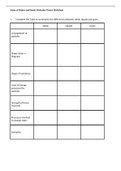
1. Complete the Table to summarize the differences between solids, liquids and gases.
Solids Liquids Gases
Arrangement of
particles
Shape (draw a
diagram)
Shape of substance
Level of energy
possessed by
particles
Strength of forces
involved:
Processes involved
to change state:
Examples:
, 2. During an investigation into water and its properties, Precious took some ice cubes, placed them in a
beaker and heated it over a burner. She took the temperature over regular intervals and drew a graph
from the results. The graph is shown below.
In terms of increase in temperature, forces between molecules, distance between molecules, average
kinetic energy between molecules, phase change, increase in potential energy and boiling point, explain
what is happening :
2.1 between points A and B
2.2 at point B
2.3 between points B and C
2.4 Are the phase changes that occur physical or chemical changes? Explain.
2.5 If you keep heating the water beyond point E, will you be able to separate the water vapour into
hydrogen and oxygen? Explain.
3. ______ is the amount of matter that makes up something.
4. ______ is the amount of space that a material takes up.
5. Anything that has mass and volume is called _______.
6. When you add energy to matter, the particles move and the matter ______.
7. Particles in a solid are packed so close together they can only ______.
8. Particles in a liquid can _______.
9. Particles in a gas can _____.
10. When you remove energy from particles they move ____ and the matter ____.
11. The _____ explains how particles act when their spacing and movement change.
12. Gases consist of large numbers of tiny particles that are far apart relative to their size. This means that
___.
13. Collisions between gas particles and between particles and container walls are elastic collisions. This
means that ____.
14. Gas particles are in constant, rapid, random motion. This can be inferred because __________.
1. Complete the Table to summarize the differences between solids, liquids and gases.
Solids Liquids Gases
Arrangement of
particles
Shape (draw a
diagram)
Shape of substance
Level of energy
possessed by
particles
Strength of forces
involved:
Processes involved
to change state:
Examples:
, 2. During an investigation into water and its properties, Precious took some ice cubes, placed them in a
beaker and heated it over a burner. She took the temperature over regular intervals and drew a graph
from the results. The graph is shown below.
In terms of increase in temperature, forces between molecules, distance between molecules, average
kinetic energy between molecules, phase change, increase in potential energy and boiling point, explain
what is happening :
2.1 between points A and B
2.2 at point B
2.3 between points B and C
2.4 Are the phase changes that occur physical or chemical changes? Explain.
2.5 If you keep heating the water beyond point E, will you be able to separate the water vapour into
hydrogen and oxygen? Explain.
3. ______ is the amount of matter that makes up something.
4. ______ is the amount of space that a material takes up.
5. Anything that has mass and volume is called _______.
6. When you add energy to matter, the particles move and the matter ______.
7. Particles in a solid are packed so close together they can only ______.
8. Particles in a liquid can _______.
9. Particles in a gas can _____.
10. When you remove energy from particles they move ____ and the matter ____.
11. The _____ explains how particles act when their spacing and movement change.
12. Gases consist of large numbers of tiny particles that are far apart relative to their size. This means that
___.
13. Collisions between gas particles and between particles and container walls are elastic collisions. This
means that ____.
14. Gas particles are in constant, rapid, random motion. This can be inferred because __________.


