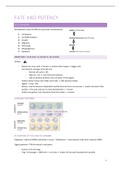
FATE AND POTENCY
CELL DIVISION
Development: blend of different processes simultaneously
1) Cell division
2) Cell differentiation
3) Growth
4) Migration
5) Patterning
6) Morphogenesis
7) Apoptosis
EMBRYONIC CLEAVAGE VS SOMATIC DIVISIONS
Embryo
- Bottom has more yolk => heavier => division takes longer => bigger cells
- Fast division/ cleavage cycle (30 min)
- Normal cell cycle is 16h
- Skips G1 + G2 => only mitosis & synthesis
- cells do produce proteins, but use what’s in the zygote
- Embryo doesn’t grow, but makes more cells => cells become smaller
- Zygote -> frog = 43h
- Reason: need to become independent quickly because there are enemies => need to be able to flee
quickly => this puts pressure on early development <-> human
- Embryo has gotten a lot of proteins from the mother <-> human
CLEAVAGE PATTERNS
ACTIVATION OF THE ZYGOTIC GENOME
Oogenesis: maternal mRNAs laid down in oocyt -> fertilization -> new proteins made from maternal mRNA
Zygotic genome = TXN of embryo’s own genes
- Human: 8-16 cell stage
- Frog: 12 cleavages = 4000 cells => very late => makes the fast early development possible
1
,DIFFERENTIATION: GENERATION OF CELLULAR DIVERSITY OR SPECIALIZED CELL TYPES
Cells have…
- Different needs
- Different phenotypes > other set of genes are activated, specific transcriptome
RESTRICTION VS POTENCY: 2 THEORIES
Restriction Potency
Cells lost all genes except those relevant to their task Cells kept entire genome and selectively turned
genes on or off
GOOD ONE
HANS SPEMANN – HILDE MANGOLD
aim: get a scence up until what stage they are totipotent
Conclusion:
- 1 nucleus has the ability to make a whole salamander
- Number of cells is not important
- Same as in monozygotic twins
- Cells keep their potency for a couple of divisions
- Increasing number of nuclei => potency goes down
POTENCY
WADDINGTON’S EPIGENETIC LANDSCAPE
Conclusion:
- This is not true
- Cells overexpress certain factors which make them a specific cell
2
,GERM LAYERS
Increase in organizational complexity
1) Embryo generates a couple of distinct regions = 3 germ layers
- Ectoderm: epidermis, CNS
- Mesoderm: cardiovascular system, urogenital system, muscles, bone & cartilage
- Endoderm: GI system, associated organs, lungs
2) Within these layers the fate of the cells is determined
ANIMAL CAP ASSAY
Conclusion: activin is a morphogen that changes the fate of the cells
3
, SPECIFICATION AND DETERMINATION
DETERMINATION ASSESSMENT BY IN VIVO TRANSPLANTATION
Specification: cell or tissue is specified to a given fate when it is capable of differentiating autonomously when
placed in isolation in a neutral environment. The cell identity is still labile
Determination: cell or tissue is determined when it is capable of differentiating autonomously even when
placed in another environment
Terminally differentiated cells: usually post-mitotic cells
GENOMIC EQUIVALENCE AND REPRO GRAMMING
Extracellular signals and ‘cues’ trigger changes in gene expression
- Stretch, flow, pressure… = mechanical cues
- TF expressed in different combinations
- 1 TF regulates in positive/ negative way
Differential gene expression:
1) Every somatic cell nucleus of an organism contains the complete genome established in the zygote
= genomic equivalence
2) Unused genes of differentiated cells are not destroyed or mutated
3) Small portion of the genome is expressed in each cell, only a portion of that is specific for that cell type
The characteristic proteome of a cell is the result of:
1) Differential gene expression
2) Selective pre-messenger RNA processing
3) Selective messenger RNA translation
4) Differential PTM regulates function/ localization/ turn-over
4
CELL DIVISION
Development: blend of different processes simultaneously
1) Cell division
2) Cell differentiation
3) Growth
4) Migration
5) Patterning
6) Morphogenesis
7) Apoptosis
EMBRYONIC CLEAVAGE VS SOMATIC DIVISIONS
Embryo
- Bottom has more yolk => heavier => division takes longer => bigger cells
- Fast division/ cleavage cycle (30 min)
- Normal cell cycle is 16h
- Skips G1 + G2 => only mitosis & synthesis
- cells do produce proteins, but use what’s in the zygote
- Embryo doesn’t grow, but makes more cells => cells become smaller
- Zygote -> frog = 43h
- Reason: need to become independent quickly because there are enemies => need to be able to flee
quickly => this puts pressure on early development <-> human
- Embryo has gotten a lot of proteins from the mother <-> human
CLEAVAGE PATTERNS
ACTIVATION OF THE ZYGOTIC GENOME
Oogenesis: maternal mRNAs laid down in oocyt -> fertilization -> new proteins made from maternal mRNA
Zygotic genome = TXN of embryo’s own genes
- Human: 8-16 cell stage
- Frog: 12 cleavages = 4000 cells => very late => makes the fast early development possible
1
,DIFFERENTIATION: GENERATION OF CELLULAR DIVERSITY OR SPECIALIZED CELL TYPES
Cells have…
- Different needs
- Different phenotypes > other set of genes are activated, specific transcriptome
RESTRICTION VS POTENCY: 2 THEORIES
Restriction Potency
Cells lost all genes except those relevant to their task Cells kept entire genome and selectively turned
genes on or off
GOOD ONE
HANS SPEMANN – HILDE MANGOLD
aim: get a scence up until what stage they are totipotent
Conclusion:
- 1 nucleus has the ability to make a whole salamander
- Number of cells is not important
- Same as in monozygotic twins
- Cells keep their potency for a couple of divisions
- Increasing number of nuclei => potency goes down
POTENCY
WADDINGTON’S EPIGENETIC LANDSCAPE
Conclusion:
- This is not true
- Cells overexpress certain factors which make them a specific cell
2
,GERM LAYERS
Increase in organizational complexity
1) Embryo generates a couple of distinct regions = 3 germ layers
- Ectoderm: epidermis, CNS
- Mesoderm: cardiovascular system, urogenital system, muscles, bone & cartilage
- Endoderm: GI system, associated organs, lungs
2) Within these layers the fate of the cells is determined
ANIMAL CAP ASSAY
Conclusion: activin is a morphogen that changes the fate of the cells
3
, SPECIFICATION AND DETERMINATION
DETERMINATION ASSESSMENT BY IN VIVO TRANSPLANTATION
Specification: cell or tissue is specified to a given fate when it is capable of differentiating autonomously when
placed in isolation in a neutral environment. The cell identity is still labile
Determination: cell or tissue is determined when it is capable of differentiating autonomously even when
placed in another environment
Terminally differentiated cells: usually post-mitotic cells
GENOMIC EQUIVALENCE AND REPRO GRAMMING
Extracellular signals and ‘cues’ trigger changes in gene expression
- Stretch, flow, pressure… = mechanical cues
- TF expressed in different combinations
- 1 TF regulates in positive/ negative way
Differential gene expression:
1) Every somatic cell nucleus of an organism contains the complete genome established in the zygote
= genomic equivalence
2) Unused genes of differentiated cells are not destroyed or mutated
3) Small portion of the genome is expressed in each cell, only a portion of that is specific for that cell type
The characteristic proteome of a cell is the result of:
1) Differential gene expression
2) Selective pre-messenger RNA processing
3) Selective messenger RNA translation
4) Differential PTM regulates function/ localization/ turn-over
4