Summary Pyc4808 Ecosystemic Psychology Study Pack (2022).
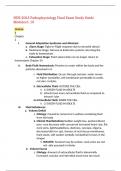
Pyc4808 Ecosystemic Psychology Study Pack (2022). INDIVIDUAL PSYCHOLOGY (Western) vs SYSTEMIC PSYCHOLOGY Most of us have been socialised into a Western, Lockean scientific tradition. Most individual psychology approaches rest on the assumptions of this linear worldview. Systems theory directs our attention away from the individual and moves towards andemphasis on recursion, reciprocity and mutual influence. Discuss this fundamental shift in worldviews by referring to the fundamental assumptions of bothtraditional individual psychology approaches and systems theory. (10) ‘Individual psychology approaches are based on assumptions that are fundamental tothewestern, Lockean tradition, while systemic family therapy rests on a very different set of assumptions. Discuss this statement by comparing the assumptions of systems theory. In your answer provide a definition of epistemology. (20-25) Whereas individual psychology approaches are based on assumptions fundamental to the Western, Lockean tradition, systemic family therapy rests onavery different set of assumptions. Western, Lockean, scientific tradition. Modernism Linear casualty (A causes B) In Individual psychology, the assumptions are consistent with such basic Americanvalues as individual responsibility and autonomy. Socialised in this way of thinking – consistent without communities + our culture Reality is out there, outside our minds and the truth is to be discovered Objective reality – break down into smaller components and uncover laws according to which the world operates Pursue knowledge by means of observation + experimentation These results are measurable and objective. The subject (observing) remain separate from object and be value free In Systemic family therapy, however, the underlying assumptions are contradictory to the traditional ways of thinking in Western society. Hence, our use of the term ‘counter-cultural’ to characterise systems theory andcybernetics. Systems theory/cybernetics directs our attention away from the individual andindividual problems viewed in isolation and toward relationships and relationshipissues between individuals. In contrast to the Lockean tradition, systems theory is consistent with the traditionlabelled as Kantian. Downloaded by: lebomonnakgotla | Distribution of this document is illegal S - The study-notes marketplace 3 Accordingly, the observer replaces the observed as the focus of attention. Downloaded by: lebomonnakgotla | Distribution of this document is illegal S - The study-notes marketplace 4 Subjectivity is seen as inevitable based on the assumption that the one whoisobserving perceives, acts on, and participates in creating his or her own reality. In addition, the interdependence of observer and observed is an important aspect of a holistic perspective that takes into account the context of their interaction. Such interaction is seen as a non-causal, dialectical process of mutual exchangein which both have influence. Finally, understanding a family or other system requires assessing patterns of interaction, with an emphasis on what is happening, rather than why it is happening. Individual Psychology (Western, Lockean) Systemic Psychology Asks WHY? Asks WHAT? Linear cause-and-effect A -B Reciprocal Causality A and B exists =giveandtake actions Subject or object dualism Dialectical Either or dichotomies Holistic Value-free science Subjective /Perceptual Deterministic /reactive Freedom of choice / pro-active Laws and law like external reality Patterns Historical Focus Here and now focus Individualistic Relational Reductionistic contextual Absolutistic relativistic Focus on content Focus on process Judgements about clients Logic behaviour in context Reality – out there How we each participate in creating our ownrealities The truth A story about stories What caused the problem How the problem is being maintained andthesolutions desired by the client Treating patients Interaction, recursion, mutual influence, perturbation People in isolation People in context/interdependence Who is in the room How the therapist THINKS about who is intheroom Define the following concepts and provide appropriate example in each one: Epistemology (2-3) A set of rules about what reality is, based on how a group of people think, talk andact. Epistemology pertains how rules that govern our thinking are created and shared– how we know what we know. How knowledge is created Your epistemology will shape your thinking as well as how you view and understand the world. Downloaded by: lebomonnakgotla | Distribution of this document is illegal S - The study-notes marketplace 5 the theory of knowledge, especially with regard to its methods, validity, and scope, and the distinction between justified belief and opinion. Defined narrowly, epistemology is the study of knowledge and justified belief. Example : Social Constructionism and Systems Theory Example :African Epistemology which includes the African conception of validityof knowledge, the purpose of the pursuit of knowledge and the role that knowledgeplays in human existence. For example, a lie cannot be truth because it is not factual and false Theory (2-3) Set of connected principles serving to explain a group of phenomena of interest tothe researcher Serving as a statement of relations believed in a body of observations Theories are informed and specified by particular epistemologies A theory is a formal idea or set of ideas that is intended to explain something. A theory is a based upon a hypothesis and backed by evidence. In science, athe- ory is not merely a guess. A theory is a fact-based framework for describingaphenomenon. A theory presents a concept or idea that is testable. Scientists can test the theorythrough empirical research and gather evidence that supports or refutes it. Example: Psychoanalytic theory, Behaviourist theory, General Systems Theory, etc.
Written for
- Institution
- University of South Africa
- Course
- Pyc4808 Ecosystemic Psychology (PYC4808)
Document information
- Uploaded on
- April 14, 2022
- Number of pages
- 51
- Written in
- 2021/2022
- Type
- SUMMARY
Subjects
-
pyc4808 ecosystemic psychology
-
pyc4808 study pack 2022
-
study pack 2022
-
pyc4808 ecosystemic psychology study pack 2022
-
pyc4808 ecosystemic psychology study pack
-
pyc4808 ecosystemic psychology 2