Psychopathology
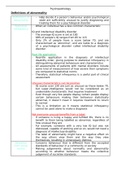
Definitions of abnormality
Definitions of - Help decide if a person’s behaviour and/or psychological
abnormality state are sufficiently unusual to justify diagnosing and
treating them for a psychological disorder
Statistical - When an individual has a less common characteristic
infrequency
IQ and intellectual disability disorder
- The average IQ score is set at 100
- 68% of people’s IQ ranges from 85 to 115
- Only 2% of people have a score below 70, and are
characterised as ‘abnormal’, and are liable to a diagnosis
of a psychological disorder called intellectual disability
disorder
Real-life application
- Real-life application in the diagnosis of intellectual
disability order, giving purpose to statistical infrequency in
distinguishing abnormal behaviours and characteristics
- All assessments of patients with mental disorders include
some kind of measurement of how severe their symptoms
are compared to statistical norms
- Therefore, statistical infrequency is a useful part of clinical
assessment
Unusual characteristics can be positive
- IQ scores over 130 are just as unusual as those below 70,
but super-intelligence would not be considered as an
undesirable characteristic that requires treatment
- Even though very few people display certain people display
certain behaviours making their behaviour statistically
abnormal, it doesn’t mean it requires treatment to return
to normal
- This is a limitation as it means statistical infrequency
cannot be used alone to make a diagnosis
Not everyone unusual benefits from a label
- If someone is living a happy and fulfilled life, there is no
benefit to them being labelled as abnormal, regardless of
how unusual they are
- For example, someone with a very low IQ but was not
distressed, capable of working and so on, would not need a
diagnosis of intellectual disability
- The label of abnormality might have a negative effect on
the way others view them and the way they view
themselves, resulting in unnecessary distress
Deviation - Concerns behaviour that is different from the accepted
from social standards of behaviour in a community or society
norms - Making judgements about normality and abnormality
according to whether behaviour meets the collective
judgement of societies standards
, Psychopathology
- Norms are specific to the culture we live in, so vary from
generation to culture and so there are very few behaviours
considered universally abnormal
Antisocial personality disorder
- A person who is impulsive, aggressive and irresponsible,
failing to conform to lawful or culturally normative ethical
behaviour
- This is considered abnormal in a wide range of cultures
Not a sole explanation
- A strength of deviation from social norms is that there is
real-life application in the diagnosis of antisocial
personality disorder
- HOWEVER, there are other factors to consider, for example
the distress to others resulting from antisocial personality
disorder
- This means that it cannot be the sole reason for defining
abnormality
Cultural relativism
- Social norms vary greatly from one generation to another
and from one community to another
- This means that a person from one cultural group may
label someone from another culture as behaving
abnormally according to their standards rather than the
standards of the person behaving that way
- For example, hearing voices is socially acceptable in some
cultures but would be seen as a sign of mental abnormality
in the UK
- This creates problems for people from one culture living
within another culture
Can lead to human rights abuses
- Historical examples of deviation from social norms show
that diagnoses were made to maintain control minority
ethnic groups and women
- For example, nymphomania was a disorder amongst
woman who had a sexual attraction towards working-class
men
- Radical psychologists suggest that modern categories of
mental disorder are abuses of people’s rights to be
different
Failure to - When someone is unable to cope with ordinary demands of
function day-to-day living
adequately - May be when they cannot maintain basic standards of
nutrition and hygiene, or cannot hold down a job or
relationships with people around them
Criteria – Rosenhan and Seligman (1989)
Definitions of abnormality
Definitions of - Help decide if a person’s behaviour and/or psychological
abnormality state are sufficiently unusual to justify diagnosing and
treating them for a psychological disorder
Statistical - When an individual has a less common characteristic
infrequency
IQ and intellectual disability disorder
- The average IQ score is set at 100
- 68% of people’s IQ ranges from 85 to 115
- Only 2% of people have a score below 70, and are
characterised as ‘abnormal’, and are liable to a diagnosis
of a psychological disorder called intellectual disability
disorder
Real-life application
- Real-life application in the diagnosis of intellectual
disability order, giving purpose to statistical infrequency in
distinguishing abnormal behaviours and characteristics
- All assessments of patients with mental disorders include
some kind of measurement of how severe their symptoms
are compared to statistical norms
- Therefore, statistical infrequency is a useful part of clinical
assessment
Unusual characteristics can be positive
- IQ scores over 130 are just as unusual as those below 70,
but super-intelligence would not be considered as an
undesirable characteristic that requires treatment
- Even though very few people display certain people display
certain behaviours making their behaviour statistically
abnormal, it doesn’t mean it requires treatment to return
to normal
- This is a limitation as it means statistical infrequency
cannot be used alone to make a diagnosis
Not everyone unusual benefits from a label
- If someone is living a happy and fulfilled life, there is no
benefit to them being labelled as abnormal, regardless of
how unusual they are
- For example, someone with a very low IQ but was not
distressed, capable of working and so on, would not need a
diagnosis of intellectual disability
- The label of abnormality might have a negative effect on
the way others view them and the way they view
themselves, resulting in unnecessary distress
Deviation - Concerns behaviour that is different from the accepted
from social standards of behaviour in a community or society
norms - Making judgements about normality and abnormality
according to whether behaviour meets the collective
judgement of societies standards
, Psychopathology
- Norms are specific to the culture we live in, so vary from
generation to culture and so there are very few behaviours
considered universally abnormal
Antisocial personality disorder
- A person who is impulsive, aggressive and irresponsible,
failing to conform to lawful or culturally normative ethical
behaviour
- This is considered abnormal in a wide range of cultures
Not a sole explanation
- A strength of deviation from social norms is that there is
real-life application in the diagnosis of antisocial
personality disorder
- HOWEVER, there are other factors to consider, for example
the distress to others resulting from antisocial personality
disorder
- This means that it cannot be the sole reason for defining
abnormality
Cultural relativism
- Social norms vary greatly from one generation to another
and from one community to another
- This means that a person from one cultural group may
label someone from another culture as behaving
abnormally according to their standards rather than the
standards of the person behaving that way
- For example, hearing voices is socially acceptable in some
cultures but would be seen as a sign of mental abnormality
in the UK
- This creates problems for people from one culture living
within another culture
Can lead to human rights abuses
- Historical examples of deviation from social norms show
that diagnoses were made to maintain control minority
ethnic groups and women
- For example, nymphomania was a disorder amongst
woman who had a sexual attraction towards working-class
men
- Radical psychologists suggest that modern categories of
mental disorder are abuses of people’s rights to be
different
Failure to - When someone is unable to cope with ordinary demands of
function day-to-day living
adequately - May be when they cannot maintain basic standards of
nutrition and hygiene, or cannot hold down a job or
relationships with people around them
Criteria – Rosenhan and Seligman (1989)