
Paleoceanography summary exam I
Paleoceanography → reconstructing the past ocean from sediment cores to get information of past
climate variability. Past information will show how the world responds to changing CO2 levels.
Latest CO2 reading: 415 ppm.
Pre-industrial: 218 ppm
Per year a 3/4 ppm increase
Ocean basics: temperature, salinity and density
Density
- Ocean is density stratified.
- in ocean = σ = ρ – 1000 (kg/m3) → simplified number
- Drives overturning circulation
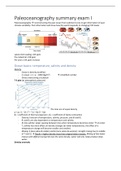
T-S plot (at atmospheric pressure)
The lines are of equal density
ρ = ρ0 ( 1 – βT ( T – T0 ) + βS (S – S0))
βT = coefficient of thermal expansion ; βS = coefficient of haline contraction
- Density: function of temperature, salinity, pressure, and βT and βS
- βT and βS are also dependent on temperature and salinity
- At low salinity: larger spacing between lines when temperature becomes cooler → at cooler
T, salinity has more effect on density changes (at lower temperatures, the effect of a
temperature change will become smaller and smaller)
- Mixing: A (less saline & colder) and B (more saline & warmer): straight mixing line (in middle
of T and S). → Result = higher density mass than original water masses. Mixing of two water
masses with different properties but the same density, water will sink, helps produce deep
water.
Density anomaly
, - Fresh water (S=0): T of max density just below 4°C
o fresh water freezes at the surface because the colder water does not sink
o Structuring of the water before freezing increases the density
- Ocean: T of max density switches.
o T of max density = freezing point → upper cold mass will sink underneath underlying
warmer mass until whole column is mixed and equally cold.
o Salt hinders structuring of the water before freezing
- Forming sea ice much harder than freezing fresh water system
- Salinity ↑, freezing point ↓
Ocean temperature
Sea surface temperature: warmer in higher latitudes. Pacific cooler than Atlantic.
Deep ocean temperature:
- Pacific: 3.36°C ; Atlantic: 3.73°C ; Indian: 3.72°C ; Average ocean: 3.52°C
- Deep water is colder than surface water because it forms at higher latitudes with low T.
Constantly cold everywhere because constantly fuelled with low T water from high latitudes
- Southern ocean → clear connection between different depths → uniform temperature
Temperature profile:
- Mixed layer = uppermost part that is well mixed due to turbulence
o How deep this layer goes is dependent on wind strength
- Thermocline = interval with largest temperature change (0 -+/- 1000M) → decrease in T from
mixed layer
- Abyss = below thermocline, temperature changes are relatively small
, - Deep ocean is typically beneath 1500 meters.
Salinity = total amount of dissolved material in g/kg of sea water
- Salinity is based on chlorinity → Absolute salinity
o S = 1.80655 Cl in gram / L
o Most Cl from oceans comes from volcanism
- Salinity based on conductivity relative to the KCI solution
o Absolute salinity = 1.00510 * practical salinity
o Ratio: salinity has no unit but often practical salinity (psu) is used
- SSS = sea surface salinity → depends on balance between evaporation (E) and precipitation
(P) = E-P balance
- High salinity in subtropical gyres → much evaporation → E-P is high
- Low salinity in high temperature low latitudes (tropics)→ much precipitation → E-P is low
- North Pacific → relatively fresh → no deep water formation
- North Atlantic → quite saline → deep water formation
Residence time
- input rate: 336*10^15 kg/yr
- Mass in ocean: 1322 * 10^18 kg
- Residence time = 39000 yr
Residence time = period one molecule of water spends in the ocean before it is removed back into
the atmosphere (where it will stay in a few days)
Mixing in the ocean takes a 1000 years.
Classes in residence time
- Millions of years → high concentrations: sodium, chlorine etc.
o High RT and high concentration: evenly/homogeneously distributed
- Shorter residence time → major nutrients
o Get consumed by biological activity
o Especially in upwelling areas and surface ocean (light means productivity)
- Very short residence time → low concentrations: micronutrients and metals
o Enter ocean → almost immediately removed
o Scavenged, interacts with other elements.
o Heterogenous distribution
Ocean circulation patterns
Sub-tropical gyre: SH → counter clockwise. NH → clockwise. Western boundary current stronger and
warmer than the eastern one.
Paleoceanography → reconstructing the past ocean from sediment cores to get information of past
climate variability. Past information will show how the world responds to changing CO2 levels.
Latest CO2 reading: 415 ppm.
Pre-industrial: 218 ppm
Per year a 3/4 ppm increase
Ocean basics: temperature, salinity and density
Density
- Ocean is density stratified.
- in ocean = σ = ρ – 1000 (kg/m3) → simplified number
- Drives overturning circulation
T-S plot (at atmospheric pressure)
The lines are of equal density
ρ = ρ0 ( 1 – βT ( T – T0 ) + βS (S – S0))
βT = coefficient of thermal expansion ; βS = coefficient of haline contraction
- Density: function of temperature, salinity, pressure, and βT and βS
- βT and βS are also dependent on temperature and salinity
- At low salinity: larger spacing between lines when temperature becomes cooler → at cooler
T, salinity has more effect on density changes (at lower temperatures, the effect of a
temperature change will become smaller and smaller)
- Mixing: A (less saline & colder) and B (more saline & warmer): straight mixing line (in middle
of T and S). → Result = higher density mass than original water masses. Mixing of two water
masses with different properties but the same density, water will sink, helps produce deep
water.
Density anomaly
, - Fresh water (S=0): T of max density just below 4°C
o fresh water freezes at the surface because the colder water does not sink
o Structuring of the water before freezing increases the density
- Ocean: T of max density switches.
o T of max density = freezing point → upper cold mass will sink underneath underlying
warmer mass until whole column is mixed and equally cold.
o Salt hinders structuring of the water before freezing
- Forming sea ice much harder than freezing fresh water system
- Salinity ↑, freezing point ↓
Ocean temperature
Sea surface temperature: warmer in higher latitudes. Pacific cooler than Atlantic.
Deep ocean temperature:
- Pacific: 3.36°C ; Atlantic: 3.73°C ; Indian: 3.72°C ; Average ocean: 3.52°C
- Deep water is colder than surface water because it forms at higher latitudes with low T.
Constantly cold everywhere because constantly fuelled with low T water from high latitudes
- Southern ocean → clear connection between different depths → uniform temperature
Temperature profile:
- Mixed layer = uppermost part that is well mixed due to turbulence
o How deep this layer goes is dependent on wind strength
- Thermocline = interval with largest temperature change (0 -+/- 1000M) → decrease in T from
mixed layer
- Abyss = below thermocline, temperature changes are relatively small
, - Deep ocean is typically beneath 1500 meters.
Salinity = total amount of dissolved material in g/kg of sea water
- Salinity is based on chlorinity → Absolute salinity
o S = 1.80655 Cl in gram / L
o Most Cl from oceans comes from volcanism
- Salinity based on conductivity relative to the KCI solution
o Absolute salinity = 1.00510 * practical salinity
o Ratio: salinity has no unit but often practical salinity (psu) is used
- SSS = sea surface salinity → depends on balance between evaporation (E) and precipitation
(P) = E-P balance
- High salinity in subtropical gyres → much evaporation → E-P is high
- Low salinity in high temperature low latitudes (tropics)→ much precipitation → E-P is low
- North Pacific → relatively fresh → no deep water formation
- North Atlantic → quite saline → deep water formation
Residence time
- input rate: 336*10^15 kg/yr
- Mass in ocean: 1322 * 10^18 kg
- Residence time = 39000 yr
Residence time = period one molecule of water spends in the ocean before it is removed back into
the atmosphere (where it will stay in a few days)
Mixing in the ocean takes a 1000 years.
Classes in residence time
- Millions of years → high concentrations: sodium, chlorine etc.
o High RT and high concentration: evenly/homogeneously distributed
- Shorter residence time → major nutrients
o Get consumed by biological activity
o Especially in upwelling areas and surface ocean (light means productivity)
- Very short residence time → low concentrations: micronutrients and metals
o Enter ocean → almost immediately removed
o Scavenged, interacts with other elements.
o Heterogenous distribution
Ocean circulation patterns
Sub-tropical gyre: SH → counter clockwise. NH → clockwise. Western boundary current stronger and
warmer than the eastern one.


