Psychology and the Brain: Week 5
What is attention?
- 1953 Colin Cherry
- Asked how we recognise what one person is saying when others are speaking at the
same time – cocktail party effect
- Dichotic listening paradigm
- ppts wear headphones and are asked to listen to input from one ear whilst the
ignoring the input from the other
- early research found that ppts tend to be able to recall the content of the message
from the attended ear
- whilst having almost no recollection from the unattended ear
- they can sometimes tell you some of the perceptual characteristics of that message
“Recall of content (also referred to as ‘shadowing’) is almost perfect for the attended
channel but almost non-existent for the unattended channel” (Treisman, 1964)
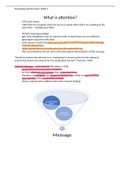
Selective attention – early selection (Broadbent, 1958)
- all perceptual characteristics are taken in
- we then select only the message that is important to us
- therefore, we recognise the content of that message whilst we only recall the
characteristics of the unattended message
- theory criticized and conflicted with other research findings
Unattended
input
Desired
information
Message
, Psychology and the Brain: Week 5
Selective attention – late selection (Deutsch & Deutsch, 1963)
- argued that both the unattended as well as the attended message get processed
including the perceptual and semantic features – content
- but only the content of the unattended message is later being made available for
conscious retrieval from a limited
capacity memory store
Unattended
input
Desired
information
Rees, Russell, Frith, & Driver (1999):
- ppts saw a stream of red images Memory
- on top of these images there were
strings of letters in green which either
formed a word or a string of random
letters
Message
- the first two graphs on the left that in
the language processing areas of the
brain
- two graphs on the right you see the
signal in these areas when
participants were told to attend to
the pictures instead of the letter strings
- there was a difference in the bold signal when participants were asked to process
words depending on whether the words were real words or nonsense letter strings
- signals are near identical - suggests that the content of the letter strings was not
processed deeply
- as there was no distinction in brain activation between words and non-words
What is attention?
- 1953 Colin Cherry
- Asked how we recognise what one person is saying when others are speaking at the
same time – cocktail party effect
- Dichotic listening paradigm
- ppts wear headphones and are asked to listen to input from one ear whilst the
ignoring the input from the other
- early research found that ppts tend to be able to recall the content of the message
from the attended ear
- whilst having almost no recollection from the unattended ear
- they can sometimes tell you some of the perceptual characteristics of that message
“Recall of content (also referred to as ‘shadowing’) is almost perfect for the attended
channel but almost non-existent for the unattended channel” (Treisman, 1964)
Selective attention – early selection (Broadbent, 1958)
- all perceptual characteristics are taken in
- we then select only the message that is important to us
- therefore, we recognise the content of that message whilst we only recall the
characteristics of the unattended message
- theory criticized and conflicted with other research findings
Unattended
input
Desired
information
Message
, Psychology and the Brain: Week 5
Selective attention – late selection (Deutsch & Deutsch, 1963)
- argued that both the unattended as well as the attended message get processed
including the perceptual and semantic features – content
- but only the content of the unattended message is later being made available for
conscious retrieval from a limited
capacity memory store
Unattended
input
Desired
information
Rees, Russell, Frith, & Driver (1999):
- ppts saw a stream of red images Memory
- on top of these images there were
strings of letters in green which either
formed a word or a string of random
letters
Message
- the first two graphs on the left that in
the language processing areas of the
brain
- two graphs on the right you see the
signal in these areas when
participants were told to attend to
the pictures instead of the letter strings
- there was a difference in the bold signal when participants were asked to process
words depending on whether the words were real words or nonsense letter strings
- signals are near identical - suggests that the content of the letter strings was not
processed deeply
- as there was no distinction in brain activation between words and non-words