Grammar:
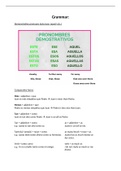
Demonstrative pronouns (este/ese/ aquel/ etc.)
Comparative forms
Más + adjective + que
Juan es más simpático que Pedro Juan is nicer than Pedro.
Menos + adjective + que
Pedro es menos simpático que Juan Pedro is less nice than Juan.
Tan + adjective + como
Juan es tan alto como Pedro Juan is as tall as Pedro
Tan + adjective + como as + adjective + as
e.g. Juana es tan alta como yo. Juana is as tall as me.
Tanto(s)/ tanta(s) + noun + como as many/much + noun + as
e.g. Juana tiene tanto dinero como su hermana. Juana has as much money as
her sister.
Verb + tanto como verb + as much as
e.g. Yo no estudio tanto como mi amiga. I do not study as much as my
friend.
, Irregular comparatives:
Bueno (= good) Mejor/mejores + que
Esta película es major que esa.
Malo (=bad) Peor/peores + que
Esos pasteles son peores que estos.
Grande (=big) Mayor/mayores + que
Yo soy mayor que ella.
Pequeño (=small) Menor/menores + que
Cinco es menor que ocho.
Personal pronouns for direct and indirect object
A direct object pronoun replaces a direct object in a sentence. A direct object is the noun that the
verb is acting on.
An indirect object is to whom or for whom an action is done. A indirect object pronoun replaces an
indirect object in a sentence.
* The indirect object goes before the direct object
* When le or les (indirect object pronouns) are followed by lo, la, los or las, the indirect object
pronoun will change to se. This is because it can be confusing and hard to say “le las”.
* Object pronouns can be attached to the end of a command or a present progressive phrase. When
you do this, you’ll have to add in accent marks to maintain the correct pronunciation/emphasis of the
syllables.
* Lo/la > geen personen and Le > people
Personal Pronouns as Direct Object (DO)
me me
te you (informal/singular)
lo (person) / lo (thing) him / it
la (person) / la (thing) her / it
lo / la you (formal/singular)
nos us
os you (informal/plural)
los (persons) / los (things) them
las (persons) / las (things) them
los / las you (formal/plural)
Persons
Te llamo por teléfono. I’ll phone you.
La invitamos para la fiesta. We invite her for the party.
¿Os vemos en la discoteca? Will we see you (informal/plural) in the
discotheque?
Los llevo a casa. I will take you (formal/plural) home.
Demonstrative pronouns (este/ese/ aquel/ etc.)
Comparative forms
Más + adjective + que
Juan es más simpático que Pedro Juan is nicer than Pedro.
Menos + adjective + que
Pedro es menos simpático que Juan Pedro is less nice than Juan.
Tan + adjective + como
Juan es tan alto como Pedro Juan is as tall as Pedro
Tan + adjective + como as + adjective + as
e.g. Juana es tan alta como yo. Juana is as tall as me.
Tanto(s)/ tanta(s) + noun + como as many/much + noun + as
e.g. Juana tiene tanto dinero como su hermana. Juana has as much money as
her sister.
Verb + tanto como verb + as much as
e.g. Yo no estudio tanto como mi amiga. I do not study as much as my
friend.
, Irregular comparatives:
Bueno (= good) Mejor/mejores + que
Esta película es major que esa.
Malo (=bad) Peor/peores + que
Esos pasteles son peores que estos.
Grande (=big) Mayor/mayores + que
Yo soy mayor que ella.
Pequeño (=small) Menor/menores + que
Cinco es menor que ocho.
Personal pronouns for direct and indirect object
A direct object pronoun replaces a direct object in a sentence. A direct object is the noun that the
verb is acting on.
An indirect object is to whom or for whom an action is done. A indirect object pronoun replaces an
indirect object in a sentence.
* The indirect object goes before the direct object
* When le or les (indirect object pronouns) are followed by lo, la, los or las, the indirect object
pronoun will change to se. This is because it can be confusing and hard to say “le las”.
* Object pronouns can be attached to the end of a command or a present progressive phrase. When
you do this, you’ll have to add in accent marks to maintain the correct pronunciation/emphasis of the
syllables.
* Lo/la > geen personen and Le > people
Personal Pronouns as Direct Object (DO)
me me
te you (informal/singular)
lo (person) / lo (thing) him / it
la (person) / la (thing) her / it
lo / la you (formal/singular)
nos us
os you (informal/plural)
los (persons) / los (things) them
las (persons) / las (things) them
los / las you (formal/plural)
Persons
Te llamo por teléfono. I’ll phone you.
La invitamos para la fiesta. We invite her for the party.
¿Os vemos en la discoteca? Will we see you (informal/plural) in the
discotheque?
Los llevo a casa. I will take you (formal/plural) home.