

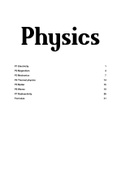
P1 Electricity 1
P2 Magnetism 4
P3 Mechanics 7
P4 Thermal physics 14
P5 Matter 16
P6 Waves 19
P7 Radioactivity 26
Formulas 31
,P1 Electricity
Insulators can be charged by friction
● When two insulators move relative to each other, friction between the two can
result in both objects becoming electrically charged.
● One of the objects becomes positively charged, and the other becomes
negatively charged.
● Conductors, such as metals, can also become charged, but will only retain that
charge if they are insulated from their surroundings. If they are not insulated, then
any charge that builds up will leak away.
It is also possible for objects to become charged by induction → neutral object placed
near a charged object can become charged by magnetic induction or electrostatic
induction
If the object is momentarily earthed, it can become permanently charged
Charging is caused by gain or loss of electrons
Like charges repel and unlike charges attract
Understand applications and hazards associated with electrostatics, including the role
of earthing
● Electrostatic charging by friction has useful applications, such as photocopying, laser
printing and electrostatic air cleaning
● Electrostatic charging by friction is often a nuisance → Hair sticking to the comb ,
thunderstorms, sparking, electric shocks
● Sparking is what occurs when the air between two objects becomes ionised by a
large voltage and therefore starts conducting. Two charged objects, that have air
between them, can discharge by a spark between them. This will happen either when
the charge becomes large enough or when the distance between the objects
becomes small enough. Small sparks are a nuisance; large sparks can be
dangerous.
● The risk of fires being caused by sparking is an aspect of electrostatic charging by
friction that can make it very dangerous
● The risk of sparking can be eliminated by earthing. If two objects, that would
otherwise cause each other to become charged by friction, are connected together
by a wire (or if one of them is connected to Earth by a wire) → electrostatic charging
cannot take place and the risk is averted.
Circuits
Direct current(dc)=Sources of ac are cells or
batteries
Alternating current (ac) = Generators in power
stations produce ac →
1
,Very common symbols in circuits
Conductors and insulators
Examples of good conductors → because of free electrons:
- all metals, particularly copper, gold and silver
- carbon (in the form of graphite)
- ionic solutions.
Examples of good insulators (poor conductors):
- most non-metals, particularly plastics, rubber, dry wood, air, vacuum
𝑄
𝐼= 𝑡
I = current (stroom), amp (A)
Q = charge (lading), coulombs (C)
Current = + → - Electrons= - → +
A voltmeter is connected in parallel
An ammeter is connected in series
𝑉
𝑅= 𝐼
R = resistance (weerstand), Ohm (𝛀)
𝑉=𝐼×𝑅V = voltage (spanning, U), Volt (v)
I = current (stroom), amp (A)
Ohm’s law → Straight line, passing in origin in V,I-graph
Filament lamp (PTC) = Temperature increases → Resistance increases
2
, NTC thermistors, LDRs and ideal diodes
NTC thermistors = Temperature increases → Resistance decreases
LDRs = Light intensity increases → Resistance decreases
Diode = Only allows current in one direction,+ → -
Current, voltage and resistance rules for series and parallel circuits
Series circuit
𝐼𝑡𝑜𝑡 = 𝐼1 = 𝐼2 =.....
𝑉𝑡𝑜𝑡 = 𝑉1 + 𝑉2 +.....
𝑅𝑡𝑜𝑡 = 𝑅1 + 𝑅2 +.....
Parallel circuits
𝐼𝑡𝑜𝑡 = 𝐼1 + 𝐼2 +.....
𝑉𝑡𝑜𝑡 = 𝑉1 = 𝑉2 =.....
1 1 1 𝑝𝑟𝑜𝑑𝑢𝑐𝑡 𝑅1𝑅2
𝑅𝑡𝑜𝑡
= 𝑅1
+ 𝑅2
+..... 𝑅𝑡𝑜𝑡 = 𝑠𝑢𝑚
= 𝑅1×𝑅2
At each branch in a parallel circuit, the total current moving into the branch is equal to the
total current moving out of it (wetten van Kirchhoff)
𝐸
𝑉= 𝑄
1 V = 1 J/C
2
power = current × voltage 𝑃 = 𝑉𝐼 = 𝐼 𝑅P = power (stroom), watt (W)
energy transfer = power × time 𝐸=Pt=𝑉𝐼𝑡
3
P2 Magnetism 4
P3 Mechanics 7
P4 Thermal physics 14
P5 Matter 16
P6 Waves 19
P7 Radioactivity 26
Formulas 31
,P1 Electricity
Insulators can be charged by friction
● When two insulators move relative to each other, friction between the two can
result in both objects becoming electrically charged.
● One of the objects becomes positively charged, and the other becomes
negatively charged.
● Conductors, such as metals, can also become charged, but will only retain that
charge if they are insulated from their surroundings. If they are not insulated, then
any charge that builds up will leak away.
It is also possible for objects to become charged by induction → neutral object placed
near a charged object can become charged by magnetic induction or electrostatic
induction
If the object is momentarily earthed, it can become permanently charged
Charging is caused by gain or loss of electrons
Like charges repel and unlike charges attract
Understand applications and hazards associated with electrostatics, including the role
of earthing
● Electrostatic charging by friction has useful applications, such as photocopying, laser
printing and electrostatic air cleaning
● Electrostatic charging by friction is often a nuisance → Hair sticking to the comb ,
thunderstorms, sparking, electric shocks
● Sparking is what occurs when the air between two objects becomes ionised by a
large voltage and therefore starts conducting. Two charged objects, that have air
between them, can discharge by a spark between them. This will happen either when
the charge becomes large enough or when the distance between the objects
becomes small enough. Small sparks are a nuisance; large sparks can be
dangerous.
● The risk of fires being caused by sparking is an aspect of electrostatic charging by
friction that can make it very dangerous
● The risk of sparking can be eliminated by earthing. If two objects, that would
otherwise cause each other to become charged by friction, are connected together
by a wire (or if one of them is connected to Earth by a wire) → electrostatic charging
cannot take place and the risk is averted.
Circuits
Direct current(dc)=Sources of ac are cells or
batteries
Alternating current (ac) = Generators in power
stations produce ac →
1
,Very common symbols in circuits
Conductors and insulators
Examples of good conductors → because of free electrons:
- all metals, particularly copper, gold and silver
- carbon (in the form of graphite)
- ionic solutions.
Examples of good insulators (poor conductors):
- most non-metals, particularly plastics, rubber, dry wood, air, vacuum
𝑄
𝐼= 𝑡
I = current (stroom), amp (A)
Q = charge (lading), coulombs (C)
Current = + → - Electrons= - → +
A voltmeter is connected in parallel
An ammeter is connected in series
𝑉
𝑅= 𝐼
R = resistance (weerstand), Ohm (𝛀)
𝑉=𝐼×𝑅V = voltage (spanning, U), Volt (v)
I = current (stroom), amp (A)
Ohm’s law → Straight line, passing in origin in V,I-graph
Filament lamp (PTC) = Temperature increases → Resistance increases
2
, NTC thermistors, LDRs and ideal diodes
NTC thermistors = Temperature increases → Resistance decreases
LDRs = Light intensity increases → Resistance decreases
Diode = Only allows current in one direction,+ → -
Current, voltage and resistance rules for series and parallel circuits
Series circuit
𝐼𝑡𝑜𝑡 = 𝐼1 = 𝐼2 =.....
𝑉𝑡𝑜𝑡 = 𝑉1 + 𝑉2 +.....
𝑅𝑡𝑜𝑡 = 𝑅1 + 𝑅2 +.....
Parallel circuits
𝐼𝑡𝑜𝑡 = 𝐼1 + 𝐼2 +.....
𝑉𝑡𝑜𝑡 = 𝑉1 = 𝑉2 =.....
1 1 1 𝑝𝑟𝑜𝑑𝑢𝑐𝑡 𝑅1𝑅2
𝑅𝑡𝑜𝑡
= 𝑅1
+ 𝑅2
+..... 𝑅𝑡𝑜𝑡 = 𝑠𝑢𝑚
= 𝑅1×𝑅2
At each branch in a parallel circuit, the total current moving into the branch is equal to the
total current moving out of it (wetten van Kirchhoff)
𝐸
𝑉= 𝑄
1 V = 1 J/C
2
power = current × voltage 𝑃 = 𝑉𝐼 = 𝐼 𝑅P = power (stroom), watt (W)
energy transfer = power × time 𝐸=Pt=𝑉𝐼𝑡
3


