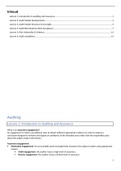
Inhoud
Lecture 1: Introduction to Auditing and Assurance.....................................................................................................1
Lecture 2: Audit Market Developments......................................................................................................................4
Lecture 3: Audit Market Structure & Oversight...........................................................................................................5
Lecture 4: Audit Risk Model & Client Acceptance........................................................................................................7
Lecture 5: Risk, Materiality & Evidence.....................................................................................................................12
Lecture 6: Audit completion......................................................................................................................................14
Auditing
Lecture 1: Introduction to Auditing and Assurance
What is an assurance engagement?
An engagement in which a practitioner aims to obtain sufficient appropriate evidence in order to express a
conclusion designed to enhance the degree of confidence of the intended users other than the responsible party
about the subject matter information.
Assurance engagement:
Attestation engagement: the accountable party (management) measures the subjects matter using appropriate
criteria;
Audit engagement: the auditor issues a high level of assurance;
Review engagement: the auditor issues a limited level of assurance.
1
, Direct engagements: the practitioner (auditor) measures or evaluates the underlying subject matter against the
applicable criteria.
What is the objective of an audit of financial statements?
To enhance the degree of confidence of intended users in the financial statements.
How do we enhance the degree of confidence of intended users in the financial statements?
By the expression of an opinion by the auditor on whether the financial statements are prepared, in all material
respects, in accordance with an applicable financial reporting framework. The financial statements should give a true
and fair view.
Management or audit Auditor Auditor issues report relied
committee hires upon by users to reduce
auditor information risk
Provide capital
Client External users
Client provides financial
statements to users
Why do users of financial statements need assurance practices?
Information may be false, biased, inaccurate, irrelevant, incomplete (information risk);
The financial statements impact the decisions of shareholders, borrowers, suppliers, customers etc.;
The transactions and valuation are complex and the users lack expertise, time and access, so the users can’t
check if the information is correct.
The value of the audit depends on public confidence in the competence and independence of the auditor.
Exogenous demand: the demand comes from regulation (government).
Endogenous demand: the demand comes from within the economy.
What is the principle of the agency theory?
The principle is that the managers of public companies (agents) ‘’work’’ for shareholders (principals) who provide
capital.
What are the assumptions of the agency theory?
That everyone maximizes their own self-interest and that everyone has ‘’rational expectations’’ (i.e. has perfect
judgement and foresight);
That managers require compensation to work hard and that they tend to not work hard (shirk) because
shareholders can’t readily monitor their work levels. Therefore shareholders want to reduce their compensation.
Managers will therefore hire auditors to show that they work hard.
What are the benefits of reliable information?
It reduces the risk and therefore the risk premium is lower;
It improves (internal) decision making.
Why is there a demand for audits by companies?
Audits are seen as normal conduct, therefore the absence may signal negligence or fraud;
It protects against liability claims;
It protects the reputation and may therefore lead to lower cost of capital;
2
, Deep pockets theory: if the auditors opinion on the financial statements is wrong and the company is bankrupt
the auditor is the only party left with sufficient funds to be sued by the company and the users.
Kausar et al. (2016) – Real Effects on the Audit Choice
What did Kausar et al. (2016) examine?
They examined whether the choice to obtain an audit eases financing frictions by conveying information about firms
future prospects that is independent of the information generated from the audit itself.
Audits increase the quality and reliability of financial statement disclosures. They reduce information asymmetry and
therefore cost of capital (verification effect).
Since many companies are subject to mandatory audits, it is impossible to study the impact of voluntary audit
choice. However, the UK increased audit exemption thresholds in 2004, therefore many companies were no longer
required to have an audit.
Which two theories did Kausar et al. (2016) study?
Signalling theory: firm want to signal that it is a high quality investment, because the audit costs are high and
therefore they show that they expect to reap greater benefits in the future;
Screening literature: external financers may require an audit to see if the firm can withstand an audit. Low
quality firms will not choose to undergo a costly audit, because the risk of failing is too high.
What impact does voluntary audit choice have according to Kausar et al. (2016)?
Companies that voluntary choose an audit increase their debt, investment, operating performance, and investment
efficiency following the regulation. The audit choice conveys information to capital providers (different from that of
the conveyed by the audit itself), which reduces information asymmetry and financing frictions.
3
Lecture 1: Introduction to Auditing and Assurance.....................................................................................................1
Lecture 2: Audit Market Developments......................................................................................................................4
Lecture 3: Audit Market Structure & Oversight...........................................................................................................5
Lecture 4: Audit Risk Model & Client Acceptance........................................................................................................7
Lecture 5: Risk, Materiality & Evidence.....................................................................................................................12
Lecture 6: Audit completion......................................................................................................................................14
Auditing
Lecture 1: Introduction to Auditing and Assurance
What is an assurance engagement?
An engagement in which a practitioner aims to obtain sufficient appropriate evidence in order to express a
conclusion designed to enhance the degree of confidence of the intended users other than the responsible party
about the subject matter information.
Assurance engagement:
Attestation engagement: the accountable party (management) measures the subjects matter using appropriate
criteria;
Audit engagement: the auditor issues a high level of assurance;
Review engagement: the auditor issues a limited level of assurance.
1
, Direct engagements: the practitioner (auditor) measures or evaluates the underlying subject matter against the
applicable criteria.
What is the objective of an audit of financial statements?
To enhance the degree of confidence of intended users in the financial statements.
How do we enhance the degree of confidence of intended users in the financial statements?
By the expression of an opinion by the auditor on whether the financial statements are prepared, in all material
respects, in accordance with an applicable financial reporting framework. The financial statements should give a true
and fair view.
Management or audit Auditor Auditor issues report relied
committee hires upon by users to reduce
auditor information risk
Provide capital
Client External users
Client provides financial
statements to users
Why do users of financial statements need assurance practices?
Information may be false, biased, inaccurate, irrelevant, incomplete (information risk);
The financial statements impact the decisions of shareholders, borrowers, suppliers, customers etc.;
The transactions and valuation are complex and the users lack expertise, time and access, so the users can’t
check if the information is correct.
The value of the audit depends on public confidence in the competence and independence of the auditor.
Exogenous demand: the demand comes from regulation (government).
Endogenous demand: the demand comes from within the economy.
What is the principle of the agency theory?
The principle is that the managers of public companies (agents) ‘’work’’ for shareholders (principals) who provide
capital.
What are the assumptions of the agency theory?
That everyone maximizes their own self-interest and that everyone has ‘’rational expectations’’ (i.e. has perfect
judgement and foresight);
That managers require compensation to work hard and that they tend to not work hard (shirk) because
shareholders can’t readily monitor their work levels. Therefore shareholders want to reduce their compensation.
Managers will therefore hire auditors to show that they work hard.
What are the benefits of reliable information?
It reduces the risk and therefore the risk premium is lower;
It improves (internal) decision making.
Why is there a demand for audits by companies?
Audits are seen as normal conduct, therefore the absence may signal negligence or fraud;
It protects against liability claims;
It protects the reputation and may therefore lead to lower cost of capital;
2
, Deep pockets theory: if the auditors opinion on the financial statements is wrong and the company is bankrupt
the auditor is the only party left with sufficient funds to be sued by the company and the users.
Kausar et al. (2016) – Real Effects on the Audit Choice
What did Kausar et al. (2016) examine?
They examined whether the choice to obtain an audit eases financing frictions by conveying information about firms
future prospects that is independent of the information generated from the audit itself.
Audits increase the quality and reliability of financial statement disclosures. They reduce information asymmetry and
therefore cost of capital (verification effect).
Since many companies are subject to mandatory audits, it is impossible to study the impact of voluntary audit
choice. However, the UK increased audit exemption thresholds in 2004, therefore many companies were no longer
required to have an audit.
Which two theories did Kausar et al. (2016) study?
Signalling theory: firm want to signal that it is a high quality investment, because the audit costs are high and
therefore they show that they expect to reap greater benefits in the future;
Screening literature: external financers may require an audit to see if the firm can withstand an audit. Low
quality firms will not choose to undergo a costly audit, because the risk of failing is too high.
What impact does voluntary audit choice have according to Kausar et al. (2016)?
Companies that voluntary choose an audit increase their debt, investment, operating performance, and investment
efficiency following the regulation. The audit choice conveys information to capital providers (different from that of
the conveyed by the audit itself), which reduces information asymmetry and financing frictions.
3