
Week 1
1. Introduction
What do you need to become a QR?
- Interest in process and meaning
- Critical approach to life and knowledge (why & how)
- Eyes and ears (listen & observe)
- Reflexivity (reflecting on your own role). Critical reflection on the research process
and one’s own role as a researcher.
- Good interaction skills
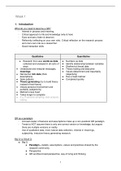
Qualitative Quantitative
● Research that uses words as data, ● Numbers as data
collected and analysed in all sorts of ● Identify relationship between variables
ways ● Shallow but broad data
● Understand and interpret messages, ● Theory testing and deductive
meanings ● Values detachment and impartiality
● Narrow but rich data (thick (objectivity)
descriptions) ● Has a fixed method
● Seek patterns ● Completed quickly
● Theory generating (try to build theory
instead of test theory)
● Values personal involvement and
partiality (subjectivity)
● Method is less fixed
● Takes longer to complete
● E.g. Purposive sampling, data analysis:
coding
QR as a paradigm
- A broad cluster of features and assumptions make up a non-positivist QR paradigm.
- Tends to NOT assume there is only one correct version or knowledge, but argues
there are multiple versions or reality.
- Use of qualitative data, more natural data collection, interest in meanings,
subjectivity, inductive theory generating research;
Big Q vs Small Q
a) Big Q
● Paradigm = beliefs, assumptions, values and practices shared by the
research community.
● Perspective
● QR as More broad perspective, way of living and thinking
1
, b) Small Q
● Technique
● Mixed method
● More common, pragmatic
● Certain RQ, a part of it can be answered with an experiment, survey, we need
some quantitative tools
History QR in Communication Science: Interdisciplinary, Psychology, Sociology, Political
science, QR in CS track.
2. Ten fundamentals of QR
1. QR is about meaning, not about numbers → we should focus on the meaning, try to
understand the people, what they think of a commercial, focus on meanings, how do
people interpret it
2. QR doesn’t provide a single answer → no incorrect or correct answers. Freedom to
use data. Creative. Can be considered as vague. Every researcher might understand
different things (based on different perspectives and backgrounds) although the data
set is the same. There is more than one way of making meaning from the analysed
data.
3. QR treats context as important → e.g. an american vs a dutch student will have a
different perspective and attitude on a commercial.
● Subjectivity. QR recognizes the subjectivity of the data we analyze and the
analysis we produce (pp. 21).
● Information and knowledge always come from somewhere
● QR doesn't treat subjectivity as bias.
4. QR can be experiential or critical → verstehen = understanding.
● Experimental QR:
○ Validates the meaning, views, perspectives, experiences and
practices expressed in the data.
○ Step into the person’s shoes, what does he tell me and how can I use
his words? E.g. walmart commercial: ask about the perspective - use
the words in the analysis
● Critical QR:
○ Interrogative stance towards meaning and experiences expressed in
the data.
○ Seeks to understand the factors influencing, and the effect of a
particular meaning or representation expressed.
2
, ○ rarely used. Do not use the words of the participants BUT what
cultural notions are below the surface? What is behind what they're
telling us. E.g. walmart commercial: Use the words to see your
perspective about this commercial.
○ Language creates rather than reflects reality.
○ Research can broadly be divided: representation, construction and
language practice.
5. QR is underpinned by ontological assumptions → ontological positions specify the
relationship between the world and our human interpretations and practices. There
are 3 main perspectives: relativism, critical realism, realism.
● Realism:
○ A view where ‘reality’ is entirely independent of human ways of
knowing about it.
○ The truth is out there and can be accessed by appropriate application
of research. There is only one truth. By doing research we can access
that truth. Qualitative approach.
○ E.g. Looking at a view through a perfect glass window in your house.
Your info corresponds with the reality out there.
● Critical realism:
○ There is a real and noble world, however, it lies behind our socially
located knowledge.
○ E.g. there is a telephone in the class, (1) useless, (2) useful to order
coffee. We all have a different perspective on how we see this
telephone.
○ E.g. looking at a view where the only way to see is through a prism,
what is seen is nuanced by the shape of the prism. If you get rid of the
prism you can see what lies behind, but you can never get beyond it.
● Relativism:
○ A view where reality entirely depends on human interpretation and
knowledge.
○ There are multiple constructed realities. What is true depends on time.
Everyone has their own reality. Qualitative approach.
○ When all have our own reality, it is difficult to do research &
communicate together.
○ E.g. prisoners looking at a view from their prison cells. Prisoners
housed in different cells will have different perspectives, but there is
no way of prioritising one prisoner's view over another’s
3
1. Introduction
What do you need to become a QR?
- Interest in process and meaning
- Critical approach to life and knowledge (why & how)
- Eyes and ears (listen & observe)
- Reflexivity (reflecting on your own role). Critical reflection on the research process
and one’s own role as a researcher.
- Good interaction skills
Qualitative Quantitative
● Research that uses words as data, ● Numbers as data
collected and analysed in all sorts of ● Identify relationship between variables
ways ● Shallow but broad data
● Understand and interpret messages, ● Theory testing and deductive
meanings ● Values detachment and impartiality
● Narrow but rich data (thick (objectivity)
descriptions) ● Has a fixed method
● Seek patterns ● Completed quickly
● Theory generating (try to build theory
instead of test theory)
● Values personal involvement and
partiality (subjectivity)
● Method is less fixed
● Takes longer to complete
● E.g. Purposive sampling, data analysis:
coding
QR as a paradigm
- A broad cluster of features and assumptions make up a non-positivist QR paradigm.
- Tends to NOT assume there is only one correct version or knowledge, but argues
there are multiple versions or reality.
- Use of qualitative data, more natural data collection, interest in meanings,
subjectivity, inductive theory generating research;
Big Q vs Small Q
a) Big Q
● Paradigm = beliefs, assumptions, values and practices shared by the
research community.
● Perspective
● QR as More broad perspective, way of living and thinking
1
, b) Small Q
● Technique
● Mixed method
● More common, pragmatic
● Certain RQ, a part of it can be answered with an experiment, survey, we need
some quantitative tools
History QR in Communication Science: Interdisciplinary, Psychology, Sociology, Political
science, QR in CS track.
2. Ten fundamentals of QR
1. QR is about meaning, not about numbers → we should focus on the meaning, try to
understand the people, what they think of a commercial, focus on meanings, how do
people interpret it
2. QR doesn’t provide a single answer → no incorrect or correct answers. Freedom to
use data. Creative. Can be considered as vague. Every researcher might understand
different things (based on different perspectives and backgrounds) although the data
set is the same. There is more than one way of making meaning from the analysed
data.
3. QR treats context as important → e.g. an american vs a dutch student will have a
different perspective and attitude on a commercial.
● Subjectivity. QR recognizes the subjectivity of the data we analyze and the
analysis we produce (pp. 21).
● Information and knowledge always come from somewhere
● QR doesn't treat subjectivity as bias.
4. QR can be experiential or critical → verstehen = understanding.
● Experimental QR:
○ Validates the meaning, views, perspectives, experiences and
practices expressed in the data.
○ Step into the person’s shoes, what does he tell me and how can I use
his words? E.g. walmart commercial: ask about the perspective - use
the words in the analysis
● Critical QR:
○ Interrogative stance towards meaning and experiences expressed in
the data.
○ Seeks to understand the factors influencing, and the effect of a
particular meaning or representation expressed.
2
, ○ rarely used. Do not use the words of the participants BUT what
cultural notions are below the surface? What is behind what they're
telling us. E.g. walmart commercial: Use the words to see your
perspective about this commercial.
○ Language creates rather than reflects reality.
○ Research can broadly be divided: representation, construction and
language practice.
5. QR is underpinned by ontological assumptions → ontological positions specify the
relationship between the world and our human interpretations and practices. There
are 3 main perspectives: relativism, critical realism, realism.
● Realism:
○ A view where ‘reality’ is entirely independent of human ways of
knowing about it.
○ The truth is out there and can be accessed by appropriate application
of research. There is only one truth. By doing research we can access
that truth. Qualitative approach.
○ E.g. Looking at a view through a perfect glass window in your house.
Your info corresponds with the reality out there.
● Critical realism:
○ There is a real and noble world, however, it lies behind our socially
located knowledge.
○ E.g. there is a telephone in the class, (1) useless, (2) useful to order
coffee. We all have a different perspective on how we see this
telephone.
○ E.g. looking at a view where the only way to see is through a prism,
what is seen is nuanced by the shape of the prism. If you get rid of the
prism you can see what lies behind, but you can never get beyond it.
● Relativism:
○ A view where reality entirely depends on human interpretation and
knowledge.
○ There are multiple constructed realities. What is true depends on time.
Everyone has their own reality. Qualitative approach.
○ When all have our own reality, it is difficult to do research &
communicate together.
○ E.g. prisoners looking at a view from their prison cells. Prisoners
housed in different cells will have different perspectives, but there is
no way of prioritising one prisoner's view over another’s
3


