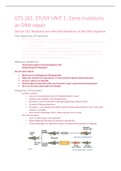
GTS 261: STUDY UNIT 1: Gene mutations
an DNA repair
Section 18.1 Mutations are inherited alterations in the DNA sequence
The importance of mutations
-
o
o
-
What are mutations?
- Are permanent changes in the nucleotide sequence of DNA
- Inherited alterations in DNA sequence
Basic facts about mutations:
1. Result from errors in DNA replication / DNA damage (later)
2. Range in size: anywhere from a single base pair, to a large chromosomal segment containing many genes
3. Can occur in coding or non-coding DNA
4. Mutations in genes can either have no effect, alter the product of a gene, or prevent function of encoded protein
5. May or may not produce visible changes in the phenotype
Categories of mutations
- Somatic mutations
o occur in non-reproductive cells of individual (somatic tissue)
o passed to new daughter cells through mitosis
o generates a clone of cells with mutant gene (genetically identical cells)
o no parent-offspring inheritance
o In humans: ~ one mutation per million mitotic divisions given adult has 1x10¹⁴ cells, many
somatic µ’s possible
o many have no phenotypic effect, others may give rise to cancer
- Germ-line mutations
o occur in cells that give rise to gametes
o parent-offspring inheritance by meiosis & reproduction
o mutant phenotype not expressed in parent, but potentially expressed in offspring
,Types of gene mutations (based on their molecular nature)
1. Nucleotide substitutions (base substitution)
o alteration of a single nucleotide in the DNA
o Transition: a purine is replaced by a different purine or, alternatively, a pyrimidine is replaced
by a different pyrimidine
o Transversion: a purine is replaced by a pyrimidine or a pyrimidine is replaced by a purine.
2. Insertions and deletions
o the addition or removal, respectively, of one or more nucleotide pairs
o In-frame mutations: insertions and deletions consisting of any multiple of three nucleotides
leave the reading frame intact, although the addition or removal of one or more amino acids
may still affect the phenotype
o Frameshift mutations: changes in the reading frame of the gene.
• usually alter all amino acids encoded by the nucleotides following the mutation, so they
generally have drastic effects on the phenotype
•
also introduce premature stop codons, terminating protein synthesis early and resulting
in a shortened (truncated) protein.
3. Expanding nucleotide repeats
o Increase in the number of copies of a certain set of nucleotides
1. Base/nucleotide substitution
Frequency of transition vs transversions
In theory, twice the number of possible transversions than transitions. But in nature, transitions are
generally more common. Why
- Transition µs are more easily generated because of the similar shapes of the molecules.
- Transition µs are less likely to be removed by natural selection because they often result in no amino
acid changes of encoded protein especially if µ occurs in 3rd base of codon (due to wobble of codons)
, 2. Insertions and deletions – indels
Insertion:
Deletion:
3. Expanding nucleotide repeats
- short motifs (1-5 bp), repeated many times
- naturally occur in coding or non-coding DNA regions
- high mutation rates due to replication errors
- also called short tandem repeats (STRs) / microsatellites
- used as genetic markers in forensics, ecology, evolution
- Copies of repeat motifs can, by mistake, increase in length, i.e. expand
- Repeat expansions beyond a certain number can cause genetic diseases
, Occurs during replication:
hairpin loop extra repeats
double a hairpin loop
causes are
stranded DNA new strand is forms at the
misalignment of incorporated
strands synthesised repeat region of
repeats/strand into new DNA
separate new strand
slippage strands
Excess amino acid repeats protein misfolding
If copies of such repeats keep on increasing / expanding in DNA (replication error), can lead to
certain genetic diseases
an DNA repair
Section 18.1 Mutations are inherited alterations in the DNA sequence
The importance of mutations
-
o
o
-
What are mutations?
- Are permanent changes in the nucleotide sequence of DNA
- Inherited alterations in DNA sequence
Basic facts about mutations:
1. Result from errors in DNA replication / DNA damage (later)
2. Range in size: anywhere from a single base pair, to a large chromosomal segment containing many genes
3. Can occur in coding or non-coding DNA
4. Mutations in genes can either have no effect, alter the product of a gene, or prevent function of encoded protein
5. May or may not produce visible changes in the phenotype
Categories of mutations
- Somatic mutations
o occur in non-reproductive cells of individual (somatic tissue)
o passed to new daughter cells through mitosis
o generates a clone of cells with mutant gene (genetically identical cells)
o no parent-offspring inheritance
o In humans: ~ one mutation per million mitotic divisions given adult has 1x10¹⁴ cells, many
somatic µ’s possible
o many have no phenotypic effect, others may give rise to cancer
- Germ-line mutations
o occur in cells that give rise to gametes
o parent-offspring inheritance by meiosis & reproduction
o mutant phenotype not expressed in parent, but potentially expressed in offspring
,Types of gene mutations (based on their molecular nature)
1. Nucleotide substitutions (base substitution)
o alteration of a single nucleotide in the DNA
o Transition: a purine is replaced by a different purine or, alternatively, a pyrimidine is replaced
by a different pyrimidine
o Transversion: a purine is replaced by a pyrimidine or a pyrimidine is replaced by a purine.
2. Insertions and deletions
o the addition or removal, respectively, of one or more nucleotide pairs
o In-frame mutations: insertions and deletions consisting of any multiple of three nucleotides
leave the reading frame intact, although the addition or removal of one or more amino acids
may still affect the phenotype
o Frameshift mutations: changes in the reading frame of the gene.
• usually alter all amino acids encoded by the nucleotides following the mutation, so they
generally have drastic effects on the phenotype
•
also introduce premature stop codons, terminating protein synthesis early and resulting
in a shortened (truncated) protein.
3. Expanding nucleotide repeats
o Increase in the number of copies of a certain set of nucleotides
1. Base/nucleotide substitution
Frequency of transition vs transversions
In theory, twice the number of possible transversions than transitions. But in nature, transitions are
generally more common. Why
- Transition µs are more easily generated because of the similar shapes of the molecules.
- Transition µs are less likely to be removed by natural selection because they often result in no amino
acid changes of encoded protein especially if µ occurs in 3rd base of codon (due to wobble of codons)
, 2. Insertions and deletions – indels
Insertion:
Deletion:
3. Expanding nucleotide repeats
- short motifs (1-5 bp), repeated many times
- naturally occur in coding or non-coding DNA regions
- high mutation rates due to replication errors
- also called short tandem repeats (STRs) / microsatellites
- used as genetic markers in forensics, ecology, evolution
- Copies of repeat motifs can, by mistake, increase in length, i.e. expand
- Repeat expansions beyond a certain number can cause genetic diseases
, Occurs during replication:
hairpin loop extra repeats
double a hairpin loop
causes are
stranded DNA new strand is forms at the
misalignment of incorporated
strands synthesised repeat region of
repeats/strand into new DNA
separate new strand
slippage strands
Excess amino acid repeats protein misfolding
If copies of such repeats keep on increasing / expanding in DNA (replication error), can lead to
certain genetic diseases