BCM252: STUDY UNIT 5
The Citric Acid Cycle
Introduction: Fate of Pyruvate
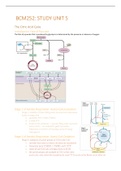
The fate of pyruvate that is produced by glycolysis is determined by the presence or absence of oxygen
Stage 1 of Aerobic Respiration: Acetyl-CoA production
- Stage 1: oxidation of fuels (fatty acids, glucose, and some amino
acids) to acetyl-CoA
o generates ATP, NADH, FADH2
o e- enter ETC
o Organic fuel molecules — glucose, fatty acids, and some
amino acids — are oxidized to yield two-carbon
fragments in the form of the acetyl group of acetyl-
coenzyme A
Stage 2 of Aerobic Respiration: Acetyl-CoA Oxidation
-
o
o
o
o
,Stage 3 of Aerobic Respiration: ETC and Oxidative
Phosphorylation
- Stage 3: ETC and oxidative phosphorylation
o Electrons carried by NADH and FADH2 are
funneled into a chain of electron carriers—the
respiratory chain—ultimately reducing O2 to H2O
o This electron flow drives the production of ATP
o Generates the vast majority of ATP during
catabolism
In Eukaryotes, Stages 2 and 3 Are Localized to the Mitochondria
- Glycolysis occurs in the cytoplasm
- Transition reaction and the citric acid cycle occurs in the mitochondrial matrix†
- Oxidative phosphorylation occurs in the inner mitochondrial membrane (bacteria- plasma membrane)
- †Except succinate dehydrogenase, which is located in the inner membrane
,Oxidative Decarboxylation of Pyruvate to Acetyl-CoA
- Under anaerobic conditions, pyruvate may simply be reduced to lactate in the
cytosol, regenerating NAD+ for continued ATP production by glycolysis.
- Pyruvate, the product of glycolysis, is transported into the mitochondrial matrix
by the mitochondrial pyruvate carrier - mitochondrial pyruvate carrier (MPC) = H+
-coupled pyruvate specific symporter in the inner mitochondrial membrane (H+
gradient is created by ETC)
- Glycolysis is linked to the citric acid cycle by the transition reaction (oxidative
decarboxylation of pyruvate to acetyl-CoA)
- Pyruvate in the mitochondrial matrix is oxidized to acetyl-CoA and by the
pyruvate dehydrogenase (PDH) complex, a highly ordered cluster of enzymes and
cofactors. In the PDH complex, a series of chemical intermediates remain bound
to the enzyme subunits as a substrate (pyruvate) is transformed into the final
product (acetyl-CoA).
- Pyruvate (3C) → Acetyl-CoA (2C) + CO2
- The conversion of pyruvate to acetyl-CoA is catalyzed by pyruvate dehydrogenase
complex – 3 enzymes
- Five cofactors, four of which are derived from vitamins, participate in the reaction mechanism. The regulation of this
enzyme complex illustrates how a combination of covalent modification and allosteric mechanism results in precisely
regulated flux through a metabolic step– Thiamine pyrophosphate (TPP), Lipoate (lipoic acid), CoA-SH, FAD, NAD+
- Oxidative decarboxylation of pyruvate [First reaction where CO2 is released (C3 → C2)]- irreversible reaction – highly
exergonic
- The overall reaction catalyzed by the pyruvate dehydrogenase complex is an oxidative decarboxylation, an irreversible
oxidation process in which the carboxyl group is removed from pyruvate as a molecule of CO2 and the two remaining
carbons become the acetyl group of acetyl-CoA. The NADH formed in this reaction gives up a hydride ion to the respiratory
chain, which carries the two electrons to oxygen or, in anaerobic microorganisms, to an alternative electron acceptor such
as nitrate or sulfate. The transfer of electrons from NADH to oxygen ultimately generates 2.5 molecules of ATP per pair of
electrons. The irreversibility of the PDH complex reaction has been demonstrated by isotopic labeling experiments: the
complex cannot reattach radioactively labeled to acetyl-CoA to yield carboxyl-labeled pyruvate.
, Coenzymes as Transient Carriers of Atoms or Functional Groups
Coenzyme A (CoA-SH)
- Coenzyme A has a reactive thiol (–SH) group that is critical to its role as an acyl carrier – the –SH group
forms a thioester with acetate in acetyl-CoA
- Because of their relatively high standard free energies of hydrolysis, thioesters have a high acyl group
transfer potential — that is, donation of their acyl groups to a variety of acceptor molecules is a
favorable reaction. The acyl group attached to coenzyme A may thus be thought of as “activated” for
group transfer.
Lipoic acid (Lipoate)
- Pseudovitamin (classified as a Bvitamin because of its
coenzyme function)
- Not a true vitamin, because it is synthesized in trace
amounts
- Lipoate- coenzyme with two thiol (-SH) groups that can
undergo reversible oxidation to a disulfide bond (–S–S–)
o serves as an electron (hydrogen) carrier and an acyl
carrier
o covalently linked to E2 via a lysine residue
(lipoyllysine) – amine linkage
The Citric Acid Cycle
Introduction: Fate of Pyruvate
The fate of pyruvate that is produced by glycolysis is determined by the presence or absence of oxygen
Stage 1 of Aerobic Respiration: Acetyl-CoA production
- Stage 1: oxidation of fuels (fatty acids, glucose, and some amino
acids) to acetyl-CoA
o generates ATP, NADH, FADH2
o e- enter ETC
o Organic fuel molecules — glucose, fatty acids, and some
amino acids — are oxidized to yield two-carbon
fragments in the form of the acetyl group of acetyl-
coenzyme A
Stage 2 of Aerobic Respiration: Acetyl-CoA Oxidation
-
o
o
o
o
,Stage 3 of Aerobic Respiration: ETC and Oxidative
Phosphorylation
- Stage 3: ETC and oxidative phosphorylation
o Electrons carried by NADH and FADH2 are
funneled into a chain of electron carriers—the
respiratory chain—ultimately reducing O2 to H2O
o This electron flow drives the production of ATP
o Generates the vast majority of ATP during
catabolism
In Eukaryotes, Stages 2 and 3 Are Localized to the Mitochondria
- Glycolysis occurs in the cytoplasm
- Transition reaction and the citric acid cycle occurs in the mitochondrial matrix†
- Oxidative phosphorylation occurs in the inner mitochondrial membrane (bacteria- plasma membrane)
- †Except succinate dehydrogenase, which is located in the inner membrane
,Oxidative Decarboxylation of Pyruvate to Acetyl-CoA
- Under anaerobic conditions, pyruvate may simply be reduced to lactate in the
cytosol, regenerating NAD+ for continued ATP production by glycolysis.
- Pyruvate, the product of glycolysis, is transported into the mitochondrial matrix
by the mitochondrial pyruvate carrier - mitochondrial pyruvate carrier (MPC) = H+
-coupled pyruvate specific symporter in the inner mitochondrial membrane (H+
gradient is created by ETC)
- Glycolysis is linked to the citric acid cycle by the transition reaction (oxidative
decarboxylation of pyruvate to acetyl-CoA)
- Pyruvate in the mitochondrial matrix is oxidized to acetyl-CoA and by the
pyruvate dehydrogenase (PDH) complex, a highly ordered cluster of enzymes and
cofactors. In the PDH complex, a series of chemical intermediates remain bound
to the enzyme subunits as a substrate (pyruvate) is transformed into the final
product (acetyl-CoA).
- Pyruvate (3C) → Acetyl-CoA (2C) + CO2
- The conversion of pyruvate to acetyl-CoA is catalyzed by pyruvate dehydrogenase
complex – 3 enzymes
- Five cofactors, four of which are derived from vitamins, participate in the reaction mechanism. The regulation of this
enzyme complex illustrates how a combination of covalent modification and allosteric mechanism results in precisely
regulated flux through a metabolic step– Thiamine pyrophosphate (TPP), Lipoate (lipoic acid), CoA-SH, FAD, NAD+
- Oxidative decarboxylation of pyruvate [First reaction where CO2 is released (C3 → C2)]- irreversible reaction – highly
exergonic
- The overall reaction catalyzed by the pyruvate dehydrogenase complex is an oxidative decarboxylation, an irreversible
oxidation process in which the carboxyl group is removed from pyruvate as a molecule of CO2 and the two remaining
carbons become the acetyl group of acetyl-CoA. The NADH formed in this reaction gives up a hydride ion to the respiratory
chain, which carries the two electrons to oxygen or, in anaerobic microorganisms, to an alternative electron acceptor such
as nitrate or sulfate. The transfer of electrons from NADH to oxygen ultimately generates 2.5 molecules of ATP per pair of
electrons. The irreversibility of the PDH complex reaction has been demonstrated by isotopic labeling experiments: the
complex cannot reattach radioactively labeled to acetyl-CoA to yield carboxyl-labeled pyruvate.
, Coenzymes as Transient Carriers of Atoms or Functional Groups
Coenzyme A (CoA-SH)
- Coenzyme A has a reactive thiol (–SH) group that is critical to its role as an acyl carrier – the –SH group
forms a thioester with acetate in acetyl-CoA
- Because of their relatively high standard free energies of hydrolysis, thioesters have a high acyl group
transfer potential — that is, donation of their acyl groups to a variety of acceptor molecules is a
favorable reaction. The acyl group attached to coenzyme A may thus be thought of as “activated” for
group transfer.
Lipoic acid (Lipoate)
- Pseudovitamin (classified as a Bvitamin because of its
coenzyme function)
- Not a true vitamin, because it is synthesized in trace
amounts
- Lipoate- coenzyme with two thiol (-SH) groups that can
undergo reversible oxidation to a disulfide bond (–S–S–)
o serves as an electron (hydrogen) carrier and an acyl
carrier
o covalently linked to E2 via a lysine residue
(lipoyllysine) – amine linkage