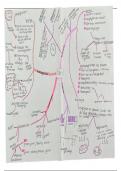
DEVELOPMENTAL BIOLOGY SUMMARY
COURSE 10 – HAN UNIVERSITY OF APPLIED SCIENCES
Table of Contents
Developmental biology I..........................................................................2
Developmental biology II .........................................................................8
Developmental Biology III .....................................................................15
,Developmental biology I
1. Preformism – organisms develop from miniature versions of themselves-
homunculi
- it was believed that the form of living things exists prior to their development
- sperm cells were seen as cells that could carry the preformed offspring
- offspring develop from a tiny fully-formed embryo within the head of the sperm cell
2. Preformism vs. Epigenesis
a. Aristotle – the idea of what was later called epigenesis- creates a preliminary theory
on how embryos generate and develop: organisms develop gradually from
undifferentiated material.
b. Willem Harvey – first shows that the life came from eggs (i.e. embryos from yolk) –
there is uniformity of the principles of development across the species.
3. Theory of recapitulation- also known as Embryological parallelism
a. Johann Meckel (1790s, Germany) and Etienne Serres (1824, France)
- The development of the embryo goes through stages that represent evolution
of ancestors
b. Ernst Haeckel – Ontogeny recapitulates phylogeny
Ontogeny = embryonic development
Phylogeny = history of evolution.
- A diagram of 8 vertebrate groups is made in three of their developmental stages.
- The earliest stages support this recapitulation because they correspond to a
common ancestral form.
- Each species seems to recapitulate ancestral morphologies during its own
development so organisms have common genetic developmental plans
4. Developmental biology – discipline that studies embryonic development and
other processes related to organisms’ development
a. development – organisms arise by a relatively slow process of progressive
change
, - begins with single cell- the fertilized egg/zygote which is a fully undifferentiated cell.
It divides mitotically and produces all the cells of the body which are fully differentiated
cells.
- development does not stop at birth or in the adulthood- e.g. 1 g of the skin is replaced
daily, millions of new RBCs are produced in the bone marrow every minute, the starfish
can renew parts of itself, metamorphosis (butterfly or frog).
5. Cellular polarization
a. extrinsic regulation - cell is in close contact with the external niche. Only 1 daughter
cell can maintain contact with the niche .
b. intrinsic regulation - with the cell there are regulators of self-renewal which are
localized asymmetrically. Only 1 daughter cell inherits them.
6. How is cell intrinsic polarity regulated?
6.1 Intrinsic
a) PAR proteins – internal cellular signal for polarization
- Partitioning defective genes which have homologs throughout the animal kingdom.
- PAR proteins constitute a highly conserved network of scaffolds, adaptors and
enzymes that control cell polarity.
- They organize cell asymmetry and coordinate the polarization of the cytoskeleton. A
key feature of the PAR network is that many of its members are asymmetrically
localized in polarized cells.
- Key features of PAR polarity factors:
- PAR polarity is well conserved in different cell types of many organisms
- They create protein domains which have distinct compositions for different
functions
- Symmetry breaking in the early C. elegans embryo
COURSE 10 – HAN UNIVERSITY OF APPLIED SCIENCES
Table of Contents
Developmental biology I..........................................................................2
Developmental biology II .........................................................................8
Developmental Biology III .....................................................................15
,Developmental biology I
1. Preformism – organisms develop from miniature versions of themselves-
homunculi
- it was believed that the form of living things exists prior to their development
- sperm cells were seen as cells that could carry the preformed offspring
- offspring develop from a tiny fully-formed embryo within the head of the sperm cell
2. Preformism vs. Epigenesis
a. Aristotle – the idea of what was later called epigenesis- creates a preliminary theory
on how embryos generate and develop: organisms develop gradually from
undifferentiated material.
b. Willem Harvey – first shows that the life came from eggs (i.e. embryos from yolk) –
there is uniformity of the principles of development across the species.
3. Theory of recapitulation- also known as Embryological parallelism
a. Johann Meckel (1790s, Germany) and Etienne Serres (1824, France)
- The development of the embryo goes through stages that represent evolution
of ancestors
b. Ernst Haeckel – Ontogeny recapitulates phylogeny
Ontogeny = embryonic development
Phylogeny = history of evolution.
- A diagram of 8 vertebrate groups is made in three of their developmental stages.
- The earliest stages support this recapitulation because they correspond to a
common ancestral form.
- Each species seems to recapitulate ancestral morphologies during its own
development so organisms have common genetic developmental plans
4. Developmental biology – discipline that studies embryonic development and
other processes related to organisms’ development
a. development – organisms arise by a relatively slow process of progressive
change
, - begins with single cell- the fertilized egg/zygote which is a fully undifferentiated cell.
It divides mitotically and produces all the cells of the body which are fully differentiated
cells.
- development does not stop at birth or in the adulthood- e.g. 1 g of the skin is replaced
daily, millions of new RBCs are produced in the bone marrow every minute, the starfish
can renew parts of itself, metamorphosis (butterfly or frog).
5. Cellular polarization
a. extrinsic regulation - cell is in close contact with the external niche. Only 1 daughter
cell can maintain contact with the niche .
b. intrinsic regulation - with the cell there are regulators of self-renewal which are
localized asymmetrically. Only 1 daughter cell inherits them.
6. How is cell intrinsic polarity regulated?
6.1 Intrinsic
a) PAR proteins – internal cellular signal for polarization
- Partitioning defective genes which have homologs throughout the animal kingdom.
- PAR proteins constitute a highly conserved network of scaffolds, adaptors and
enzymes that control cell polarity.
- They organize cell asymmetry and coordinate the polarization of the cytoskeleton. A
key feature of the PAR network is that many of its members are asymmetrically
localized in polarized cells.
- Key features of PAR polarity factors:
- PAR polarity is well conserved in different cell types of many organisms
- They create protein domains which have distinct compositions for different
functions
- Symmetry breaking in the early C. elegans embryo