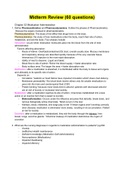
Midterm Review (60 questions)
Chapter 32 Medication Administration
1. Define Pharmacokinetics and Pharmacodynamics: Outline the phases of Pharmacokinetics.
Discuss the organs involved in pharmacokinetics.
Pharmacodynamics: The study of the effect that drugs have on the body.
Pharmacokinetics: the study of how medications enter the body, reach their site of action,
metabolize, and exit the body. Four phases include:
Absorption: occurs when medication molecules pass into the blood from the site of med
administration.
Factors affecting absorption:
- Route of Admin: Oral/Gastrointestinal (GI) tract, overall usually slow. Mucous membrane
and respiratory airways are absorbed quickly because of the very vascular tissue.
Intravenous (IV) injection is the most rapid absorption.
- Ability of med to dissolve: Liquid and tablet.
- Blood flow to site of admin: Richer the blood supply = faster absorption rate.
- Body surface area: The larger the area = faster absorption rate.
Distribution: after a medication is absorbed, it is distributed within the body to tissue and organs
and ultimately to its specific site of action.
Depends on:
- Circulation *patients w/ heart failure have impaired circulation which slows med delivery.
- Membrane permeability *the blood-brain barrier allows only fat soluble medications to
pass into the brain and cerebrospinal fluid (CSF)
- Protein binding *because most meds bind to albumin patients with decreased albumin
are at risk of toxicity or increased med activity.
Metabolism: after a medication reaches its site of action, it becomes metabolized into a less
active or an inactive form that is easier to excrete.
- Biotransformation: Occurs under the influence enzymes that detoxify, break down, and
remove biologically active chemicals. *Most occurs in the liver
- Kidneys, blood, intestines, and lungs play a role *if these organs aren’t working correctly
(liver disease) medication is eliminated more slowly, resulting in its accumulation. Patient
at risk for toxicity.
Excretion: after a medication is metabolized, they exit the body through the kidneys, liver,
bowel, lungs, exocrine glands. *Chemical makeup of medication determines the organ of
excretion.
2. What are the nursing diagnoses in regards to medication administration to patients? pg.630
- Anxiety
- Ineffective Health maintenance
- Deficient knowledge (Medication Self-Administration)
- Nonconpliance (Medications)
- Impaired Swallowing
- Impaired Memory
, - Caregiver Role Strain (Caregiving activities)
3. What is a therapeutic effect of a drug? What is allergic and anaphylactic reactions to drugs?
What are side effects, toxic effects, idiosyncratic effects, and adverse effects of medications?
- Therapeutic effect: The expected or predicted physiological response caused by a
medication.
- Adverse effects: The undesired, unexpected, and often unpredictable response to
medication.
Side effects: A predictable and often unavoidable adverse effect produced at a usual
therapeutic dose.
Allergic reactions: The medication or chemical acts as an antigen, triggering the release of the
antibodies in the body. Symptoms may vary depending on the individual and the medication.
Severe or Anaphylactic reactions, which are life threatening, are characterized by sudden
constriction to bronchiolar muscles, edema or the pharynx and larynx, and severe wheezing or
shortness of breath.
Toxic effects: Often develop after prolonged intake of a medication or when a medication
accumulated in the blood because of impaired metabolism or excretion. *Antidotes can treat
specific types of toxicity ex: naloxone (Narcan), an opioid antagonist, reverses the effect of
opioid toxicity.
Idiosyncratic response: Unpredictable effects in which a patient overreacts or under reacts to a
medication or has a reaction different from normal. *Ex: a child who takes Benadryl, an
antihistamine, becomes extremely agitated instead of drowsy.
4. Discuss the process of drug administration: how does a nurse proceed with administering a
medication to a patient? How does the nurse evaluate the effectiveness of drug administration?
Nursing process of administration:
- Assessment: Patient history, patients current condition, patients attitude about
medication use, learning needs, factors affecting adherence to medication therapy.
- Diagnosis: Using assessment data to determine a patient's actual or potential problems
with medication therapy.
- Planning: Organize your care activities to ensure safe administration. Setting goals and
related outcomes contributes to patient safety and allows for wise use of tie during med
admin. Setting priorities; provide the most important information about the medication
first. Teamwork and collaboration during medication administration is essential.
- Implementation: Health promotion; patient and family teaching. Acute care; accurate
dose calculation and measurement, correct administration, recording medication
administration. Special considerations; Infants and children, older adults, polypharmacy.
- Evaluation: Through the patient’s eyes; partner with your patients. Patient outcomes; use
knowledge of the desired effect and common side effects of each medication to compare
expected outcomes with actual finding.
5. Discuss routes of drug administration, what is the time frame for absorption of medication. How
does the nurse collect peak and trough levels of medication?
Peak: Is the highest level of concentration. Trough: Is the lowest level of concentration.
Chapter 32 Medication Administration
1. Define Pharmacokinetics and Pharmacodynamics: Outline the phases of Pharmacokinetics.
Discuss the organs involved in pharmacokinetics.
Pharmacodynamics: The study of the effect that drugs have on the body.
Pharmacokinetics: the study of how medications enter the body, reach their site of action,
metabolize, and exit the body. Four phases include:
Absorption: occurs when medication molecules pass into the blood from the site of med
administration.
Factors affecting absorption:
- Route of Admin: Oral/Gastrointestinal (GI) tract, overall usually slow. Mucous membrane
and respiratory airways are absorbed quickly because of the very vascular tissue.
Intravenous (IV) injection is the most rapid absorption.
- Ability of med to dissolve: Liquid and tablet.
- Blood flow to site of admin: Richer the blood supply = faster absorption rate.
- Body surface area: The larger the area = faster absorption rate.
Distribution: after a medication is absorbed, it is distributed within the body to tissue and organs
and ultimately to its specific site of action.
Depends on:
- Circulation *patients w/ heart failure have impaired circulation which slows med delivery.
- Membrane permeability *the blood-brain barrier allows only fat soluble medications to
pass into the brain and cerebrospinal fluid (CSF)
- Protein binding *because most meds bind to albumin patients with decreased albumin
are at risk of toxicity or increased med activity.
Metabolism: after a medication reaches its site of action, it becomes metabolized into a less
active or an inactive form that is easier to excrete.
- Biotransformation: Occurs under the influence enzymes that detoxify, break down, and
remove biologically active chemicals. *Most occurs in the liver
- Kidneys, blood, intestines, and lungs play a role *if these organs aren’t working correctly
(liver disease) medication is eliminated more slowly, resulting in its accumulation. Patient
at risk for toxicity.
Excretion: after a medication is metabolized, they exit the body through the kidneys, liver,
bowel, lungs, exocrine glands. *Chemical makeup of medication determines the organ of
excretion.
2. What are the nursing diagnoses in regards to medication administration to patients? pg.630
- Anxiety
- Ineffective Health maintenance
- Deficient knowledge (Medication Self-Administration)
- Nonconpliance (Medications)
- Impaired Swallowing
- Impaired Memory
, - Caregiver Role Strain (Caregiving activities)
3. What is a therapeutic effect of a drug? What is allergic and anaphylactic reactions to drugs?
What are side effects, toxic effects, idiosyncratic effects, and adverse effects of medications?
- Therapeutic effect: The expected or predicted physiological response caused by a
medication.
- Adverse effects: The undesired, unexpected, and often unpredictable response to
medication.
Side effects: A predictable and often unavoidable adverse effect produced at a usual
therapeutic dose.
Allergic reactions: The medication or chemical acts as an antigen, triggering the release of the
antibodies in the body. Symptoms may vary depending on the individual and the medication.
Severe or Anaphylactic reactions, which are life threatening, are characterized by sudden
constriction to bronchiolar muscles, edema or the pharynx and larynx, and severe wheezing or
shortness of breath.
Toxic effects: Often develop after prolonged intake of a medication or when a medication
accumulated in the blood because of impaired metabolism or excretion. *Antidotes can treat
specific types of toxicity ex: naloxone (Narcan), an opioid antagonist, reverses the effect of
opioid toxicity.
Idiosyncratic response: Unpredictable effects in which a patient overreacts or under reacts to a
medication or has a reaction different from normal. *Ex: a child who takes Benadryl, an
antihistamine, becomes extremely agitated instead of drowsy.
4. Discuss the process of drug administration: how does a nurse proceed with administering a
medication to a patient? How does the nurse evaluate the effectiveness of drug administration?
Nursing process of administration:
- Assessment: Patient history, patients current condition, patients attitude about
medication use, learning needs, factors affecting adherence to medication therapy.
- Diagnosis: Using assessment data to determine a patient's actual or potential problems
with medication therapy.
- Planning: Organize your care activities to ensure safe administration. Setting goals and
related outcomes contributes to patient safety and allows for wise use of tie during med
admin. Setting priorities; provide the most important information about the medication
first. Teamwork and collaboration during medication administration is essential.
- Implementation: Health promotion; patient and family teaching. Acute care; accurate
dose calculation and measurement, correct administration, recording medication
administration. Special considerations; Infants and children, older adults, polypharmacy.
- Evaluation: Through the patient’s eyes; partner with your patients. Patient outcomes; use
knowledge of the desired effect and common side effects of each medication to compare
expected outcomes with actual finding.
5. Discuss routes of drug administration, what is the time frame for absorption of medication. How
does the nurse collect peak and trough levels of medication?
Peak: Is the highest level of concentration. Trough: Is the lowest level of concentration.